Deer Resistant Perennials

The most dependable deer resistant perennials are peony, catmint, lavender, salvia, Russian sage, yarrow, and lamb's ear in sun, and bleeding heart, hellebore, brunnera, lungwort, astilbe, and ferns in shade. Deer skip them because they're aromatic, fuzzy, bitter, toxic, or all four at once, and every one of them comes back bigger each year instead of getting eaten to the crown. None of them is deer proof, that plant doesn't exist, but these are the ones that survive a hard browsing winter and still bloom in June.
Before you buy anything: check your USDA zone with our free growing zone lookup. A perennial is only worth planting if it's hardy where you live, and the zone ranges in the tables below are the first filter.
Here's the frustration this page fixes. You plant a border, it looks great in May, and by mid-June something has eaten the buds off half of it. Below are 25 perennials with zones, sun needs, bloom time, and the specific reason deer leave them alone, organized so you can build a bed that flowers from February through October without feeding the neighborhood herd.
Deer Resistant vs. Deer Proof Perennials
Worth saying up front: "deer proof perennials" isn't a real category. Deer are opportunists, and in late winter or a drought summer they'll eat plants they've ignored for years.
What you're really buying is a ranking. A deer resistant perennial is one deer skip when other food is available, and a deer tolerant perennial is one that shrugs off the occasional nibble and grows back. Our main guide to deer resistant plants covers the four defense traits in depth, strong aroma, fuzzy leaves, toxic or bitter sap, and tough texture, and the same framework runs through this list.
The Rutgers New Jersey Agricultural Experiment Station (NJAES) maintains the reference database most landscape designers use, rating plants from A (rarely damaged) to D (frequently severely damaged). Their Landscape Plants Rated by Deer Resistance list is built on field observation in genuinely high-pressure conditions, which makes it conservative in the right direction. Look up anything you plan to buy in quantity.
25 Deer Resistant Perennials: The Master Table
| Perennial | Zones | Sun | Bloom time | Why deer skip it | Reliability |
|---|---|---|---|---|---|
| Peony (Paeonia lactiflora) | 3-8 | Full sun | Late spring (May-Jun) | Bitter foliage, thick woody stems | Very high |
| Catmint (Nepeta 'Walker's Low') | 3-8 | Full sun | Late spring to fall (May-Sep) | Minty oils, gray fuzzy leaves | Very high |
| Lavender (Lavandula angustifolia) | 5-9 | Full sun | Early summer (Jun-Jul) | Camphor oils, silver fuzz | Very high |
| Salvia (Salvia nemorosa) | 4-8 | Full sun | Late spring, reblooms (May-Jul) | Strong sage oils | Very high |
| Russian sage (Salvia yangii) | 4-9 | Full sun | Mid summer to fall (Jul-Sep) | Sharp scent, woody stems | Very high |
| Yarrow (Achillea millefolium) | 3-9 | Full sun | Summer (Jun-Aug) | Aromatic ferny foliage | Very high |
| Lamb's ear (Stachys byzantina) | 4-8 | Full sun | Early summer (Jun) | Wool-textured leaves | Very high |
| Bleeding heart (Dicentra spectabilis) | 3-9 | Part to full shade | Spring (Apr-May) | Toxic isoquinoline alkaloids | Very high |
| Foxglove (Digitalis purpurea) | 4-9 | Part shade | Early summer (Jun) | Cardiac glycosides; seriously toxic | Very high |
| Monkshood (Aconitum napellus) | 3-7 | Part shade | Late summer to fall (Aug-Oct) | Aconitine; one of the most toxic garden plants | Very high |
| Hellebore (Helleborus) | 4-9 | Shade to part shade | Late winter (Feb-Apr) | Toxic sap, leathery evergreen leaves | Very high |
| Ferns (most genera) | 3-9 | Shade | Foliage only | Tough fronds, low nutrition | High |
| Brunnera (Brunnera macrophylla) | 3-8 | Shade | Spring (Apr-May) | Sandpapery, hairy leaves | Very high |
| Lungwort (Pulmonaria) | 3-8 | Shade | Early spring (Mar-Apr) | Bristly, coarse leaves | Very high |
| Astilbe | 3-8 | Part to full shade | Early summer (Jun-Jul) | Bitter, finely divided foliage | High |
| Bearded iris (Iris germanica) | 3-9 | Full sun | Late spring (May-Jun) | Bitter rhizome, stiff sword leaves | High |
| Siberian iris (Iris sibirica) | 3-9 | Sun to part sun | Late spring (May-Jun) | Same bitterness, tougher grassy foliage | High |
| Oriental poppy (Papaver orientale) | 3-7 | Full sun | Late spring (May-Jun) | Milky alkaloid sap, bristly stems | High |
| Baptisia (false indigo) | 3-9 | Full sun | Late spring (May-Jun) | Bitter alkaloids, tough stems | Very high |
| Bee balm (Monarda didyma) | 4-9 | Sun to part sun | Mid summer (Jul-Aug) | Oregano-family oils | High |
| Agastache (hyssop) | 5-9 | Full sun | Mid summer to fall (Jul-Oct) | Licorice-mint scent | High |
| Black-eyed Susan (Rudbeckia fulgida) | 3-9 | Full sun | Mid summer to fall (Jul-Sep) | Coarse bristly leaves | Moderate to high |
| Coreopsis (Coreopsis verticillata) | 3-9 | Full sun | Summer (Jun-Sep) | Thread-fine foliage, little to bite | Moderate to high |
| Coneflower (Echinacea purpurea) | 3-9 | Full sun | Mid summer to fall (Jul-Sep) | Bristly stems, but sweet flower buds | Moderate |
| Sedum 'Autumn Joy' (Hylotelephium) | 3-9 | Full sun | Late summer to fall (Aug-Oct) | Succulent leaves; often browsed anyway | Low to moderate |
Read that last column carefully. It's the difference between a list that's honest and one that gets you a bare bed.
Deer Resistant Perennials for Full Sun
Sun beds are the easy half, because most of the strongly aromatic plants are Mediterranean sun lovers. Build the backbone from these.
Catmint is the single best value on this page. It blooms from late May into September if you shear it back after the first flush, spreads about 3 feet, tolerates drought and bad soil, and deer will not touch it. Use it as the front edge of any bed you want defended.
Peony surprises people. It looks soft and lush, exactly the profile deer usually strip, but the foliage is bitter and deer leave it alone reliably. A peony planted correctly (eyes no more than 2 inches deep) lives 50 years or more, which makes it the highest return per dollar in the whole border.
Russian sage and lavender deliver the same defense from different sides of summer. Lavender peaks in June and July; Russian sage takes over in July and holds through September with silver stems that stay attractive into winter. Our full write-up on whether Russian sage is deer resistant covers the rare cases where it does get browsed.
Salvia 'May Night' and 'Caradonna' give you deep purple spikes in late spring and rebloom in August if you cut them back hard after the first bloom. They're also among the most reliably ignored plants in the sun garden.
Baptisia is underused. It behaves like a shrub, hits 3 to 4 feet wide, sends up blue lupine-like spikes in late spring, then holds handsome blue-green foliage until frost. It takes three years to look impressive and then needs nothing forever.
Bearded iris is the direct swap for daylily. Same sword foliage, same architectural role, similar bloom season, and deer skip it because the rhizome and leaves are bitter.
Deer Resistant Perennials for Shade
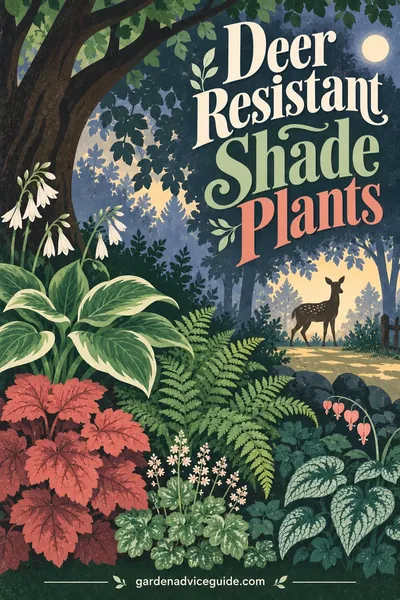
Shade is where deer damage hurts most, because the classic shade plant is the hosta and deer treat hostas like salad. Every plant below fills that same role without the loss.
Hellebore blooms in February or March, before anything else is awake, and keeps leathery evergreen foliage year-round. It's toxic, so nothing eats it, including rabbits. Zones 4-9, and it slowly seeds around into drifts.
Brunnera 'Jack Frost' is the hosta replacement most people settle on. Big heart-shaped silver-veined leaves, forget-me-not blue flowers in April, and a sandpapery leaf surface deer reject on contact.
Lungwort (Pulmonaria) does the same job at a smaller scale, with spotted leaves and pink-to-blue spring flowers. The bristly leaf hairs are the defense.
Bleeding heart gives you arching stems of pink lockets in April and May. It goes dormant by midsummer in hot climates, so pair it with ferns or astilbe that fill the gap.
Astilbe brings the feathery plumes hostas never provide, in white, pink, or red, in June and July. It wants consistent moisture; in dry shade it sulks.
Ferns are the structural filler. Japanese painted fern, ostrich fern, autumn fern, and lady fern all work, and mature fronds have almost no nutritional value to a browsing deer.
Foxglove and monkshood handle the vertical accent in part shade. Both are genuinely poisonous, which is exactly why deer avoid them, so site them away from where small children play and wear gloves when you cut monkshood back.
Plan for Continuous Bloom
The mistake in most deer resistant plantings is a June peak and nothing else. Pick one or two from each row below and the bed carries color for eight months.
| Bloom window | Sun perennials | Shade perennials |
|---|---|---|
| Late winter (Feb-Mar) | Hellebore | |
| Early spring (Mar-Apr) | Lungwort, brunnera | |
| Mid spring (Apr-May) | Bleeding heart | |
| Late spring (May-Jun) | Peony, bearded iris, Siberian iris, baptisia, Oriental poppy, salvia | Foxglove |
| Early summer (Jun-Jul) | Lavender, yarrow, catmint, lamb's ear | Astilbe |
| Mid summer (Jul-Aug) | Bee balm, coreopsis, coneflower, Russian sage | |
| Late summer (Aug-Sep) | Black-eyed Susan, agastache, Russian sage | |
| Fall (Sep-Oct) | Sedum, agastache, aster | Monkshood |
| Winter interest | Russian sage stems, ornamental grasses, sedum seed heads | Hellebore foliage, evergreen ferns |
Catmint deserves its own note here: sheared once in early July, it reblooms and effectively covers May through September on its own. It is one of several perennials that bloom all summer, which are the plants worth building a browsed border around.
Worked example: a 20-foot sunny border that blooms 8 months
Take a bed 20 feet long and 6 feet deep, full sun, deer approaching from the lawn side.
Front row (the aromatic barrier), 20 feet: catmint 'Walker's Low' spreads about 3 feet, so 20 ÷ 3 = 7 plants. Catmint is one of the cheapest perennials on the bench and one of the easiest to divide, so buy three and split them if you are patient.
Middle row, 20 feet at 2.5-foot spacing = 8 plants: - 3 salvia 'May Night' (May and August bloom) - 3 yarrow 'Moonshine' (June to August) - 2 lamb's ear (silver texture all season)
All three are common, widely stocked and inexpensive as perennials go. Lamb's ear in particular spreads fast enough that one plant becomes three by the following spring.
Back row, 20 feet at 3.5-foot spacing = 6 plants: - 2 peony (late May) - 2 Russian sage (July to September) - 2 baptisia (late May, then structure)
This is the priciest row, because peony and baptisia are both slow to produce and are sold at a size that reflects it. Both are also the longest-lived plants in the bed, so the cost lands once and never again. Bare-root peony ordered for fall shipping costs far less than the same plant potted in spring.
Accents tucked in: 5 bearded iris (late May), 3 coneflower (July to September), 3 black-eyed Susan (July to September). Iris is the one to ask around for rather than buy, since every gardener who grows it is digging up surplus rhizomes in July and giving them away.
Total: 32 plants, and a bloom sequence running late May → June → July → August → September, with Russian sage stems and iris foliage carrying winter. It is a real outlay in one season. Set it against replacing two dozen browsed hostas every couple of years, forever, and the border pays for itself inside one replacement cycle and then keeps paying.
If the whole list at once is too much, buy it in the order that matters: front row first, because the aromatic barrier is what turns the deer aside, then the back row, then the accents. A half-planted border with the catmint in beats a fully planted one without it.
Plant on 2.5- to 3-foot centers for most of these. First season it looks sparse; year two it closes; year three it looks like the catalog photo.
Plant These Instead of Hostas and Daylilies
The two plants that account for most deer damage in American gardens are hosta and daylily. Here's what does the same job.
| If you lost this | Plant this instead | What you get |
|---|---|---|
| Hosta (shade, bold leaves) | Brunnera 'Jack Frost' | Same big heart-shaped leaves, silver veining, blue spring flowers |
| Hosta (shade, texture) | Ferns + hellebore | Fine texture plus evergreen leathery foliage and February bloom |
| Hosta (shade, edging) | Lungwort | Spotted low mound, early flowers, fully deer resistant |
| Daylily (sun, strappy foliage) | Bearded or Siberian iris | Same sword leaves and architecture, bitter rhizome deer avoid |
| Daylily (sun, long bloom) | Catmint or coreopsis | Months of bloom instead of a two-week window |
| Daylily (sun, mass planting) | Black-eyed Susan | Same easy mass effect, coarse leaves deer dislike |
| Impatiens (shade color) | Astilbe or wax begonia | Real color in shade without the overnight loss |
| Tulip (spring color) | Daffodil or allium | Toxic bulbs deer and squirrels both leave alone |
If you want spring color from bulbs to layer under these perennials, our guide to deer resistant bulbs covers daffodils, alliums, snowdrops, and fritillaria, all of which naturalize among perennials without competing.
The Perennials That Get Browsed More Than Lists Admit
Three plants show up on nearly every "deer proof perennials" list and shouldn't be trusted at face value.
Sedum 'Autumn Joy' is the biggest offender. It's succulent, water-rich, and blooms in September when other browse is drying out, which is the trade-off with most perennials that save their flowers for autumn. In high-pressure yards deer eat the stems to nubs. Plant it if you like it, but not as a load-bearing part of the design, and expect to protect it.
Coneflower (Echinacea) holds up fine in June and loses its flower buds in August, especially in a dry year. The bristly stems deter casual browsing; the sweet developing buds do the opposite.
Hardy geranium and coral bells (Heuchera) are frequently listed and frequently browsed. Heuchera in particular gets pulled out of the ground entirely by deer testing it.
The pattern behind all three: soft, fleshy, or sugary tissue beats a mild texture defense once deer are hungry enough.
Protecting First-Year Perennials
Even a very resistant perennial is vulnerable in its first season, because new growth is softer and lower in the compounds that make mature plants unpalatable. Three cheap habits get plants to year two.
- Spray a repellent at planting and every 3 to 4 weeks through the first season. Rotate two products, because deer habituate to a single scent. Odor repellents based on putrefied egg solids consistently test better than taste-based ones.
- Cage anything expensive for one year. A 3-foot cylinder of hardware cloth around a new peony or baptisia costs almost nothing and removes all risk.
- Water well through the first summer. A stressed plant stays soft and small; a vigorous one gets past the tender stage faster.
For structure around these beds, evergreen and thorny shrubs make the best perimeter, and our guide to deer resistant shrubs covers boxwood, juniper, and the arborvitae substitutes that don't get stripped in winter.
One more piece of realism. Perennial selection reduces damage; it doesn't eliminate it. Penn State Extension and most state wildlife agencies put the only guaranteed exclusion at an 8-foot fence. If there's a bed you truly refuse to lose, fence that one and plant everything else from the tables above.
FAQ
What perennials will deer absolutely not eat?
Nothing is absolute, but the closest are monkshood, foxglove, daffodil, hellebore, and bleeding heart, because they're genuinely toxic rather than just unpleasant. Aromatic perennials like catmint, lavender, Russian sage, and salvia come next. A starving deer in February will still sample almost anything, so treat these as very low risk rather than zero risk.
Do deer eat coneflowers and black-eyed Susans?
Both get browsed more than most lists admit. Black-eyed Susan holds up reasonably well thanks to its coarse, bristly leaves, but coneflower loses its flower buds regularly in high-pressure yards and dry summers. Plant them if you like them, and expect to spray them in August. Neither belongs in the front line of a deer-defended bed.
What can I plant instead of hostas where deer are a problem?
Brunnera 'Jack Frost' is the closest match: big heart-shaped silver-veined leaves and a sandpapery surface deer reject. Hellebore adds evergreen foliage and February bloom, lungwort covers the low edging role, and ferns supply the fine texture. Together those four fill a shade bed with more seasonal interest than hostas ever gave you.
Are deer resistant perennials also drought tolerant?
Many of them, yes, and the overlap isn't a coincidence. The aromatic Mediterranean plants deer avoid, including lavender, Russian sage, catmint, yarrow, salvia, and thyme, evolved oily leaves partly to conserve water. The shade-loving deer resistant perennials are the exception; astilbe, bleeding heart, and lungwort all want consistent moisture.
When should I plant deer resistant perennials?
Spring or early fall. Spring planting gives the plant a full season to establish before its first winter, which matters most in zones 3-5. Fall planting, roughly six weeks before your first hard freeze, works well in zones 6-9 because roots grow in cool soil while the top is dormant. Either way, protect first-year plants; they're the most likely to be browsed.
Do deer eat peonies?
Almost never. Peony foliage is bitter and the stems are woody, and the plant ranks among the most reliably ignored perennials in the sun garden. Occasionally a deer will nip a fat bud in spring, which is annoying but not damaging to the plant. Peonies are the safest big-flower investment in deer country.
Will deer resistant perennials keep deer out of my whole garden?
No. Aromatic perennials planted as a continuous perimeter make it harder for deer to smell the tastier plants behind them, which reduces visits. They don't create a barrier. A hungry deer walks straight through a bed of catmint to reach a tulip. Use resistant perennials to shrink your losses, and a fence for the one bed that has to be safe.
How do I tell deer damage from rabbit damage on perennials?
Look at the cut. Deer have no upper front teeth, so they tear, leaving a ragged, shredded edge. Rabbits have sharp incisors and leave a clean 45-degree snip. Height helps too: rabbit damage sits under about 2 feet, deer feed from roughly 2 to 5 feet up. Torn tips at chest height on a shrub are deer every time.
Updated August 2026
A note on numbers. This page gives you plant counts, spacings, heights and bloom timing, not dollar figures. Nursery stock, bare-root orders and hardware are priced by your region, your supplier and the season, and we do not set any of it. Work out what you need here, then price the list at two or three local suppliers.