Deer Resistant Plants

The most reliable deer resistant plants are the ones deer can't stand to smell, chew, or touch: aromatic herbs like lavender, rosemary, catmint, and Russian sage; fuzzy-leaved perennials like lamb's ear and brunnera; toxic plants like daffodil, foxglove, monkshood, and bleeding heart; and tough, spiky, leathery growth like boxwood, juniper, and barberry. Nothing on that list is deer proof, a hungry deer in February will eat boxwood, but these plants get browsed last instead of first. Pair them with the right layout and a fence where it counts, and you can keep a garden that survives a herd.
Not sure what will survive your winters? Find your USDA zone with our free growing zone lookup before you buy a single plant. Deer resistance means nothing if the plant dies in January.
Here's the real problem: you spent a weekend planting, and something ate it to the ground overnight. Most "deer proof plant" lists online are copied from each other, never tested, and quietly wrong about half a dozen species. This guide gives you the four traits that make a plant unappealing, category-by-category tables you can shop from, an honest look at what deer will eat anyway, and the two things that actually stop them.
Deer Resistant vs. Deer Proof: The Honest Version
There is no such thing as a deer proof plant. Anyone selling you one is selling you something.
Deer are opportunistic browsers. An adult whitetail eats several pounds of vegetation a day, and what it eats depends on how much easier food is available. In a wet June with acorns coming and clover everywhere, your lavender is safe. In a drought August, or in late winter when the woods are stripped bare, that same deer will chew things it has ignored for three years.
So "deer resistant" means something specific and useful: a plant deer skip when they have other options. It's a ranking, not a guarantee. Three practical rules follow from that:
- Local pressure decides everything. Ten deer per square mile and a neighborhood full of hostas means your resistant plants are genuinely safe. Sixty deer per square mile in a suburb with no hunting and no predators means your list shrinks fast.
- Young plants get eaten more. New growth is softer, sweeter, and lower in the defensive compounds that make mature plants unpalatable. A three-year-old boxwood is far safer than the one you planted last week.
- Deer learn by taste. They sample. A deer will bite a new plant, spit it out, and remember. That means you'll still see chew marks on resistant plants in the first season, even on the good ones. Damage isn't the same as failure.
Some people say "deer tolerant plants" instead, which is arguably the better phrase. It describes plants that shrug off an occasional nibble and keep growing, which is really what you want.
Why Deer Resistant Plants Work: The Four Defense Traits
This is the part worth memorizing, because it lets you evaluate any plant at the garden center, including ones no list covers. Deer avoid plants for four reasons, and the strongest choices stack two or three of them.
| Defense trait | What it does to a deer | Classic examples |
|---|---|---|
| Strong aroma | Volatile oils overwhelm a deer's nose, which is its main way of finding safe food. Also masks nearby plants. | Lavender, rosemary, sage, mint, catmint, Russian sage, bee balm, yarrow, marigold |
| Fuzzy or hairy leaves | Fine hairs feel wrong in the mouth and clog the palate. Deer reject the texture before flavor matters. | Lamb's ear, brunnera, lungwort, black-eyed Susan, poppy, ageratum |
| Toxic or bitter sap | Alkaloids and glycosides cause real illness. Deer avoid them instinctively and by learned experience. | Daffodil, monkshood, foxglove, bleeding heart, hellebore, poppy, boxwood |
| Tough, leathery, or spiky texture | Hard to bite, hard to digest, sometimes painful. Deer prefer soft, water-rich new growth. | Boxwood, juniper, barberry, holly, ornamental grasses, ferns, sedge |
Now apply it. Picking up an unfamiliar plant at the nursery, ask: does it smell strongly when I rub a leaf? Are the leaves furry? Is the sap milky or the tag marked toxic? Are the leaves stiff, needled, or thorny? Two yes answers and it's probably a safe bet. Zero yes answers and it's deer food, whatever the tag claims.
The trait that fails most often is aroma, because it fades. Lavender in bloom is nearly untouchable. Lavender in March, cut back and dormant, is just a woody stem, and starving deer will nip it.
The Rutgers Deer Resistance Ratings, Explained
If you want one authority to trust, it's the Rutgers New Jersey Agricultural Experiment Station (NJAES). Their Landscape Plants Rated by Deer Resistance database is the reference most landscape designers in deer country actually use, and it's built on decades of field observation rather than nursery marketing.
Rutgers NJAES sorts plants into four letter grades:
| Rating | Meaning | How to use it |
|---|---|---|
| A | Rarely damaged | Safe in almost any garden. Use these where you can't afford losses. |
| B | Seldom severely damaged | Expect occasional nibbles. Fine for most yards. |
| C | Occasionally severely damaged | Only in low-pressure areas, or behind a barrier. |
| D | Frequently severely damaged | Deer candy. Don't plant it unfenced. |
Two things to know about that scale. First, the ratings are based on New Jersey conditions, which means high deer pressure, so they're conservative in a helpful way. Second, a rating applies to a species, not always to every cultivar. Some sweeter-bred hybrids get browsed when the straight species doesn't.
In the tables below we've used plain-language ratings rather than reprinting Rutgers' letter grades plant by plant, because the exact grade sometimes varies by species within a genus. Look up your specific plant in their database before you buy a hundred of anything.
Deer Resistant Herbs and Aromatics
If you plant one category, plant this one. Culinary and ornamental herbs are the most consistently avoided plants in the landscape, they're cheap, and most of them are drought-tolerant sun lovers that thrive on neglect.
| Herb | USDA zones | Sun | Why deer skip it | How reliable |
|---|---|---|---|---|
| Lavender (Lavandula) | 5-9 (varies) | Full sun | Camphor-heavy oils, gray fuzzy foliage | Very high |
| Rosemary (Salvia rosmarinus) | 7-10 (annual colder) | Full sun | Piney resins, stiff needled leaves | Very high |
| Sage (Salvia officinalis) | 4-8 | Full sun | Strong oils, pebbly furry leaves | Very high |
| Catmint (Nepeta) | 3-8 | Full sun | Minty oils, gray-green fuzz | Very high |
| Mint (Mentha) | 3-8 | Sun to part shade | Menthol; plant in a pot, it runs | Very high |
| Thyme (Thymus) | 4-9 | Full sun | Tiny aromatic leaves, low sprawl | High |
| Oregano (Origanum) | 4-9 | Full sun | Pungent oils | High |
| Chives & garlic chives (Allium) | 3-9 | Full sun | Onion compounds | Very high |
| Russian sage (Salvia yangii) | 4-9 | Full sun | Sharp sage scent, woody stems | Very high |
| Lemon balm (Melissa) | 4-9 | Sun to part shade | Citrus oils; spreads, contain it | High |
One warning: parsley, basil, and cilantro are the exceptions. They're mild, soft, and deer will absolutely eat them. Keep those in a container by the door.
Deer Resistant Perennials
Perennials are where most gardeners feel the pain, because they're the expensive part of a border. This is the short version; our full guide to deer resistant perennials covers 20-plus species with bloom times and a shade section.
| Perennial | Zones | Sun | Defense trait | How reliable |
|---|---|---|---|---|
| Peony (Paeonia) | 3-8 | Full sun | Bitter foliage, thick stems | Very high |
| Bleeding heart (Dicentra) | 3-9 | Part to full shade | Toxic alkaloids | Very high |
| Lamb's ear (Stachys byzantina) | 4-8 | Full sun | Wool-textured leaves | Very high |
| Foxglove (Digitalis) | 4-9 | Part shade | Cardiac glycosides, seriously toxic | Very high |
| Monkshood (Aconitum) | 3-7 | Part shade | Highly toxic; wear gloves | Very high |
| Yarrow (Achillea) | 3-9 | Full sun | Aromatic ferny foliage | Very high |
| Salvia (Salvia nemorosa) | 4-8 | Full sun | Strong oils | Very high |
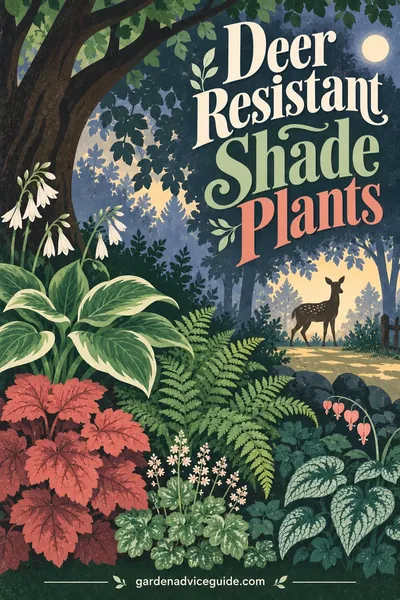
| Hellebore (Helleborus) | 4-9 | Shade | Toxic, leathery evergreen leaves | Very high |
| Ferns (most) | Varies | Shade | Tough fronds, low nutrition | High |
| Black-eyed Susan (Rudbeckia) | 3-9 | Full sun | Coarse bristly leaves | Moderate to high |
| Coneflower (Echinacea) | 3-9 | Full sun | Bristly stems, but sweet buds | Moderate |
| Sedum 'Autumn Joy' | 3-9 | Full sun | Succulent; often browsed anyway | Low to moderate |
That last row matters. Sedum shows up on dozens of deer proof plant lists, and in high-pressure yards deer eat the fleshy stems right down. Same story with coneflower, which holds up fine in June and loses its flower buds in a dry August. Believe the moderate ratings.
Deer Resistant Shrubs
Shrubs are your structure, and losing one costs more than losing a perennial. Full details are in our guide to deer resistant shrubs, but here's the working list.
| Shrub | Zones | Size | Defense trait | Notes |
|---|---|---|---|---|
| Boxwood (Buxus) | 5-9 | 2-8 ft | Alkaloids plus tough leaves | The gold standard; browsed only in famine winters |
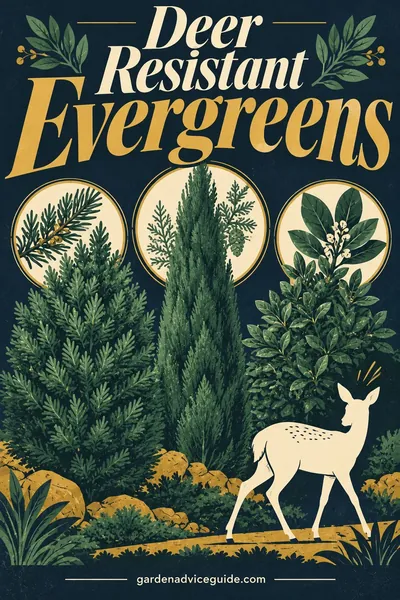
| Juniper (Juniperus) | 3-9 | 1-25 ft | Prickly, resinous needles | Most types very safe; some soft cultivars browsed |
| Barberry (Berberis) | 4-8 | 3-6 ft | Thorns | Very effective, but invasive and banned in several states |
| Butterfly bush (Buddleja) | 5-9 | 5-10 ft | Bitter, fuzzy leaves | Use sterile cultivars; invasive in the Pacific Northwest |
| Spirea (Spiraea) | 3-8 | 2-5 ft | Small, dry leaves | Moderate only; young plants do get browsed |
| Bayberry (Myrica) | 3-7 | 5-10 ft | Waxy aromatic foliage | Excellent for coastal and poor soil |
| Russian cypress (Microbiota) | 3-7 | 1-2 ft | Resinous evergreen | Good arborvitae substitute at ground level |
| Common lilac (Syringa vulgaris) | 3-7 | 8-15 ft | Bitter foliage | Reliable, plus a spring scent payoff |
Before you buy barberry, check your state. Japanese barberry is prohibited or restricted in New York, Pennsylvania, Massachusetts, Maine, New Hampshire, and elsewhere because it escapes into woodlands and raises tick populations. Thorny native alternatives exist, and your local extension office can name the right ones for your county.
Deer Resistant Bulbs
Bulbs are the easiest win in the whole garden, because the split is so clean: the amaryllis and onion families are chemically defended, and almost nothing else is. Our deer resistant bulbs guide goes deeper on planting depth and naturalizing.
| Bulb | Zones | Bloom | Verdict |
|---|---|---|---|
| Daffodil (Narcissus) | 3-8 | Early to mid spring | Excellent. Lycorine makes every part toxic; squirrels skip them too |
| Allium (ornamental onion) | 3-9 | Late spring to summer | Excellent. Onion compounds; the tall globes are unmissable |
| Snowdrop (Galanthus) | 3-7 | Late winter | Excellent. Same alkaloid family as daffodils |
| Fritillaria (crown imperial, F. imperialis) | 5-8 | Mid spring | Excellent. Skunky scent repels deer and voles |
| Grape hyacinth (Muscari) | 4-8 | Mid spring | Good. Occasionally the flowers get nipped |
| Camassia | 4-8 | Late spring | Good, and it tolerates wet soil |
| Tulip | 3-8 | Mid to late spring | Deer candy. Avoid, or fence them completely |
| Crocus | 3-8 | Very early spring | Frequently eaten by deer and rodents both |
Tulips are the single most common mistake in deer country. If you can't give them up, our guide on when to plant tulip bulbs covers timing, and the only real protection is a fenced bed or a container up on a deck.
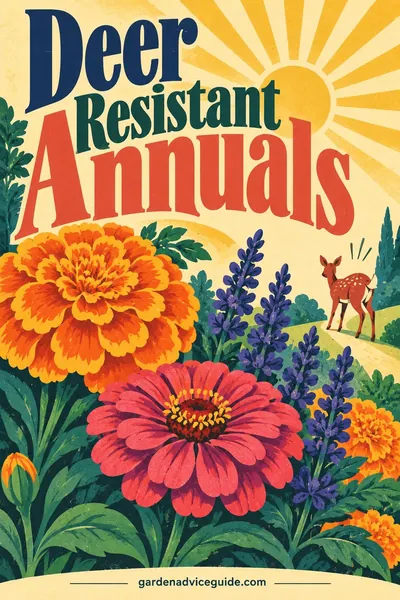
Deer Resistant Annuals
Annuals give you a season of color while your perennials establish. These hold up best.
| Annual | Sun | Defense trait | Notes |
|---|---|---|---|
| Marigold (Tagetes) | Full sun | Pungent foliage | Reliable, though young deer sometimes test them |
| Snapdragon (Antirrhinum) | Sun to part sun | Bitter sap | Cool-season bloomer, great in spring and fall |
| Zinnia | Full sun | Rough sandpapery leaves | Good, not perfect; flowers get nipped occasionally |
| Ageratum | Sun to part sun | Fuzzy leaves, faint scent | Very reliable |
| Dusty miller | Full sun | Felted silver foliage | Excellent texture defense |
| Sweet alyssum | Sun to part sun | Honey scent, tiny leaves | Good, and it self-sows |
| Wax begonia | Part shade | Waxy, bitter leaves | The best shade annual for deer country |
| Impatiens | Shade | None | Deer strip these overnight. Don't |
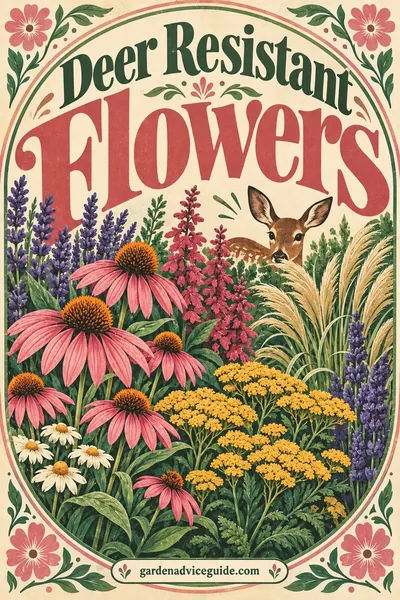
Our roundup of deer resistant flowers pulls the annuals and perennials together by color and bloom season if you're planning a display rather than a border.
Ornamental Grasses: The Underrated Category
Grasses barely get mentioned on most deer resistant plant lists, and they should be near the top. Deer are grazers of soft new growth, and mature ornamental grasses are dry, fibrous, and silica-rich. There's almost nothing in them worth chewing.
Reliable performers: switchgrass (Panicum virgatum, zones 5-9), little bluestem (Schizachyrium scoparium, zones 3-9), miscanthus (zones 5-9, but check invasiveness locally), feather reed grass (Calamagrostis 'Karl Foerster', zones 4-9), and northern sea oats (Chasmanthium, zones 4-9, for shade). Carex sedges work in shade too.
The one exception is spring. Freshly emerging grass blades in April are tender, and deer will graze them. Established clumps outgrow the damage in two weeks.
What Deer Love: Stop Planting These
Half of deer-proofing a garden is subtraction. If you have these and you're losing plants every year, the plants are the problem.
| Plant | Why deer love it | Plant this instead |
|---|---|---|
| Hosta | Soft, water-rich, no defenses at all | Ferns, brunnera, hellebore, lungwort |
| Daylily | Sweet buds and tender foliage | Bearded iris, yarrow, Siberian iris |
| Tulip | Sugary bulb and flower | Daffodil, allium, camassia |
| Arborvitae (Thuja) | Soft evergreen, browsed to a bare stick in winter | Juniper, spruce, Russian cypress |
| Yew (Taxus) | Toxic to most animals, yet deer eat it happily | Boxwood, inkberry holly |
| Roses (most) | Tender new canes and buds | Rugosa roses (thorny, tougher) or shrub spirea |
| Impatiens | Zero chemical or physical defense | Wax begonia, ageratum |
| Crocus | Early, sweet, first thing available | Snowdrop, winter aconite |
Arborvitae deserves a special note. It's sold everywhere as a privacy hedge, and in deer country it gets browsed into a bare column up to the browse line, roughly five feet off the ground, and never recovers. If you want an evergreen screen where deer live, plant Norway spruce, juniper, or a mixed hedge instead.
When Deer Browse Hardest: The Seasonal Reality
Deer damage isn't spread evenly across the year, and knowing the pattern tells you when to be vigilant.
Late winter and early spring (February to April) is the worst window. Natural browse is gone, the deer are running a calorie deficit, and body fat is at its lowest. This is when boxwood, holly, and even juniper get eaten. It's also when the first soft green shoots appear and become the only fresh food in the county.
Spring flush (May to June) brings heavy damage to new growth specifically. Tender shoots on shrubs and emerging perennials are the most nutritious food available. Damage in this window looks like ragged torn tips, because deer have no upper front teeth and tear rather than clip. That ragged edge is how you tell deer from rabbits, which leave a clean 45-degree cut.
Drought summers flip the script completely. A dry July pushes deer into irrigated landscapes because your garden is the only green, hydrated food around. Gardeners who go five years without damage often lose plants in the first bad drought year.
Fall rut (September to November) brings a different kind of damage entirely: bucks rubbing velvet off their antlers on young tree trunks. This shreds bark on saplings 1 to 4 inches in diameter and can girdle and kill a tree in one night. No plant choice prevents it. Wrap young trunks with corrugated tree guards or hardware cloth cylinders from September through December, and stake them so the deer can't push them over.
The Layering Strategy: Aromatic Perimeter, Soft Center
Here's the technique that makes deer resistant planting work as a system instead of a shopping list. Deer navigate by smell. If the outer edge of a bed smells overwhelmingly of mint and camphor, the deer's nose can't pick out the tastier plants two feet behind it, and a deer that can't identify food usually moves on.
So build in three rings:
- Outer ring (aromatic barrier): catmint, lavender, Russian sage, salvia, yarrow, thyme. Solid, unbroken, at least 2 feet deep.
- Middle ring (structure and texture): boxwood, juniper, ornamental grasses, lamb's ear, ferns.
- Inner core (the plants you'd hate to lose): whatever your soft spot is, plus bulbs.
Worked example: a 30-foot border
Say you have a bed 30 feet long and 8 feet deep along a driveway, with the deer coming from the woods on the open side.
- Outer ring: catmint 'Walker's Low' spreads about 3 feet wide, so 30 feet ÷ 3 = 10 plants for a continuous fragrant edge. Cheapest row in the bed, since catmint is a common perennial sold small.
- Second row: 5 lavender at 3-foot spacing across half the length, plus 4 Russian sage at 3 feet across the other half. That's 9 plants, and also inexpensive.
- Middle: 5 boxwood at 4-foot spacing down the center line for winter structure, plus 3 clumps of little bluestem. 8 plants, and the priciest row by a wide margin, because boxwood is sold by size and you are paying for years of growing time.
- Inner core near the driveway: 3 peonies at 3-foot spacing, and 100 daffodil bulbs tucked between everything at 6-inch spacing. Bulbs get dramatically cheaper per bulb in bags of 50 or 100, so buy the big bag.
That is 30 plants plus 100 bulbs for a bed that keeps its shape through a browsing winter. Boxwood size is the single biggest lever on what it costs: buying them small and waiting three years cuts that row to a fraction. Compare the whole thing to replanting forty hostas every other year forever, and the math is not close, because this bed is bought once.
Two rules make the layering work. Keep the aromatic ring continuous, because a 3-foot gap is an invitation. And plant the aromatics on the side deer actually approach from; watch for the trails, the flattened grass, and the tracks, and defend that line.
Repellents: Useful, Not a Solution
Repellents work, in the specific sense that they reduce browsing for a few weeks. They don't create a protected garden.
Two types exist. Odor repellents (putrefied egg solids, blood meal, predator urine) make an area smell dangerous or rotten. Field trials at several land-grant universities have generally found egg-based products among the more effective options. Taste repellents (capsaicin, bitrex) only work once a deer bites, so they protect the plant it bit next time, not this time.
What actually matters is the routine:
- Reapply every 3 to 4 weeks, and after heavy rain, no matter what the label promises.
- Rotate between two or three products. Deer habituate to a single scent within a season.
- Start before damage begins, ideally in early spring. Breaking an existing feeding habit is much harder than preventing one.
- Spray new growth specifically. That's what deer are after, and it isn't protected by last month's application.
- Expect roughly 50 to 70 percent reduction in a moderate-pressure yard, and much less in a high-pressure one.
Motion-activated sprinklers work well on a small, defined area like a vegetable bed, and they keep working as long as the water's on. Bars of soap, human hair, and aluminum pie pans do essentially nothing after the first week.
Fencing: The Only Real Guarantee
If you want a garden deer will not touch, you need a fence. Everything else is risk reduction.
An adult whitetail clears 7 feet without effort, so 8 feet is the standard recommended height for a single upright deer fence. Penn State Extension and most state wildlife agencies use that number, and it's the height that makes woven-wire deer fencing and black polypropylene mesh fencing standard products.
Where 8 feet isn't allowed or isn't wanted, three alternatives work:
| Fence type | Spec | Where it works |
|---|---|---|
| Single vertical | 8 ft woven wire or poly mesh | Full-property exclusion; the reliable default |
| Slanted / outward-leaning | 6 ft high, leaned 30° outward | Deer judge width and height together and won't jump it; needs space |
| Double fence | Two 4-5 ft fences, 4-5 ft apart | Suburbs with height limits; deer won't jump into a narrow landing zone |
| Electric (baited) | 3-4 strands, peanut-butter-baited | Vegetable gardens; trains deer to avoid the line |
Two details that decide whether a fence works. Run it to the ground, because deer crawl under far more often than people expect; stake the bottom edge or pin it with landscape fabric staples. And close the gaps: an open gate, a stream crossing, or a driveway break makes the rest of the fence decorative.
For most homeowners the sensible compromise is a small fenced core (vegetable beds, roses, the tulip bed) inside an unfenced landscape planted entirely with resistant species. You get one enclosure to maintain instead of a whole property.
Your First Season Plan
If you're starting from a garden that's been eaten, work in this order:
- Find your zone first. Use the growing zone lookup so every plant below is one that survives your winter.
- Map the deer trails. Two weeks of watching tells you the approach lines. Defend those, not the whole perimeter.
- Remove the magnets. Pull hostas, daylilies, and tulips from unfenced beds, or move them behind a barrier. You're not just saving those plants; you're removing the reason deer visit at all.
- Plant the aromatic ring in spring, so it establishes before the next hungry winter.
- Protect young plants for the first year with repellent or a temporary mesh cage. First-year plants are far more vulnerable than the same plant at year three.
- Wrap young tree trunks in September ahead of the rut.
- Fence the one bed you refuse to lose. Eight feet, to the ground, no gaps.
FAQ
Are there any truly deer proof plants?
No. Every "deer proof plant" list is really a deer resistant list with better marketing. Daffodils, monkshood, and boxwood come closest because they're genuinely toxic or unpalatable, but a starving deer in late winter will sample almost anything. Plan for resistance, not immunity.
Do deer eat lavender or rosemary?
Very rarely. Both are loaded with camphor and other volatile oils that deer find repellent, and both rank near the top of every resistance list including the Rutgers NJAES database. The risk window is early spring, when the plants are cut back and barely aromatic, and hungry deer sometimes nip the woody stems. Established plants recover with no lasting damage.
What smells do deer hate the most?
Mint, camphor, sage, garlic and onion, rotten egg, and predator scents like coyote or fox urine. That's why catmint, lavender, Russian sage, and ornamental alliums work as barrier plants, and why the most effective commercial repellents are built on putrefied egg solids. Deer rely on scent to find safe food, so overwhelming their nose does more than any single plant choice.
How tall does a fence need to be to keep deer out?
Eight feet for a standard upright fence. Deer clear 7 feet routinely from a standing start. A 6-foot fence angled 30 degrees outward also works, because deer won't jump a barrier that's both tall and wide, and two 4- to 5-foot fences spaced 4 to 5 feet apart work for the same reason. Whatever you build, seal it to the ground; deer go under fences constantly.
Will deer eat plants they normally avoid?
Yes, in three situations: late winter when natural browse is gone, drought summers when your irrigated garden is the only green food, and any time deer density is very high relative to the food supply. Population pressure matters more than the plant list. A yard with 10 deer per square mile and one with 60 are different gardens entirely.
Are deer resistant plants also rabbit resistant?
Only partly. There's overlap on toxic plants like daffodil and monkshood, which both animals avoid. But rabbits happily eat some deer resistant plants, including young lamb's ear and coneflower, and they browse below 2 feet where deer feed at 2 to 5 feet. You can tell them apart by the cut: rabbits leave a clean 45-degree snip, deer leave a torn, ragged tip because they have no upper front teeth.
Do marigolds actually keep deer away?
Marigolds are genuinely deer resistant thanks to their pungent foliage, and they're a good annual choice. What they don't do is protect neighboring plants. The "plant marigolds and deer won't come" idea overstates the effect; a border of marigolds around a bed of hostas will not save the hostas. Use them as part of an aromatic perimeter, not as a force field.
What can I plant instead of arborvitae for a privacy screen?
Norway spruce, blue spruce, upright junipers like 'Skyrocket' or 'Spartan', American holly, or a mixed hedge of several of those. Arborvitae is one of the most heavily browsed landscape plants in North America and gets stripped bare up to the 5-foot browse line in a single hard winter. If you already have arborvitae, wrapping it in burlap or mesh for the winter is the only practical rescue.
Updated August 2026
A note on numbers. This page gives you plant counts, spacings, layouts and browse ratings, not dollar figures. Nursery stock, bulbs and repellents are priced by your region, your supplier and the season, and we do not set any of it. Work out the plant list here, then price it locally.