Do Deer Eat Dahlias?

Yes, deer eat dahlias, and they go after them hard. Dahlias sit firmly on the "frequently and severely damaged" end of every browse-preference list, right beside hostas, daylilies, and tulips. Deer take the flower buds first, then the new shoots, and a hungry group can strip a 20-plant bed to bare stems in a single night.
There is no deer resistant dahlia. Not a color, not a form, not a cultivar. In deer country you fence them, cage them, spray them on a real schedule, or you plant something else. The good news is that dahlias recover from browsing far better than most flowers do, because the tuber underground keeps the plant alive.
Whether dahlias stay in your ground over winter changes the whole protection calendar, so check your zone with our free planting zone tool before you plan anything.
Updated September 2026
Are dahlias deer resistant at any stage?
No stage is safe above ground, but the risk is not even across the season. Here's where the damage actually lands.
| Stage | Timing | What deer take | Consequence |
|---|---|---|---|
| First shoots from the tuber | 2 to 4 weeks after planting | Entire shoot at ground level | Tuber pushes new shoots in 2 to 3 weeks, bloom delayed |
| Vegetative growth, 12 to 24 in | Early to midsummer | Growing tips and leaves | Bushier plant, bloom delayed 3 to 4 weeks |
| Bud stage | Mid to late summer | Buds specifically | Total flower loss on those stems |
| Peak bloom | August to October | Open flowers and buds | The damage you notice, and it hurts |
| After frost, foliage down | Late fall | Nothing above ground | Tubers are safe from deer |
| Tubers underground | All year | Deer do not dig | Voles and squirrels do, deer don't |
Two things matter in that table.
The bud stage is the worst overlap. Deer pressure climbs sharply from late August through October as wild forage dries down and the rut approaches. That's the exact stretch when dahlias hit their peak. A bed that sailed through June untouched can lose its whole show in the first week of September.
Deer do not eat dahlia tubers. They don't dig, though in zone 7 and colder the tubers come out of the ground anyway, which our guide to preparing dahlias for winter walks through. If your tubers are disappearing, look at voles, squirrels, or chipmunks instead. Voles tunnel and leave a hollow crown; squirrels leave open holes and scattered soil.
What deer damage on dahlias looks like
Get the diagnosis right first, because slugs, earwigs, and rabbits all attack dahlias too, and the fixes have nothing in common.
Deer have no upper front teeth. They grip and tear, which leaves a ragged, stringy break on a stem. Rabbits bite cleanly at an angle, like scissors. Slugs and earwigs rasp holes into petals and leaves without cutting anything through.
| Sign | Deer | Rabbit | Slug or earwig |
|---|---|---|---|
| Cut edge | Ragged, torn, stringy | Clean 45 degree slice | No cut, holes rasped out |
| Damage height | Ground to 6 ft | Under 24 in | Anywhere, mostly low |
| What's missing | Buds and whole stem tips | Lower stems, young shoots | Petal edges, leaf holes |
| Pattern | A line of plants along the walk-through | Scattered near cover | Worst after damp nights |
| Other evidence | Split hoof prints, pellet piles | Round droppings, fur tufts | Slime trails, earwigs in blooms |
| Time of day | Dusk and dawn | Dawn and dusk | Overnight, damp weather |
The dahlia signature for deer is unmistakable once you've seen it: a straight run of plants with every bud snipped off at roughly the same height, foliage mostly intact, and the stems left standing. Deer eat selectively when they're not starving, and buds are the sweetest part of the plant.
If you're seeing damage across several beds and not just the dahlias, our guide to plants deer love has a fuller damage-identification chart.
Will a browsed dahlia grow back?
Usually yes, and this is genuinely the best news in this article. Dahlias regenerate from the tuber in a way that annuals cannot.
Grazed to the ground in spring: full recovery. A tuber with a healthy crown pushes new shoots in 2 to 3 weeks. Bloom time slides back roughly 3 to 4 weeks, which in most zones still leaves plenty of season.
Tips taken in early summer: recovery plus branching. Deer effectively pinch the plant. It responds by pushing side shoots from the nodes below, and you end up with a bushier plant carrying more, slightly smaller flowers. Cut the ragged stem cleanly just above a leaf pair and it looks intentional within a month.
Buds taken in late summer: those stems are done. The plant will push new buds, but each new flower stem needs about 3 to 5 weeks from bud initiation to open bloom. In a zone where frost arrives in early October, September browsing often means the season is over.
Repeated browsing all season: the tuber suffers. A plant that loses its foliage three or four times cannot build tuber reserves, and it will store poorly over winter or come back weak next year. One hit is a nuisance. Four is a real loss.
The recovery math: count the days from your last browse event to your average first frost date. If you have more than 40 days, you'll get flowers. Between 25 and 40 days, you'll get buds that may or may not open. Under 25 days, cut your losses and protect the foliage so the tuber stores well. Pull your frost date from the zone tool linked above rather than guessing, because the difference between an October 1 and an October 25 first frost changes the decision completely.
How to protect dahlias from deer, ranked by what works
1. A real fence. The only method that works every night with zero maintenance. Deer clear 6 feet without effort, so 8 feet is the standard. Two parallel 4-foot fences set 4 to 5 feet apart also work, because deer judge depth poorly and won't jump into a narrow landing zone.
2. Cages on individual plants. For a small bed, a heavy tomato cage wrapped in bird netting or 1-inch poultry netting covers a dahlia completely. Dahlias need staking anyway, so you're combining two jobs. Extend the cage as the plant grows, since deer will browse anything poking out the top.
3. Netting over the whole bed. Deer netting on 6-foot posts around a dahlia bed is faster than caging each plant and costs less than fencing. It doesn't have to be beautiful, it has to be there in late August.
4. Repellent, rotated and on a schedule. Repellents work when they're applied before the first bite and rotated so deer don't habituate. Applied after damage starts, they're much weaker, because a deer that has already found a food source works harder to get past a smell.
| Repellent type | Typical duration | Reapply after rain? | Notes |
|---|---|---|---|
| Putrescent egg solids | 3 to 4 weeks | Yes | Most consistent class, scent based |
| Capsaicin (hot pepper) | 2 to 3 weeks | Yes | Taste based, deer must bite first |
| Garlic and clove oil | 2 to 3 weeks | Yes | Milder to work with, moderate results |
| Blood meal | 1 to 2 weeks | Always | Draws dogs and raccoons |
| Predator urine | 2 to 4 weeks | Yes | Results vary a lot by region |
Rotate between two different classes every application. Spray in the evening on dry foliage, cover buds and new growth specifically, and reapply after every heavy rain and every time the plant puts on 6 inches of new growth. During bud season, that means every 2 weeks minimum.
5. Fishing line at deer chest height. One or two strands of 30-pound monofilament on stakes, at about 30 inches and 45 inches. Deer walk into something invisible and reroute. Cheap and surprisingly effective on a small bed, though a resident herd eventually learns the yard.
6. Motion-activated sprinklers. They work well and they work best when you move them every couple of weeks so they stay a surprise. One unit covers a small bed. Turn them off before your own first evening walk-through.
7. Placement. Put dahlias close to the house, near a door you actually use, along a driveway, or inside an existing fenced area. Deer avoid enclosed spaces with a single exit and unfamiliar footing.
8. A less appealing perimeter. Ringing the bed with strongly aromatic plants does not protect dahlias directly, but it makes the first few steps into that part of the yard less rewarding, which does shift traffic. Our deer resistant flowers guide covers what to use, and deer resistant plants has the full shrub, perennial, and bulb list.
Worked example: a 20-plant dahlia bed in zone 6
Real numbers from a bed that gets nightly deer traffic, so you can see how the calendar shakes out.
The setup: 20 dahlia tubers, 18 inches apart, in a 4 by 15 foot bed against a back fence. Zone 6, last frost around May 10, average first frost October 8. Deer through the yard most nights.
| Date | Plant stage | Job | Time |
|---|---|---|---|
| May 15 | Tubers planted, soil 60°F | Plant, stake, no protection needed yet | 2 hours |
| June 1 | First shoots, 3 in | First repellent spray, egg-solids type | 15 min |
| June 12 | 10 in | Cages set over each plant, second spray | 90 min |
| June 28 | 20 in | Rotate to a capsaicin product | 15 min |
| July 14 | 32 in, first buds | Raise cage netting, back to egg solids | 30 min |
| Aug 1 | 40 in, budding hard | Spray, check netting height weekly | 15 min |
| Aug 15 | Peak growth | Spray, add second fishing line strand | 30 min |
| Sept 1 | Full bloom, deer pressure rising | Spray every 2 weeks from here | 15 min each |
| Oct 8 | First frost, foliage blackens | Stop spraying, cut back, lift tubers | 2 hours |
The whole protection burden is about 6 hours across five months, and roughly half of it is the one afternoon spent setting cages.
The version that fails: same bed, no cages, repellent sprayed once in June and once in July. Deer walk the fence line on August 26 and take buds off 17 of 20 plants. The plants push new buds, but the first ones open around September 30 and the October 8 frost ends the season eight days later. Result: one week of flowers instead of eight, and tubers that stored poorly because the plants spent August rebuilding instead of feeding the crown.
Six hours of work versus seven weeks of flowers. That's the trade, and it's not close.
Does your zone change the deer calendar?
It does, in one specific way that catches people out.
Zones 8 to 10, where dahlias overwinter in the ground. Tubers stay put and push growth early, sometimes in March. That first flush of soft green shoots arrives when deer are at their hungriest and wild forage is at its thinnest. Your protection has to start weeks earlier than a northern gardener's does.
Zones 3 to 7, where tubers are lifted and stored. You control the planting date, so nothing green exists until you put it there. Planting after the soil hits 60°F means shoots come up in late May or June, when deer have plenty of alternative browse. Rose mallow behaves the same way, breaking dormancy so late that gardeners give it up for dead. That's a real advantage, and it's worth using.
Everywhere: the fall overlap is the same. Peak dahlia bloom and peak deer pressure land on top of each other from late August onward, no matter your zone. If you only protect for one stretch of the year, make it that one.
The other bulbs and tubers in your beds have their own risk profiles, and some of them are genuinely safe. Daffodils, alliums, and fritillaria are close to deer-proof, while tulips and crocus are as heavily browsed as dahlias. Our deer resistant bulbs guide sorts them out.
Do deer eat dahlias of every color and variety?
Honestly, no, and it's worth being clear about that because plenty of plant labels imply otherwise.
Deer avoid plants for three reasons: strong aromatic oils, fuzzy or bristly texture, and toxic compounds. Dahlias have none of those. The foliage is smooth, mild, and water-rich, and the buds are soft and sugary. That describes an ideal browse plant.
What does shift the odds slightly:
- Plant size. A mature 5-foot dinnerplate dahlia loses a smaller percentage of itself to one browsing event than an 18-inch border variety does.
- Companions. Dahlias planted inside a mass of strongly scented perennials get found later than dahlias standing alone in an open bed. Later, not never.
- Local alternatives. A yard with a big soft hosta bed 30 feet away often loses the hostas first. That's not resistance, that's a decoy.
Anything sold as a "deer resistant dahlia" is marketing. Treat it as you would any other dahlia.
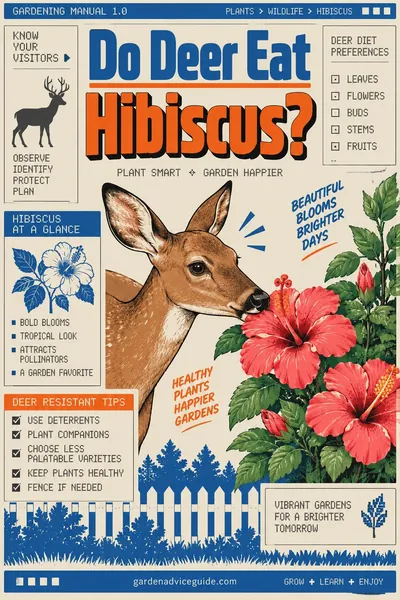
If you want the same look with genuinely lower risk, aromatic perennials and tough-textured shrubs are the direction to go, and the same question comes up with other big-flowered favorites like hibiscus. See do deer eat hibiscus for how that one compares.
Frequently asked questions
Are dahlias deer resistant at all?
No. Dahlias are among the most heavily browsed ornamental plants in a home garden, comparable to hostas and tulips. Smooth foliage, soft buds, and no aromatic oils make them an easy target. In deer country they need physical protection or a consistent repellent schedule.
Do deer eat dahlia tubers?
No. Deer do not dig, so tubers in the ground or in winter storage are safe from them. Missing or hollowed tubers point to voles, squirrels, chipmunks, or gophers instead. Voles tunnel and leave the crown hollowed out, and squirrels leave open holes with soil scattered around them.
What do deer eat first on a dahlia?
Flower buds, almost every time. Buds are the softest, sweetest part of the plant, and deer will strip buds off a whole row while leaving most of the foliage untouched. New growing tips are second, and mature leaves are third.
How do I stop deer from eating my dahlia buds?
Start repellent before bud set, not after the first damage, and rotate between two different repellent types every 2 to 3 weeks through August and September. Pair that with netting over the bed or cages on individual plants, because bud season and peak deer pressure arrive at the same time.
Will my dahlias bloom again after deer eat them?
Often yes, if it happens early enough. A dahlia pushes new buds in roughly 3 to 5 weeks after being browsed. Count the days from the damage to your average first frost: over 40 days means you'll get flowers, under 25 means you probably won't. Damage in June is a delay, damage in September usually ends the season.
Should I cut back a dahlia deer have chewed?
Yes, tidy it up. Cut each ragged stem cleanly just above a leaf pair, which encourages branching and removes the torn tissue where rot starts. Water steadily, feed lightly with a low-nitrogen fertilizer, and leave the rest of the plant alone.
Do deer eat dahlias in pots?
Yes, and container dahlias on open ground are just as vulnerable as bedded ones. Containers on a deck or porch with railings fare much better, because deer avoid enclosed footing and hard surfaces they can't judge.
Does deer netting damage dahlia flowers?
Not if you keep it off the plant. Support the netting on stakes or cages so there's several inches of clearance around the foliage, and raise it as the plants grow. Netting draped directly on buds will bruise petals and can snag stems on a windy night.
The short version
Deer eat dahlias, they take the buds first, and the worst overlap is late August through October when peak bloom meets rising deer pressure. No cultivar is resistant, so protection is physical: fencing, individual cages, or netting over the bed, backed up by two rotating repellents applied every 2 to 3 weeks through bud season.
The consolation is real recovery. A tuber survives browsing that would kill an annual outright, and a plant grazed in June usually blooms in August. Line up your planting and frost dates with our free planting zone tool, and check the wider list in deer resistant flowers if you want the rest of the bed to fight for itself.