Backyard Landscaping Ideas by Sun, Size, and Budget

The backyard landscaping ideas that hold up are the ones built around how the space gets used, in this order: where people sit, how they walk between the door and that seat, where water goes when it rains, and only then what gets planted. Get those four right and a modest yard looks better than an expensive one that skipped them. A usable outdoor dining area needs about 12 by 14 feet. A path people will actually use needs 36 inches of clear width. Everything else is negotiable.
Start with your zone and frost dates. Our free frost date and hardiness zone lookup tells you which of the plants below are hardy where you live and when it is safe to put them in the ground.
Updated September 2026
A note on numbers. We do not publish prices. Nursery, bulk material and contractor pricing varies by region, by season and by the specifics of your yard, and anything printed here would be wrong somewhere and out of date everywhere within months. What this page gives you instead is the dimensions, the quantities, and the questions that make three local quotes comparable.
Backyards fail for a different reason than front yards do. A front yard is looked at. A backyard is occupied, so a design that ignores traffic, glare, and where the grill smoke blows will be quietly abandoned no matter how good the planting is.
Backyard Landscaping Ideas Sorted by What the Yard Has to Do
Pick the row that matches your yard, not the one that matches the photo you liked. The third column is relative: the cheapest rows trade labor for money, and the priciest rows all have a machine, a wall or a structure in them.
| Yard type | The move that matters most | Relative effort and cost | Common mistake |
|---|---|---|---|
| Small city lot, under 800 sq ft | One paved surface, plants on the perimeter only | Low, because the area is small | Splitting it into three tiny zones |
| Long and narrow | Break the length with a screen or a bed two thirds down | Low, mostly plants and mulch | A straight path down the middle |
| Wide and shallow | Deep corner beds, patio pushed to one side | Low to moderate, scales with bed depth | A bed of even depth all the way around |
| Sloped away from the house | One terrace at seating level, planting below | The priciest row here, walls and machine time | Trying to keep turf on the slope |
| Sloped toward the house | Drainage first, hardscape second | High, and most of it is invisible drain work | Any planting before the water is solved |
| Deep shade from mature trees | Wood chip surface, shade perennials, no lawn | The cheapest row here, chips are often free | Reseeding grass every spring |
| Full sun, no shade at all | Shade structure or a fast shade tree before anything else | Moderate, a tree is far cheaper than a pergola | An unshaded patio nobody sits on |
| Pool already in place | Non littering evergreens, hard surface within 10 ft of coping | Moderate, driven by plant size at purchase | Deciduous trees near the water |
The single biggest cost driver in a backyard is access. If a mini excavator or a dumping trailer can get to the work area, hardscape prices sit at the low end of every range. If everything has to come through a 36 inch gate by wheelbarrow, expect 30 to 50 percent on top of any installed hardscape quote, and add a day to every DIY estimate.
Size the seating area before you draw anything else
Furniture dimensions decide patio size, and most patios are built too small because they were sized by eye on bare ground, where everything looks bigger.
| Use | Minimum finished size | Why |
|---|---|---|
| Two chairs and a small table | 8 by 8 ft | 36 in of pull back behind each chair |
| Dining for four | 10 by 10 ft | A 36 in round table plus chair clearance |
| Dining for six | 12 by 14 ft | A 40 by 60 in table plus 36 in all around |
| Dining for six plus a lounge area | 16 by 20 ft | Two zones with a walking lane between |
| Fire pit with six chairs | 16 ft diameter clear | 3 to 4 ft of seat space beyond the pit edge |
Mark the shape out with a garden hose or marking paint and put your actual furniture on it for a day before you commit. A patio is the most expensive thing in most backyards to make bigger later.
Fire pits, grills, and the clearances codes care about
Most municipal codes require an open fire pit to sit at least 10 feet from any structure, property line, or fence, and some set it at 15 or 25 feet. Nothing may overhang it, which rules out putting one under a pergola roof or a low tree canopy. Gas fire features have their own listed clearances printed on the appliance, and those override any general rule. Check with your local fire marshal or building department before you build a permanent one, because burn bans and setbacks vary town by town and a permanent masonry pit in the wrong spot is expensive to move.
Set seating 3 to 4 feet back from the outer edge of the pit. Under and around it, use gravel, pavers, or stone, never a wood deck or a mulch bed.
Privacy Landscaping That Works, With Real Spacing
Fences top out at 6 feet in most residential codes. Plants are how you get privacy above that, and the spacing decides whether you get a screen in four years or a row of colliding trees.
| Screen plant | Zones | Mature size | Spacing on center | Notes |
|---|---|---|---|---|
| 'Green Giant' arborvitae | 5 to 8 | 25 to 40 ft tall, 8 to 12 ft wide | 6 to 8 ft | Fast, 2 to 3 ft a year, deer usually leave it |
| 'Emerald Green' arborvitae | 3 to 8 | 12 to 15 ft tall, 3 to 4 ft wide | 3 to 4 ft | Narrow, but deer strip it in hard winters |
| American holly | 5 to 9 | 15 to 30 ft, 8 to 15 ft wide | 8 to 10 ft | Evergreen, needs a male for berries |
| Wax myrtle | 7 to 10 | 10 to 15 ft | 6 to 8 ft | Tolerates salt and wet soil |
| Clumping bamboo (Fargesia) | 5 to 9 | 8 to 12 ft | 4 to 5 ft | Clumping only, never running bamboo. See our cold hardy bamboo picks |
| Panicle hydrangea | 3 to 8 | 6 to 8 ft | 5 to 6 ft | Deciduous, screens May through November only |
| Switchgrass or miscanthus | 4 to 9 | 5 to 7 ft | 3 to 4 ft | Cheapest fast screen, dies back in winter |
Two rules save people from the most common privacy planting failure. First, do not plant a screen row tight to the property line, because half the mature plant will hang over it and half the maintenance will be on the neighbor's side. Set the row back by half the mature width, so 5 feet in for a 10 foot wide arborvitae. Second, do not plant a solid single species hedge across the whole line. One disease event takes out the entire screen, and you wait another six years. Alternate two or three species instead.
For fast height, a mixed row is better than a monoculture: a large grass hits full height in one season while the evergreens behind it take five.
Small Backyard Landscaping Ideas
Small yards reward subtraction. Every additional element makes the space read smaller.
- One surface, not three. A single paved area that runs to the edges makes a 20 by 30 foot yard feel larger than a patio, a path, a lawn patch, and a gravel strip in the same space.
- Plant vertically. A 3 foot wide bed with a climbing hydrangea, a clematis, or espaliered apples on a wall delivers the greenery of a 10 foot bed and eats 3 feet of floor.
- Skip the lawn if it is under about 300 square feet. At that size turf takes the same mower, fertilizer, and irrigation as a real lawn and never looks good, because it is mostly edge. Replace it with a paved surface or a ground cover such as creeping thyme in sun or Pennsylvania sedge in shade.
- Use large containers instead of narrow beds. Three pots of 20 inch diameter or larger read as intentional. Six small pots read as clutter, and small pots dry out in a single hot day. Our container gardening guide covers soil volume and watering for pots that size.
- Light it. A small yard used after dark is a room. Low voltage path lights every 8 to 10 feet and two uplights on a tree turn 400 square feet into usable space for less in parts than a single piece of patio furniture.
- Mirror the interior floor level. A patio set at the same height as the indoor floor, with a threshold no more than 1 to 2 inches down for drainage, makes the two spaces read as one.
Simple backyard landscaping ideas that take one weekend
- Cut a clean spade edge on every bed, 4 inches deep, and mulch to 2 to 3 inches. Our guide to mulch types covers which material suits which bed.
- Remove the bottom limbs from one overgrown tree up to about 8 feet. This alone can turn an unusable dark corner into a seating spot.
- Lay a 4 by 8 foot gravel pad for two chairs: excavate 4 inches, add landscape fabric, then 3 inches of compacted crushed stone with a 1 inch layer of screenings on top.
- Group five containers by the door and plant them from one species list so they read as a set.
- Replace a straight concrete walk edge with a 2 foot deep planting bed on one side only.
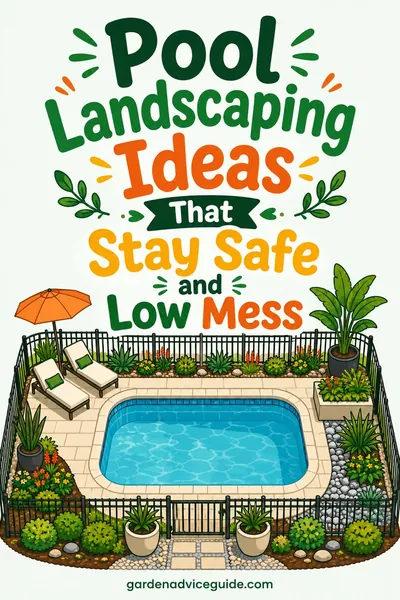
Backyard Pool Landscaping
Pool surroundings have rules that ordinary beds do not, and most of them are about litter and safety.
- No deciduous trees within 15 feet of the coping. Leaf drop clogs skimmers and stains decking. Evergreens, ornamental grasses that are cut once a year, and broadleaf evergreens are the low litter choices.
- Nothing thorny or bee heavy within reach of a bare foot. Barberry, roses, and dense flowering ground covers near the deck are a bad combination with wet feet.
- Watch the root systems. Willow, poplar, silver maple, and bamboo do real damage to pool shells and plumbing. Keep any large tree at least 20 feet from the structure, more on a shallow water table.
- Salt and chlorine splash zone. Within about 6 feet of the water, use tolerant species: dwarf yaupon holly, ornamental grasses, agapanthus in zones 8 and warmer, sedum, or juniper.
- Barrier code is not optional. Most US jurisdictions adopting the International Swimming Pool and Spa Code require a barrier of at least 48 inches with a self closing and self latching gate, and specify how far plantings and furniture must stay from that barrier so nothing becomes a climbing aid. Check locally before you plant anything against a pool fence.
Screening the equipment pad matters more than most people expect. Leave 3 feet of clear service access on all sides of the pump and heater, and screen with a removable panel or a loosely spaced planting rather than a hedge that has to be cut back every time a technician visits.
Drainage, Grade, and the Work Nobody Photographs
If water sits anywhere in the yard for more than 24 hours after rain, fix it before you spend a dollar on plants.
- The ground should fall away from the house at about 2 percent, which is a quarter inch per foot, for the first 10 feet. That is 2.5 inches of fall over 10 feet.
- A patio should drain away from the house at 1/8 to 1/4 inch per foot. A flat patio is a puddle.
- A French drain is a trench 12 to 18 inches deep and 6 to 12 inches wide, sloped at 1 percent minimum, with perforated pipe in washed stone wrapped in fabric. It is priced by the linear foot either way, and hiring it out runs roughly double to triple the material cost, because the trench is the work.
- A rain garden works where the soil percolates. Dig a test hole 12 inches deep, fill it with water, let it drain, then fill it again and time it. If it drops less than half an inch per hour, the site will not infiltrate and you need a pipe instead.
- Never grade water toward a neighbor's property. In most states that is actionable, and in many municipalities it needs a permit regardless of direction.
What Drives the Cost of Each Backyard Element
The elements below are ordered roughly cheapest to priciest to build yourself. What matters more than any published range is the last column, because those are the variables that make two quotes for the same patio land a factor of two apart.
| Element | Hiring it out, relative to DIY | What moves the number most |
|---|---|---|
| Fire pit, prefab ring | Not usually hired out | Diameter, and whether it burns wood or is plumbed for gas |
| Low voltage lighting, 10 fixtures | Four to five times | Fixture quality, transformer size, how much trenching |
| Gravel patio, 200 sq ft | About four times | Edging type, stone type, depth of the base |
| Sod, 1,000 sq ft | About triple | Grade prep, grass type, whether old turf has to be stripped |
| Raised beds, three 4 by 8 ft | About triple | Material, bed height, delivered soil volume |
| Privacy screen, 40 linear ft | Roughly triple | Plant size at purchase, ahead of everything else |
| Fire pit, masonry | Roughly four times | Stone, footing depth, whether a gas line is run |
| Paver patio, 200 sq ft | Roughly three times | Base depth, site access, laying pattern, number of cuts |
| Pergola, 12 by 12 ft | About three times | Wood species, footing type, whether a permit is required |
Read the middle column as the reason to do the top of the list yourself and hire the bottom. Anything where the multiple is three or more is mostly somebody's time, and time is the one input you can substitute.
Buying plants small is the honest way to cut a backyard budget. A 40 foot arborvitae screen in 6 foot balled stock is one of the most expensive single lines you can put in a backyard. The same screen in 3 foot container stock is a small fraction of that and is only about two years behind. A pergola and a patio, by contrast, do not get cheaper by waiting.
Raised beds are worth their own decision. Our comparison of raised beds versus in ground planting covers when the extra soil cost pays for itself, and the soil volume calculator will tell you how many cubic yards a set of beds actually swallows, which is usually more than people expect.
Planting the Backyard: Ideas by Exposure
The back of a house often has the sunniest and the shadiest spots on the property within 40 feet of each other. Split the yard by exposure before you shop.
- Full sun, 6 or more hours: switchgrass, little bluestem, coneflower, catmint, Russian sage, sedum, panicle hydrangea, dwarf ninebark. All are drought tolerant once established and none need staking.
- Part shade, 3 to 6 hours: oakleaf hydrangea, smooth hydrangea, viburnum, heuchera, astilbe, Japanese forest grass, foamflower.
- Full shade under trees, dry: Christmas fern, epimedium, Pennsylvania sedge, wild ginger, hellebore. Do not add more than 2 inches of soil over existing tree roots, which suffocates them.
- Wet corners: switchgrass, Siberian iris, red twig dogwood, inkberry holly, swamp milkweed.
Space at mature width, not pot size. Our plant spacing calculator converts a bed area and an on center spacing into a plant count, and it uses the same math shown in our main landscaping ideas guide. If you want the yard to feed bees and butterflies, the plant list in how to attract pollinators overlaps heavily with the full sun list above. Where deer browse, check deer resistant shrubs before ordering a screen row, since arborvitae is a favorite food in some regions. A pergola post or a fence panel is planting space too, and flowering vines by zone covers which climbers are hardy where and how much structure each one needs.
Frequently Asked Questions
How much does backyard landscaping cost?
It depends which of three jobs you are actually doing, and they are separated by multiples rather than by a few percent. A planting only refresh is the cheapest of the three, and hiring it out roughly triples what the materials alone would cost you. Adding a patio multiplies the whole project again, because hardscape brings base material, machine time and disposal with it. A full renovation with hardscape, lighting, irrigation and a structure is several times a refresh. Four things then move your own number inside those tiers: site access, slope, whether drainage has to be corrected first, and how large you buy the plants. To get a figure you can trust, write one scope with dimensions, plant sizes and material names on it, send that identical scope to three local contractors, and ask each of them in writing what the bid excludes.
What is the cheapest way to landscape a backyard?
Reduce the lawn, mulch the reclaimed area, and plant it with a small number of species bought in one gallon pots or divided from friends. A 300 square foot bed made this way costs less than a single weekend of hired labor, most of it in the plants and the rest in mulch, and it eliminates 300 square feet of mowing forever. Do the edge work and the mulching first, because those two alone change how the yard reads.
How do I landscape a backyard on a slope?
Decide whether the slope is under 3 to 1, meaning 3 feet horizontal for every 1 foot of drop. Below that, deep rooted ground covers and shrubs planted on individual level terraces will hold it without walls. Steeper than 3 to 1, you are looking at terracing, and any wall over 4 feet from the bottom of its footing needs an engineered design and usually a permit. Never leave bare soil on a slope over winter: seed it with annual rye or cover it with erosion netting until plants establish.
How far apart should I plant privacy trees?
Space at the mature width of the species, not tighter. 'Green Giant' arborvitae reaches 8 to 12 feet wide, so plant at 6 to 8 feet on center for a solid screen and accept that the row will thicken over five years. Planting at 3 feet on center gets you a screen two years sooner and a row of dying, bare bottomed trees by year twelve, because the interior branches never see light.
What can I plant close to the house foundation?
Keep anything with a mature width over 4 feet at least 4 feet from the wall, and leave 18 to 24 inches of access behind every shrub for painting, gutter work, and air flow. Do not plant trees within 15 to 20 feet of a foundation, and keep plantings clear of the dryer vent, the gas meter, the AC condenser (which needs 24 to 36 inches of clearance per the manufacturer), and any crawl space vent.
When is the best time to install backyard landscaping?
Hardscape can go in any time the ground is not frozen or saturated. Planting is better in early fall, roughly 6 weeks before your first frost, which gives roots a season to establish before summer heat. Spring is the second best window. Summer planting works only if you can water deeply twice a week through the first season. Look up your dates with the frost date and hardiness zone lookup rather than guessing, and check your growing zone before ordering anything marginal.
Do I need a permit for a backyard patio or fire pit?
It depends on the jurisdiction. A patio at grade often does not need one, but it may count toward an impervious surface limit that does. Structures with a roof, walls over 3 or 4 feet, gas lines, electrical circuits, and permanent fire features almost always need a permit and an inspection. Pools have their own barrier code. Call the building department first, since a permit is inexpensive and a stop work order after the base is compacted is not.