Front Yard Landscaping Ideas: Plants, Beds, and Scale

The front yard landscaping ideas that change how a house looks are mostly about proportion, not plant variety. Beds need to be deep enough to hold two layers, which means 5 to 6 feet from the wall on a one story house and 7 to 9 feet on a two story. The walkway needs to be 4 feet wide so two people can use it. Plants need to be spaced at mature width. Do those three things with eight species and the yard looks designed. Do the opposite with forty species and it looks like a nursery clearance rack.
Check your zone first. Our free frost date and hardiness zone lookup gives you the hardiness zone and planting dates that every recommendation below depends on.
Updated September 2026
A note on numbers. We do not publish prices. Nursery, bulk material and contractor pricing varies by region, by season and by the specifics of your yard, and anything printed here would be wrong somewhere and out of date everywhere within months. What this page gives you instead is the quantities, the proportions, and the questions that make three local quotes comparable.
A front yard is seen from three distances: from a car at 25 miles per hour, from the sidewalk, and from the front door. Detail that only works at three feet is wasted, and a bed under 4 feet deep disappears entirely from the street.
Front Yard Landscaping Ideas That Fix the Most Common Problems
| Problem you have | The fix | What you are buying | Effort |
|---|---|---|---|
| Beds look like a stripe against the house | Widen to 5 to 6 ft and curve the front edge | Mulch for the new area, and nothing else if you cut a spade edge | One weekend |
| Overgrown shrubs swallowing windows | Remove and replant with dwarf cultivars | Disposal, plus replacement shrubs in three gallon pots | Two weekends |
| Nothing looks good after June | Add three fall and winter interest plants per bed | A handful of perennials or one shrub per bed | One afternoon |
| Yard is all lawn, no structure | One tree plus two beds at the corners of the house | A balled and burlapped or container tree, bed plants, mulch | Two weekends |
| Walkway is 30 in wide and cramped | Widen to 4 ft, or add a 12 in gravel shoulder each side | Gravel and edging, or a full concrete or paver replacement | Varies |
| Slope down to the street | Terrace with one low wall, plant above and below | Wall block or stone, base gravel, drainage pipe, and a crew | Contractor for walls |
| House is a plain rectangle | Vary planting height at the corners, keep the entry low | Two taller corner shrubs, and lower plants at the door | One weekend |
| Bare, hot strip along the driveway | Salt tolerant grasses set back 18 to 24 in | One flat of grasses and mulch | One afternoon |
The cheapest rows on that list are the ones that trade labor for money: edging, widening, and mulching cost almost nothing but your weekend. The expensive rows are the ones with a wall, a walk, or a machine in them. Hiring the work out typically multiplies a planting job by roughly 2.5 to 3 and a hardscape job by 2 to 3, because labor and the contractor's plant markup are most of an installed price.
Get the proportions right before choosing a single plant
Three ratios do most of the work in a front yard.
- Bed depth to house height. A single story wall is about 10 feet to the eave, and a 5 to 6 foot bed sits right. A two story wall is 18 to 20 feet, and the same 5 foot bed looks like a shelf. Go to 7 to 9 feet.
- Corner planting height to house height. Aim for the tallest corner plant to reach roughly one third to one half the height of the wall it stands against at maturity. That is 4 to 6 feet on a one story house and 7 to 10 feet at a two story corner.
- Entry planting height. Keep everything within 6 feet of the front door under about 3 feet tall. The door needs to be the thing you see. Tall plants flanking a door make a house look smaller and darker than it is.
Curved bed edges read better than straight ones on most houses, but only if the curve is large. A curve with a radius under about 4 feet reads as a wobble from the street. Lay it out with a hose, then walk to the curb and look before you cut.
Rules from the street that override the design
- Sight triangles. On a corner lot most municipalities restrict anything over 24 to 36 inches tall inside a triangle measured 25 feet back from the intersection along each street. This is enforced, and it is a safety rule, so check your zoning code before planting a corner.
- Driveway sight lines. Keep plantings within 10 feet of the driveway apron under 30 inches so you can see the sidewalk when backing out.
- The right of way. The strip between the sidewalk and the curb usually belongs to the city, even though you mow it. Street trees there often need a permit and must come from an approved species list.
- Mailbox clearance. For curbside delivery, USPS specifies the bottom of the box 41 to 45 inches above the road surface, with the face set back 6 to 8 inches from the front face of the curb. Plantings must not block a carrier reaching it from the vehicle.
- Utility easements. Check your plat. A bed over a sewer lateral or a shared easement can be dug up legally by the utility, and they do not replant it.
- HOA approval. Many associations require written approval for any front yard change, including lawn removal. Get it in writing first.
A Planting Plan That Works on Almost Any House
Use four roles, and fill each role with one or two species rather than five.
1. Evergreen structure, 30 to 40 percent of the planting. These carry December. Dwarf and compact cultivars keep them from eating the windows.
| Evergreen | Zones | Mature size | Spacing | Sun |
|---|---|---|---|---|
| Boxwood 'Green Velvet' | 5 to 9 | 3 to 4 ft | 3 to 4 ft | Sun to part shade |
| Inkberry holly 'Shamrock' | 5 to 9 | 3 to 4 ft | 3 to 4 ft | Sun to part shade |
| Dwarf yaupon holly | 7 to 10 | 3 to 4 ft | 3 ft | Full sun |
| 'Gem Box' inkberry | 5 to 9 | 2 to 3 ft | 2.5 to 3 ft | Sun to part shade |
| Dwarf globe blue spruce | 2 to 8 | 3 to 5 ft | 4 to 5 ft | Full sun |
| 'Soft Serve' false cypress | 4 to 8 | 6 to 10 ft | 5 to 6 ft | Full sun |
2. Flowering shrubs, 20 to 30 percent. These give the yard a season.
Panicle hydrangea ('Little Lime' at 3 to 5 feet, zones 3 to 8), oakleaf hydrangea (6 to 8 feet, zones 5 to 9), dwarf fothergilla (3 feet, zones 5 to 8), Virginia sweetspire 'Little Henry' (2 to 3 feet, zones 5 to 9), and compact ninebark (3 to 4 feet, zones 3 to 7) all stay in scale without shearing.
3. Perennials and grasses, 30 to 40 percent. Plant these in drifts of 5 to 9 of one species, never one of each.
Full sun: coneflower, catmint, little bluestem, sedum, salvia 'May Night', daylily, and threadleaf coreopsis. Part shade: heuchera, hosta, astilbe, hellebore, and Japanese forest grass. Shade: Christmas fern, epimedium, and foamflower.
4. Ground cover, the last 10 percent. Creeping thyme, sedum, or Pennsylvania sedge along a walk edge closes the gap between the bed and the pavement so weeds cannot start there.
Space everything at mature width, and expect two full seasons of gaps. Filling those gaps with more shrubs is the mistake that produces the overgrown foundation planting you are trying to fix. Our plant spacing calculator turns bed area and on center spacing into a plant count, and the layout arithmetic is worked through step by step in our main landscaping ideas guide.
Seasonal interest, checked month by month
Walk your list against the calendar. A front yard needs something happening in at least eight months of the year.
| Season | What carries it | Example plants |
|---|---|---|
| Late winter | Evergreen structure, bark, hellebore | Boxwood, red twig dogwood, hellebore |
| Early spring | Bulbs and early shrubs | Daffodil, fothergilla, serviceberry |
| Late spring | Perennials starting, iris | Salvia, catmint, Siberian iris |
| Summer | Long blooming perennials | Coneflower, daylily, panicle hydrangea |
| Early fall | Grasses and late perennials | Little bluestem, sedum, aster |
| Late fall | Foliage color and seed heads | Fothergilla, oakleaf hydrangea, switchgrass |
| Winter | Structure, berries, standing grass | Inkberry, winterberry, miscanthus |
Daffodils are worth calling out for front yards where deer or rabbits browse: they are among the few bulbs that neither animal eats. Our list of deer resistant perennials is the safe shopping list where browsing is heavy.
Small Front Yard Landscaping Ideas
A front yard under about 600 square feet has different rules, because a small space punishes clutter.
- Two beds, not five. One at the entry, one at the far corner of the house. The lawn between them, if any, should be a simple shape a mower can turn in.
- One tree, placed to frame not to fill. A small tree with a 15 to 20 foot mature spread, such as serviceberry, redbud, Japanese maple, or a flowering cherry matched to your cherry blossom tree growing zone, planted 12 to 15 feet from the wall and off to one side of the door.
- Fewer, larger plants. Three 4 foot shrubs beat nine 18 inch ones in a small yard, because the eye stops moving.
- Replace turf under 200 square feet. A lawn that small is all edge and never looks good. Gravel with stepping stones, a low ground cover, or an expanded bed all beat it and end the mowing.
- Give the walk a shoulder. A 12 to 18 inch band of low planting on each side of the front walk makes a narrow path feel generous without widening the concrete.
- Watch scale on hardscape. A boulder that would look small in a half acre yard looks like a parked car in a 20 foot front yard.
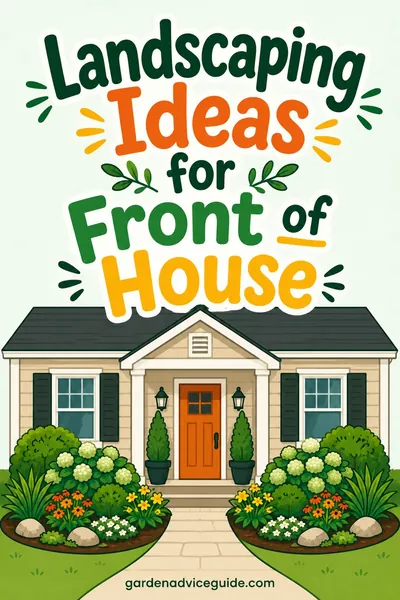
If the constraint is money rather than space, the tight budget version of this plan is laid out in cheap simple front yard landscaping ideas. If the constraint is that the house itself looks blank, the entry specific version is landscaping ideas for the front of a house.
Quantities for a Real Front Yard
You cannot compare quotes without knowing what the job actually contains. Take a common layout: two beds totaling 260 square feet, 40 linear feet of new edge, and 30 perennials. Here is the full takeoff, which is the sheet you hand to a nursery or to three contractors.
| Item | How to calculate it | This example |
|---|---|---|
| Mulch | Square feet times depth in inches, divided by 324, gives cubic yards | 260 x 3 / 324 = 2.4 yards, so order 2.5 to 3 |
| Shrubs | Bed area divided by mature spacing, in three gallon pots | 9 shrubs at 3 to 4 ft spacing across both beds |
| Perennials | Drifts of 5 to 9 per species, one gallon pots | 30 plants, four or five species |
| Edging | Linear feet of bed front | 40 linear feet of steel, or a cut spade edge instead |
| Delivery | One charge per bulk drop | One mulch delivery, so order the full amount at once |
Order the mulch overage on purpose. Bulk mulch spreads thin at bed edges, and a short order means paying a second delivery charge for half a yard.
The two decisions that move this job's number most are both yours to make before anyone quotes it. Pot size is the first: the same shrub in a one gallon pot is a fraction of the three gallon price and catches up within two seasons. Edging is the second: a cut spade edge costs nothing but your time and has to be recut once a year, while steel edging is bought by the linear foot and lasts. Neither choice changes the finished design, and together they can halve a materials list.
Hired out, the same job is quoted by the square foot of bed, and the gap between doing it yourself and hiring it out is labor plus the contractor's plant markup, which typically runs 1.5 to 2 times wholesale and usually carries a one year plant warranty. That warranty is worth something on a large tree and very little on a flat of perennials.
Home improvement studies frequently put the resale return on front yard landscaping near or above 100 percent of the money spent. Treat that as a directional estimate rather than a promise, since it depends heavily on the neighborhood and on what the yard looked like before.
How to get quotes you can actually compare
Landscaping bids are notoriously hard to line up, because every designer proposes a slightly different yard. Fix that by specifying the yard yourself.
- Draw the beds on paper with dimensions, including depth from the wall at the corners and at the entry, and the linear feet of edge.
- Name the plants and the pot sizes. Species, cultivar, and container size for every item. Three bids on nine unnamed shrubs are three different prices for three different plants.
- State the mulch type and depth, because bark, hardwood, and dyed products are not interchangeable in price or in how long they last.
- Say who removes what. Old shrub removal, stump grinding, sod stripping, and hauling are each separate labor, and each one is commonly left out of a low bid.
- Ask what happens to the soil. Amended, tilled, or planted as found. This is invisible in a photo and it decides whether the bed thrives.
- Ask about irrigation separately, because a drip line under the mulch is cheap in parts and is the difference between a bed that survives August and one that does not.
- Get three bids, and ask each one what they excluded. That answer, not the total, is where the real differences live.
Watering a new front yard
New plantings need consistent water for the first full season regardless of how drought tolerant the mature plant will be.
- Water deeply twice a week rather than lightly every day. A soaking that wets the top 6 to 8 inches drives roots down.
- A new shrub needs roughly 1 to 2 gallons per application per gallon of pot size, so a 3 gallon shrub takes 3 to 6 gallons.
- Drip line or soaker hose under the mulch is one of the cheapest parts of the whole bed, and it is the difference between a bed that survives August and one that does not.
- Stop supplemental watering of established natives after the second season, but keep watering hydrangeas and anything in a hot west facing bed.
Keeping weeds out of a young bed matters more than in an established one, because bare soil between plants is where they start. Mulch at 2 to 3 inches, and see how to get rid of weeds for what to do when they arrive anyway. For the lawn that remains, mowing height by grass type is set out in the lawn care calendar.
Frequently Asked Questions
What drives the price of a front yard renovation?
Four things, in order: whether there is hardscape in the plan, the pot sizes you buy, how much removal and disposal the old yard needs, and whether grading or drainage has to be fixed first. Plant variety barely matters. A one weekend refresh of edging, cleanup, and mulch is the cheapest thing on the list and changes the look more than anything else you can do for the money, which is why it is worth doing before you price anything larger.
What should I plant in front of my house?
Work in layers: an evergreen for winter structure at each corner, one or two flowering shrubs in the middle range, and perennials or grasses in drifts along the front. Keep everything within 6 feet of the door under 3 feet tall, keep mature width at least 4 feet off the wall, and leave 18 to 24 inches of access behind every shrub. Choose the specific plants from the tables above by matching your sun hours and your growing zone.
How deep should a front yard flower bed be?
Five to six feet from the wall on a one story house, and seven to nine feet on a two story. Anything under 4 feet cannot hold a shrub layer plus a perennial layer, so it reads as a border stripe. If you cannot go deep everywhere because of a walk or a driveway, go deep at the corners and let the bed narrow at the entry.
How far should shrubs be planted from the house?
Measure by mature width, not pot size. Plant the center of a shrub at least half its mature width plus 18 inches from the wall, so a 4 foot wide shrub sits 3.5 to 4 feet out. That leaves service access, keeps foliage off siding where it traps moisture, and avoids blocking crawl space vents. Keep trees 15 to 20 feet from the foundation, and never plant anything within 3 feet of a gas meter or a dryer vent.
Should I remove my front lawn?
Removing turf makes sense when the lawn is under about 200 square feet, when it is shaded and never fills in, when water restrictions make it expensive to keep, or when you would rather not mow. Keep it when children play on it or when the neighborhood expectation or an HOA rule requires it. A middle path works well: shrink the lawn to a simple mowable shape and expand the beds around it. Replacement ground covers include creeping thyme in sun, clover in mixed conditions, and Pennsylvania sedge in dry shade.
When is the best time to plant a front yard?
Early fall, roughly six weeks before your average first frost, is the best window in most of the United States, because the soil is warm, the air is cool, and roots grow all fall. Early spring after the soil dries is the second choice. Avoid midsummer planting in zones 7 and warmer unless you can water three times a week. Get your own dates from the frost date and hardiness zone lookup rather than working from a general calendar.
How do I make a front yard low maintenance?
Cut the lawn area, mulch every bed to 2 to 3 inches, choose species that reach the size you want without shearing, install drip irrigation on a timer, and repeat few species rather than collecting many. Shearing is the maintenance task people underestimate most, and it exists only because the plant was too big for the spot. A dwarf cultivar chosen correctly never needs it. The same principle applies out back, where the space planning matters more than the plant list: see backyard landscaping ideas.