Are Coral Bells Deer Resistant?

Mostly, yes. Coral bells (Heuchera) are rated in the "seldom severely damaged" tier by Rutgers NJAES, and in a normal growing season deer walk past them. The foliage is thick, slightly hairy, faintly bitter, and low to the ground, which is close to the opposite of what a browsing deer wants. The catch is winter: coral bells stay evergreen or semi-evergreen through most of their range, so in a deep-snow February they can be one of the only green things a hungry deer can reach.
Heat and humidity decide which coral bells survive where. Check your zone free with our Growing Zone Lookup before you buy, then use the species table below.
Updated September 2026
A note on numbers. This page gives you spacings, plant counts, quantities and timings, not dollar figures. Coral bells, compost and repellent are priced by your nursery, your region and the season, and we do not set any of it. Work out the buy list here, then price it locally.
That winter exception is the whole story of heuchera and deer, and almost nobody mentions it. A gardener who plants coral bells in May, watches them go untouched all summer, and then finds them chewed to nubs in March concludes the plant is not deer resistant. It is. It just happens to be available at the one time of year when deer stop being picky. Below is what actually protects them, which species handle your climate, and what else is more likely to kill a coral bell than a deer ever will.
Why deer usually skip coral bells
Deer feed by smell first and texture second, and coral bells fail both tests from a deer's point of view.
1. Coarse, hairy, leathery leaves. Heuchera foliage is thick with a fuzzy or slightly sticky surface, especially in the H. villosa bloodline. Deer prefer thin, smooth, water-rich leaves that go down easily. Hosta, daylily, and tulip are the classic targets for exactly that reason. A heuchera leaf feels closer to felt.
2. Bitter tannins and saponins. The roots and foliage of Heuchera carry astringent compounds, which is how the genus earned its old common name, alumroot. Native peoples used the root as an astringent. That bitterness is a one-bite lesson, and deer remember plants.
3. Low, mounded growth. Coral bells top out around 8 to 12 inches of foliage. Deer graze most efficiently at chest and head height, stripping leaves off upright stems. Bending down to nibble a ground-hugging rosette costs more effort for less food.
Rutgers New Jersey Agricultural Experiment Station publishes Landscape Plants Rated by Deer Resistance, which most nursery tags borrow from. Heuchera sits at "seldom severely damaged," one grade below the top. That is a realistic rating, not a marketing claim. No plant is deer proof, and the Rutgers scale deliberately refuses to say otherwise.
Are coral bells deer resistant in winter?
Less so, and this is the part worth planning around. Coral bells hold their leaves through winter in most of zones 5 through 9. In zone 4 they die back further but often keep a green center.
Here is what changes in winter:
The competition disappears. By January the woods offer bark, twigs, and evergreen browse. A mounded green rosette sitting at snow level in a suburban yard is easy calories.
Snow flattens the alternatives. After a heavy snow, deer feed on whatever pokes through. Low evergreen perennials at the edge of a bed become accessible in a way a 4-foot shrub is not.
Winter foliage is milder. The tannin concentration in older, cold-hardened leaves is lower than in the vigorous summer flush. It is a smaller deterrent at the exact moment deer are least fussy.
What to do about it, in order of effort:
- Leave a light evergreen bough cover. After the ground freezes, lay cut pine or spruce branches loosely over the clumps. This buffers freeze-thaw cycles and physically hides the foliage.
- Spray a repellent twice, in late November and again in late January. Winter repellent applications last far longer than summer ones because there is no new growth diluting them and no rain washing them off weekly.
- Plant coral bells behind something, not at the bed edge. A row of low ornamental grass or a dwarf conifer in front makes them less obvious and less reachable.
- Accept the haircut. Coral bells regrow completely from the crown each spring. Winter browsing is ugly, not fatal. Cut the damaged foliage off in March and the plant flushes clean.
The two other moments to watch: fresh transplants, which smell like nursery soil and fertilizer for their first few weeks, and flower stalks in June, which some deer strip while leaving the foliage alone. Neither harms the plant.
Coral bells species and varieties compared
Deer resistance is roughly the same across every heuchera, so buy on climate fit instead. This is where most coral bell disappointment starts: the gorgeous purple hybrid sold nationwide is often a H. sanguinea or H. micrantha type that melts in southern humidity.
| Type / Bloodline | Zones | Sun Tolerance | Humidity Tolerance | Foliage Notes |
|---|---|---|---|---|
| H. villosa and its hybrids ('Caramel', 'Autumn Bride', 'Southern Comfort') | 4-9 | Part sun to shade, some take full sun | Excellent, the group for the Southeast | Large fuzzy leaves, vigorous, best crown rot resistance |
| H. americana ('Dale's Strain', 'Green Spice') | 4-9 | Part shade | Very good | Marbled silver and green, native to eastern woodlands |
| H. micrantha ('Palace Purple' type) | 4-9 | Part shade | Good | Classic bronze purple, reliable and cheap |
| H. sanguinea ('Firefly', 'Ruby Bells') | 3-8 | Part sun | Fair, struggles in the humid South | The best true red flowers of the genus |
| 'Obsidian', 'Blackout' (dark hybrids) | 4-9 | Part shade, protect from afternoon sun | Fair to good | Near-black leaves scorch in strong sun |
| 'Lime Marmalade', 'Citronelle' (chartreuse) | 4-9 | Shade to part shade | Good, villosa heritage | Bright lime, lights up a dark corner, burns in full sun |
| 'Caramel' | 4-9 | Part sun to sun | Excellent | Apricot to amber, one of the toughest ever bred |
| 'Autumn Bride' (H. villosa) | 3-8 | Shade to part sun | Excellent | Plain green, huge, and the best white fall flowers |
| Heucherella (x Heuchera / Tiarella) | 4-9 | Shade to part shade | Good | Cut leaves, often trailing, same deer resistance |
| Tiarella (foamflower) | 3-8 | Shade | Very good | Spring flowers, spreads by runners, also deer resistant |
Read that table this way:
South of zone 7, buy villosa blood. 'Caramel', 'Southern Comfort', 'Autumn Bride', and their relatives handle heat and humidity that kills the fancier hybrids. This single decision saves more coral bells than any other.
Dark foliage needs shade. Near-black varieties like 'Obsidian' look their best in bright shade. In four hours of afternoon sun they bleach and crisp at the edges.
Bright foliage needs shade too, but for a different reason. Chartreuse and amber leaves sunburn easily. Morning sun with afternoon shade is the sweet spot for almost every colored heuchera.
Deer rating does not vary between them. Every one of these carries the same coarse texture and astringent chemistry. Pick on climate, color, and size.
Worked example: a 10-foot deer resistant shade edging
You have a 10-foot border under a maple, deer walk through the yard, and you want year-round color instead of bare mulch.
Step 1: Plan the spacing. Coral bells mature at 12 to 18 inches wide for most varieties, and 24 inches for villosa types. At 15-inch spacing:
- 10 ft divided by 1.25 ft = 8 plants for a single row
- A staggered double row at 15 inches on center, offset, needs 14 plants and reads as a solid ribbon by year two
Step 2: Mix the colors, keep the species consistent. Under a maple in zone 6, use 7 'Caramel' and 7 'Obsidian' alternating. The amber and near-black contrast is visible from 50 feet, and both take dry root competition from maple roots reasonably well.
Step 3: Build the buy list.
| Item | Quantity | Sold as | What moves the price |
|---|---|---|---|
| Coral bells, 1-gallon pots | 14 | Individual pots | Pot size and whether the cultivar is a recent introduction. This is nearly the whole bill |
| Compost for the planting strip, 2 in over 10 x 2 ft | 3.3 cu ft | Bags of 1 to 2 cu ft, or bulk by the yard | At this volume bagged wins, since 3 cu ft is far under any delivery minimum |
| Shredded leaf or bark mulch, 2 in | 3.3 cu ft | Bags of about 2 cu ft | Free if you shred your own leaves, which is what most of this bed wants anyway |
| Deer repellent, first winter | 1 bottle | Concentrate or ready to spray | Concentrate is far cheaper per application and one bottle covers several winters |
The plants are almost the entire cost, and everything else is rounding. Buying 4-inch pots instead of 1-gallon roughly halves the plant line and costs you one season of fill-in, which is usually the right trade for an edging you will divide in three years anyway.
Set against annual impatiens along the same 10 feet, coral bells are the cheaper option within a few years: you buy roughly twenty impatiens every single spring forever, while the coral bells are a one-time purchase that lasts 8 to 10 years and divides into free plants. Deer also eat impatiens on sight, which the coral bells do not have to survive.
Step 4: Budget for the real maintenance. Plan on lifting and replanting the whole run once every 3 to 4 years when the crowns lift out of the soil. That takes about an hour and costs nothing.
Growing coral bells so they last
Heuchera dies from three things, and deer are not on the list.
Bright shade or morning sun. Most colored varieties want 3 to 4 hours of morning sun and shade the rest of the day. Deep shade gives you thin, stretched plants. Full afternoon sun scorches the leaves.
Sharp drainage, and never plant the crown low. Crown rot is the number one killer. Set the plant so the crown sits at or slightly above the soil surface, never buried. In heavy clay, plant on a slight mound or amend the bed with compost and coarse grit. Our guide on how to test garden soil covers checking drainage properly.
Even moisture, not wet feet. Coral bells want about an inch of water a week and hate sitting in saturated soil. A 2 inch mulch layer holds moisture evenly. Keep the mulch pulled back an inch from the crown itself. See our mulch guide for depths by material.
Divide every 3 to 4 years, in spring or early fall. Heuchera grows a woody stem that lifts the crown higher each year until the roots are basically in the air. When you can see 2 inches of bare woody stem, lift the plant, cut the woody portion off, and replant the rosette deeper. This one habit doubles the life of the planting.
Check for frost heave every March. Freeze-thaw cycles push shallow-rooted heuchera right out of the ground. Walk the bed after the last hard freeze and firm any plant that has lifted back into the soil. A plant left heaved with roots exposed dies within weeks.
Cut off the winter-tattered leaves in early spring. Do not cut back in fall. The old foliage protects the crown through winter. Clean it up in March once new growth starts.
Skip heavy fertilizer. A light spring feeding is plenty. Rich, high-nitrogen soil produces soft growth and worse crown rot.
What actually damages coral bells
Frost heave. The leading cause of death in zones 4 through 6. Fix it in spring as described above.
Crown and root rot. Caused by planting too deep, mulch piled on the crown, or clay that stays wet. The plant collapses suddenly and pulls free with no roots attached.
Black vine weevil. The adults chew distinctive notches in the leaf margins at night, which is cosmetic. The larvae eat roots underground, which is not. A plant that wilts in moist soil and lifts out easily has weevil grubs. Beneficial nematodes applied in late summer are the practical control.
Voles. They tunnel under mulch and eat the crown from below in winter. A vole-damaged plant looks exactly like a rotted one. Keep mulch thin near the crown and avoid deep mulch against a lawn edge.
Foliar nematode. Angular brown patches between the leaf veins in late summer. It spreads in splashing water. Remove and discard the affected leaves and water at the base.
Rabbits. They will take the flower stalks and occasionally young foliage. Rabbit cuts are clean and angled at 45 degrees, low to the ground. Deer tear, leaving a ragged edge.
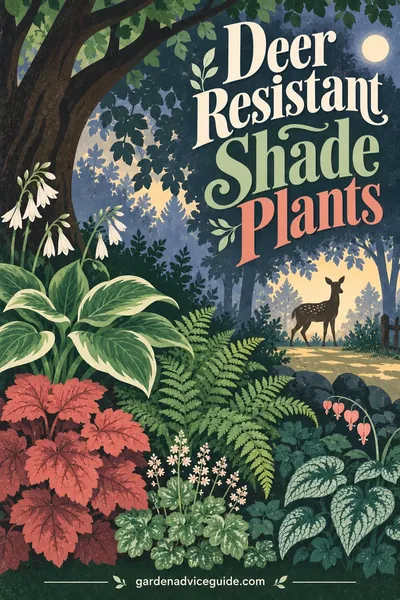
Companion plants for a deer resistant shade bed
Every plant below shares the same conditions and is also rated deer resistant, so the bed reads as a whole rather than one protected plant among tempting neighbors.
| Companion | Zones | Height | Season of Interest | Why It Pairs Well |
|---|---|---|---|---|
| Foamflower (Tiarella) | 3-8 | 6 to 12 in | Spring flowers | Same family, same conditions, spreads gently |
| Barrenwort (Epimedium) | 4-8 | 8 to 15 in | Spring flowers, evergreen foliage | Dry shade champion, tough under trees |
| Hellebore (Helleborus) | 4-9 | 12 to 18 in | Late winter flowers | Toxic to deer, evergreen, blooms in February |
| Japanese forest grass (Hakonechloa) | 5-9 | 12 to 18 in | Cascading gold foliage | Texture contrast against solid heuchera mounds |
| Ferns (Christmas, autumn, lady) | 3-9 | 12 to 36 in | Foliage all season | Deer almost never touch ferns |
| Brunnera ('Jack Frost') | 3-8 | 12 to 15 in | Blue spring flowers, silver leaves | Fuzzy leaves deer skip, echoes silver heucheras |
| Lungwort (Pulmonaria) | 3-8 | 8 to 12 in | Early spring flowers, spotted leaves | Bristly foliage, one of the safest shade perennials |
| Bleeding heart (Dicentra) | 3-9 | 12 to 36 in | Spring flowers | Goes dormant in summer, so heuchera covers the gap. See bleeding heart and deer |
| Astilbe | 3-8 | 12 to 36 in | Summer plumes | Needs more moisture, plant it in the damper end |
For the full shade list with sun requirements and bloom times, see deer resistant shade plants, and for the structural backbone of a shady deer resistant bed, deer resistant perennials.
What coral bells will not do for you
They will not protect neighboring plants. Heuchera is passively unappealing, not actively repellent. It has no strong scent, unlike lavender or bee balm, so it does not mask what is planted beside it. A deer will step over a row of coral bells to reach a hosta.
They will not survive being buried. More coral bells die from a mulch volcano over the crown than from any animal.
They will not stay looking sharp without division. By year four an undivided heuchera is a woody stub with a tuft of leaves on top. Division is not optional maintenance, it is the plant's life cycle.
They will not stop rabbits or voles. Different animals, different rules.
For fencing heights, repellent rotation schedules, and what to do about the plants you refuse to give up, see our pillar guide to deer resistant plants, and check plants deer love to see what is drawing deer into the yard in the first place.
FAQ
Do deer eat coral bells?
Rarely in the growing season, and occasionally in winter. From spring through fall, deer walk past coral bells because the leaves are coarse, hairy, and bitter, and the plant sits too low to graze efficiently. In winter, when the foliage stays green and other food is buried, a hungry deer will browse it. The plant regrows from the crown in spring, so the damage is cosmetic.
Is heuchera deer resistant enough to plant without a fence?
Yes, in most yards. Heuchera is rated "seldom severely damaged," which is the tier where you can plant without protection and accept the occasional bad year. If you have very high deer pressure, add a repellent application in late November and again in late January, which is when the risk actually sits.
Which coral bells are most deer resistant?
All of them, equally. Every Heuchera species and cultivar shares the same leaf texture and astringent chemistry, so there is no meaningful difference between 'Caramel', 'Obsidian', 'Palace Purple', or a plain green H. villosa. Choose on heat tolerance and sun exposure instead, since those are what actually decide whether the plant thrives.
Do deer eat heuchera flowers?
Sometimes. The tall wiry flower stalks in late spring are softer than the foliage, and some deer strip them while ignoring the leaves entirely. It looks alarming and harms nothing. Cut the spent stalks off at the base and many varieties push a second flush.
Why are my coral bells sticking up out of the ground?
Frost heave, or natural woody crown growth, and usually both. Heuchera builds a woody stem that lifts the crown a little higher every year, and winter freeze-thaw cycles push shallow roots up out of the soil. Lift the plant in spring, cut off the bare woody portion, and replant the rosette so the crown sits at soil level. Do this every three or four years.
Are coral bells evergreen?
Semi-evergreen in most of their range. In zones 6 through 9 they hold most of their foliage through winter, looking tattered by March. In zones 4 and 5 they die back much further but keep a green center under snow. That winter foliage is exactly why they occasionally get browsed, and why you leave it on the plant until spring rather than cutting it back in fall.
What can I plant with coral bells that deer also avoid?
Hellebores, epimedium, ferns, brunnera, lungwort, foamflower, Japanese forest grass, and astilbe all want the same bright shade and are all rated deer resistant. Hellebores are the strongest of the group because they are genuinely toxic, and they flower in February when nothing else does. That combination gives a shade bed something happening in every month of the year.
Do coral bells come back after deer eat them?
Yes, almost always. Deer browse the foliage, not the crown, and the crown is where next year's growth comes from. Cut off the chewed leaves in early spring, keep the plant watered, and it will flush a full set of new foliage by late April or May. The only real risk is a plant that was already weak from crown rot or frost heave going into winter.