Is Dappled Willow Deer Resistant?

Dappled willow is not a reliably deer resistant shrub. Deer eat it, and they go after exactly the part you planted it for: the soft pink and white new growth on the tips. In light deer pressure a mature plant shrugs the damage off and regrows, which is why so many people report no problems. In heavy pressure, a young dappled willow gets browsed to bare sticks in its first two winters.
The damage that actually kills a dappled willow usually is not eating at all. It is buck rub, when a male deer strips the bark off a young trunk with his antlers in fall. One night of that can finish a grafted tree-form plant that deer never took a single bite of.
Dappled willow (Salix integra 'Hakuro Nishiki') is typically listed as hardy in zones 4 through 9. Confirm your own zone in a few seconds with our free planting zone tool before you buy, since color and vigor both drop off at the warm end of that range.
Updated September 2026
What "deer resistant" means on a plant tag
Nothing, legally. Any nursery can print it, and plenty do. The phrase is marketing, not a rating.
The real ratings come from land-grant university trials, and the best-known one is the Rutgers landscape plant list, which sorts plants into four tiers: rarely damaged, seldom severely damaged, occasionally severely damaged, and frequently severely damaged. You can read the Rutgers ratings yourself, and it is worth doing before you put a new shrub in deer country.
Willows do not sit at the top of those lists. They land in the browsed range rather than the avoided range, and dappled willow is a willow with unusually tender growth. Compare that with the plants deer genuinely walk past: fuzzy leaves, strong scent, bitter sap, or spines. Dappled willow has none of those defenses. It has thin, soft, water-rich leaves on fast growing stems, which is close to a description of preferred deer food.
Our roundup of deer resistant shrubs covers the ones that actually earn the label, and plants deer love is the other half of the same list.
Is dappled willow deer resistant enough for a hedge?
For a screening hedge in real deer country, no. Here is the practical problem with hedges specifically.
A deer browse line sits at roughly 4 to 6 feet, which is as high as an adult deer comfortably reaches. A dappled willow hedge is usually maintained at 4 to 6 feet. That means the entire plant is inside the browse zone, top to bottom, for its whole life. Contrast that with a single specimen grown as a small tree, where the canopy sits above the line once the plant is tall enough and only the trunk is exposed.
Three factors decide how the hedge actually performs:
- Local deer density. A suburban yard with two deer passing through in October is a different situation from a property backing woods with a resident herd.
- What else is available. Deer eat what they prefer first. Once the preferred food runs out in January and February, the definition of edible expands considerably.
- Plant age. New plants have soft growth at nose height and no reserves. Established plants have woody structure deer cannot easily damage and root reserves to push new shoots.
If you are set on the look, plant the hedge and protect it for the first three years, which is what the section below covers. A dappled willow that survives to maturity with a solid root system regrows browsed tips fast enough to keep looking like a hedge. One that gets hammered in its first winter often never catches up.
The two kinds of damage, and which one is worse
People searching for whether dappled willow is deer resistant are usually picturing chewed leaves. That is the smaller problem.
Browsing
Deer have no upper front teeth. They grip a shoot between a lower incisor pad and a hard palate, then tear. The result is a ragged, stringy, torn-off stem end, never a clean cut. On dappled willow they take the tip growth first, which is the pink and white part, so the plant can lose its entire ornamental value while staying perfectly alive.
Browsing rarely kills an established shrub. It resets it. A willow that gets browsed hard in February pushes new shoots in April, and by June it looks presentable again. The exception is a first-year plant, where losing all the top growth means losing the leaf area the roots needed to establish.
Antler rubbing
This is the one that kills plants. From about September through November, bucks rub their antlers against smooth-barked young trunks to strip velvet and mark territory. They favor trunks roughly 1 to 4 inches across with no low branches to get in the way, which describes a young dappled willow standard precisely.
A rub tears the bark off in vertical strips. If the damage goes all the way around the trunk, the plant is girdled and it dies, sometimes not until the following summer when it leafs out and then collapses.
Grafted tree-form dappled willow is the most vulnerable plant in this whole discussion. The showy variegated top is grafted onto a plain willow rootstock, usually at 3 to 4 feet. Damage below that graft line does not regrow as dappled willow. It regrows as ordinary green willow, and you have lost the plant you chose even though something is still alive in the hole.
When deer hit dappled willow: the risk calendar
Damage is not spread evenly through the year. Knowing the two peak windows lets you protect the plant for about five months instead of twelve.
| Season | Browsing risk | Rub risk | What to do |
|---|---|---|---|
| Late winter (Jan to Mar) | High | None | Netting or fencing on young plants |
| Spring (Apr to Jun) | Moderate to high | None | Repellent on new growth every 3 to 4 weeks |
| Summer (Jul to Aug) | Low | None | Nothing. Other food is abundant |
| Fall (Sep to Nov) | Moderate | High | Trunk cage or wrap on anything with a single stem |
| Early winter (Dec) | Moderate | Ending | Keep the trunk protection on |
Late winter is the browse peak because natural food has run out. Fall is the rub peak because of the rut. If you only do two things all year, protect the trunk from September through November and keep young plants netted from January through March.
How to protect a dappled willow from deer
Work down this list in order. The first two items solve most of the problem.
- Cage the trunk before September. Wrap a cylinder of welded wire or hardware cloth around the trunk, 4 to 5 feet tall, held 3 to 6 inches off the bark by stakes. A tube pressed flat against the trunk traps moisture and can cause its own problems. This is the single highest-value thing on the list for tree-form plants.
- Net young shrubs through late winter. Bird netting or plastic deer netting draped over a shrub form and staked at the base is enough to make deer move on. They are looking for easy calories, not a puzzle.
- Rotate two or three repellents. Egg-based and predator-scent repellents both work, and both stop working when deer get used to them. Alternate products, reapply every three to four weeks, reapply after heavy rain, and start before damage begins rather than after. New growth is unprotected the day it appears, so spring applications need to be frequent.
- Fence properly or not at all. Deer clear a 5-foot fence without effort. Effective deer fencing is 8 feet, or two parallel 4-foot fences set about 4 feet apart, which defeats them because they will not jump into a space they cannot judge.
- Move the plant out of the travel lane. Deer follow habitual routes. A dappled willow planted in the middle of one gets hit far harder than the same plant 20 feet to the side, near the house, or behind a fence line.
- Give up the low-odds tricks. Soap bars, hair clippings, and single strands of fishing line have very short-lived effects at best. They are not a plan for a plant you care about.
Deer damage or rabbit damage?
The fix is different, so identify the animal before you buy anything.
| Clue | Deer | Rabbit |
|---|---|---|
| Cut surface | Ragged, torn, stringy | Clean, angled about 45 degrees |
| Height of damage | Up to 5 or 6 feet | Below 2 feet, or above the snow line |
| Bark damage | Vertical shredding from antlers, fall only | Neat gnawing rings at the base, winter |
| Tracks | Split heart shape, 2 to 3 inches | Small paired prints |
| Droppings | Clustered pellets about 0.5 inch | Round pellets about 0.4 inch |
Rabbits are the more common culprit on a shrub-form dappled willow, and the fix is simple: a 2-foot collar of quarter-inch hardware cloth pushed an inch or two into the soil, set out from the stems.
Will a browsed dappled willow come back?
Almost always, and faster than you would expect. This is the one genuine advantage of planting a willow in deer country.
Dappled willow is grown by coppicing, which means cutting it hard on purpose. Standard care is a hard prune in late winter, taking the whole plant back to 12 to 24 inches, because the brightest pink and white color appears only on brand new wood. A plant browsed to sticks in February has effectively been pruned by the deer, and it responds the same way: a flush of new shoots in spring.
The recovery steps after heavy browsing:
- Prune the ragged ends off in late winter. Cut back to a clean bud rather than leaving a torn stub, which invites dieback and disease.
- Do not fertilize heavily. A stressed plant pushed with nitrogen makes soft growth that deer like even more. Skip the feed and let it rebuild on its own.
- Mulch 2 to 3 inches deep, kept a few inches back from the stems, to hold the moisture willows want. Depth by material is covered in our mulch guide.
- Water through the first two summers. Willows are thirsty. A plant regrowing lost top growth in dry soil is fighting on two fronts.
Rub damage is the one that may not recover. If less than about a quarter of the trunk circumference is stripped, the plant usually heals over. Half is a serious wound. All the way around is fatal, and the honest move is to replace the plant rather than nurse it for two years.
Growing conditions that keep it tough
A vigorous dappled willow outgrows deer damage. A struggling one does not, so the growing basics are part of the deer plan.
- Light: full sun for the strongest variegation, with afternoon shade in zones 8 and 9 where the leaves scorch.
- Soil: consistently moist. This is one of the few landscape shrubs that genuinely enjoys a wet spot, a rain garden edge, or a low corner of the yard where nothing else works.
- Size: left alone it reaches roughly 8 to 10 feet tall and wide. Hard pruned every late winter it holds at 4 to 6 feet with much better color.
- Speed: fast. Several feet of new growth in a season is normal, which is what lets it recover from browsing.
- Pruning: late winter, before bud break, cutting back to a low framework. A light shearing in early summer produces a second flush of pink tips.
If your deer pressure is severe, plant something else
Some properties are simply not places for a willow. If deer walk through your yard daily, or if you have lost plants before, choose from the shrubs that actually rate well and put the willow somewhere protected.
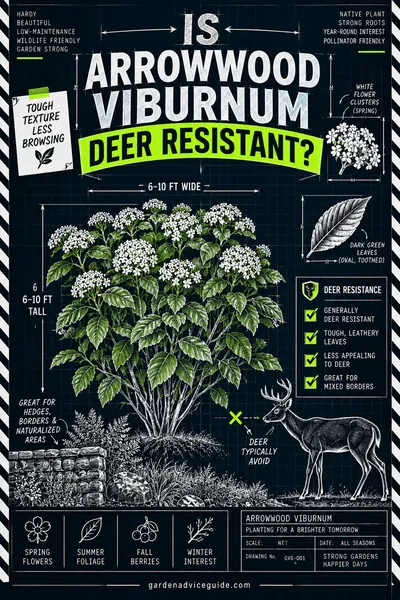
Shrubs that hold up far better under pressure include boxwood, spirea, Russian sage, juniper, bayberry, and viburnums with fuzzy or textured leaves. Even those are not deer-proof in a hard winter, and the more useful lists sort them honestly. Start with deer resistant shrubs and deer resistant evergreens for structure, then check individual plants like arrowwood viburnum and crepe myrtle, which behave very differently from each other despite both being sold as deer resistant.
For a wider view of how deer decide what to eat and how to build a planting they mostly ignore, our overview of deer resistant plants covers the whole approach.
FAQ
Do deer eat dappled willow?
Yes. Deer browse dappled willow, mostly the soft new growth in spring and the accessible stems in late winter when other food is gone. Established plants usually survive and regrow, but young plants in heavy deer areas can be stripped in a single winter, and grafted tree forms are also at risk from antler rubbing in fall.
Is Hakuro Nishiki willow deer resistant?
Hakuro Nishiki is the common variety name for dappled willow, so the answer is the same: only moderately, and less so than the tag suggests. Deer pressure in your specific yard matters more than the variety. The safest assumption is that it will be browsed, and to plan protection for the first three years.
Will a dappled willow grow back after deer eat it?
Usually yes. Dappled willow is normally cut back hard every late winter anyway, so heavy browsing acts like a rough pruning. Clean up the torn ends in late winter, keep it watered, and expect a full flush of new growth in spring. The exception is a grafted standard damaged below the graft, which will not regrow as dappled willow.
What smells keep deer away from willows?
Egg-based repellents, garlic, predator urine, and strongly scented soaps all reduce browsing for a while. Deer habituate to any single scent within a few weeks, so rotate two or three products, reapply every three to four weeks, and reapply after heavy rain. Repellents reduce damage rather than eliminate it.
How tall does a fence need to be to stop deer?
Eight feet for a single fence. Deer clear 5 and 6-foot fences routinely, especially when they are used to a property. A pair of 4-foot fences set about 4 feet apart also works, because deer will not jump a gap they cannot judge the landing on. For one shrub, a cage is far simpler than fencing the whole yard.
Do rabbits eat dappled willow too?
They do, and on a shrub-form plant rabbits often cause more winter damage than deer. Look at the cut ends: rabbits leave a clean 45-degree cut below 2 feet, deer leave a torn, ragged end higher up. A collar of quarter-inch hardware cloth around the base stops rabbits completely.