How to Grow Sweet Potatoes: Start Slips Indoors and Plant After Frost

To grow sweet potatoes, start slips indoors about 8 weeks before your last spring frost, plant them out 2 to 3 weeks after that frost once the soil has warmed to about 65°F, and dig the roots roughly 90 to 120 days later. A slip is simply a leafy sprout that grows from a sweet potato. You snap it off, let it root, and plant it.
The whole crop comes down to warmth. Sweet potatoes are a tropical plant, and cold soil makes slips sit still or rot. Give them a warm start, full sun, loose soil and a long enough season, and one plant can give you several pounds of roots. Northern gardeners can still succeed with a fast variety and warmed soil.
Key facts
- Start slips about 8 weeks before your last spring frost.
- Plant out when soil is 65°F and nights stay above 55°F.
- Space plants about 12 to 18 inches apart.
- Harvest in about 90 to 120 days, before a hard frost.
- Cure roots warm and humid for 5 to 10 days before storing.
The slip timer below does the counting for you. Choose your zone group (zones 3 to 5, 6 to 7, or 8 to 10) and how you will grow them: in the ground, in a raised bed, or in a container or grow bag. It gives you a date to start slips indoors and a date to plant them outside. For the exact frost date behind those numbers, look up your ZIP code with our frost dates finder first.
Garden Advice Guide · free calculator
Sweet Potato Slip Timer: Start Date and Planting Date
Pick your zone group and how you will grow. You get when to start slips indoors and when to plant out.
Need more? Open the free Frost Dates.
 Planting Zones
 Frost Dates
 Planting Calendar
Quick reference: what sweet potatoes need
| Need | Target |
|---|---|
| Soil temperature | 65°F or warmer at 4 inches |
| Night air | Above 55°F |
| Sun | 6 to 8 hours or more |
| Soil | Loose, sandy loam, pH about 5.5 to 6.5 |
| Spacing | 12 to 18 inches, rows 3 feet apart |
| Days to harvest | 90 to 120 |
Counting back from your frost date
Sweet potato timing has two anchor points, and both hang on your average last spring frost. The first is the day you start slips, about 8 weeks before that frost. The second is planting day, about 2 to 3 weeks after it.
Here is a worked example. Say you garden in zone 6 and your last frost is around April 20. Count back 8 weeks and you get about February 23 to set a sweet potato in water. Count forward 2 to 3 weeks from April 20 and you land on roughly May 4 to May 11 for planting out. Add 100 days for a variety like Beauregard and you are digging in mid to late August, well before a typical zone 6 first fall frost in mid October.
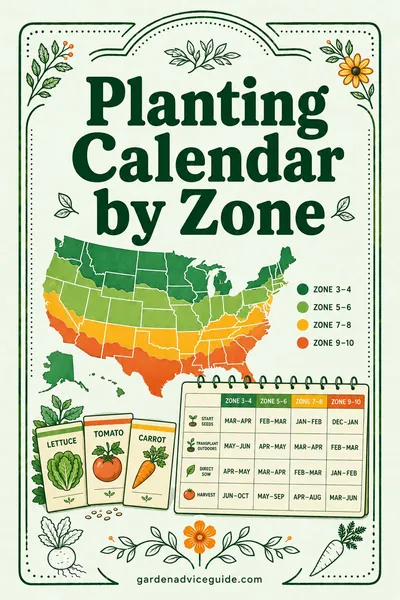
In zone 4, with a last frost near May 20, planting slides into early June and you have about 100 to 110 frost-free days before fall. That is tight, so a fast variety and black plastic make a real difference. In zone 8 or 9, the season is long enough that you can plant in April or even May and still have time to spare. Our when to plant tool shows the safe window for your ZIP code, and the planting calendar lays out what else goes in that same week.
Starting slips at home, step by step
Begin with a firm, unblemished sweet potato. Many grocery-store roots are treated to stop sprouting, so an organic root from a farm stand, or one you grew last year, sprouts far more reliably. If you would rather skip this step, certified slip growers sell rooted slips by mail in spring, and those are free of the viruses that can build up over years of home saving.
- Set the root half in water in a jar, held up with toothpicks, or lay it on its side half buried in damp potting mix.
- Keep it warm, above 70°F, and bright. The top of a fridge or a seedling heat mat works well.
- Wait 2 to 4 weeks for sprouts, longer in a cool house.
- Twist off slips when they reach 4 to 6 inches and stand them in a glass of water.
- Plant once they have a tuft of white roots, usually in about a week.
The soil method tends to give sturdier slips and more of them, since the root is not sitting in water that can turn murky. One medium root can produce 10 to 20 slips over several weeks, and you can keep harvesting slips as new ones appear. If slips are ready before the soil is, pot them up on a sunny sill. The seed starting calculator is handy for planning this indoor stretch alongside your tomatoes and peppers.
Choosing a variety for your season
Variety matters more in the north than anywhere else. Days to maturity on the label tell you whether a sweet potato can finish before your fall frost, so match that number to your frost-free days.
Georgia Jet is one of the fastest, at about 90 days, which makes it a favorite in zones 4 and 5. Beauregard is the classic orange-fleshed type, reliable and productive, at about 90 to 100 days. Covington is similar, with smooth, even roots. If space is tight, look at bush or compact types such as Vardaman and Porto Rico, which keep their vines closer to the plant and suit containers and small beds. White and purple-fleshed sweet potatoes exist too, and most take a little longer, so they are best in zones 7 and warmer.
Getting the bed ready
Sweet potatoes want loose, well-drained soil that roots can push through easily. Heavy clay gives you small, twisted or stringy roots, while sandy loam gives smooth, well-shaped ones. If your soil is heavy, build raised rows or mounds about 8 to 12 inches tall and about 12 inches wide, and mix in compost. A raised bed is even easier, and our raised bed soil calculator tells you how many bags or cubic yards fill it.
Go easy on fertilizer. Too much nitrogen gives you a jungle of vines and very few roots. A moderate amount of compost worked in before planting is usually enough. A slightly acidic soil, about pH 5.5 to 6.5, suits them well. If you have never tested your soil, our guide on how to test garden soil explains the options.
In short-season areas, lay black plastic over the prepared row a week or two before planting. It can warm the soil several degrees, which helps slips root faster.
Planting day
Check the soil before you plant. Push a thermometer about 4 inches deep in the morning. When it reads 65°F or more for several days and the forecast nights are above 55°F, you are ready. If not, wait. A week of patience costs far less than slips that sulk for a month.
Plant each slip so its roots and the bottom few inches of stem are buried, with only the top leaves showing. Space them 12 to 18 inches apart, with rows about 3 feet apart. Wider spacing gives fewer but larger roots, closer spacing more but smaller ones. Our plant spacing calculator tells you how many slips fit a given bed. Water them in well. Slips often flop for a day or two and then perk up.
Summer care for strong roots
For the first two to three weeks, keep the soil evenly moist while the slips root in. After that, sweet potatoes are fairly drought tolerant. About an inch of water a week is plenty, and in the last three to four weeks before harvest you can ease off, which helps prevent roots from cracking.
Weed carefully early on. Once the vines spread they shade the ground and smother most weeds on their own. Try not to let the vines root along the stem where they touch the soil; lifting them gently now and then keeps the plant putting energy into the main roots. The young leaves and shoot tips are edible too, cooked like spinach, and pinching a few for dinner will not hurt the crop.
Deer and rabbits like the leaves and voles chew roots. For local pest help, ask your cooperative extension office.
Growing them in pots and grow bags
Sweet potatoes do well in containers, which also warm up faster than the ground in spring. Use a pot or grow bag of at least 5 gallons for one plant, and 10 to 15 gallons for two. Fabric grow bags drain well and tip out easily at harvest.
Fill with a loose potting mix, not garden soil, and make sure there are drainage holes. Place the container in full sun. Containers dry out fast in summer, so check them daily and water when the top inch feels dry. A bush variety like Vardaman or Porto Rico keeps things tidy on a patio. For more on choosing pot sizes, see our guide to growing vegetables in pots.
When and how to dig
Most sweet potatoes are ready in 90 to 120 days. The leaves often start to yellow as harvest nears, but you do not have to wait for that. The real deadline is cold: dig before the soil drops below about 55°F for long, and always before a hard frost, since cold soil can damage roots and frost-killed vines can pass rot down into them. Use our when to harvest tool to see a likely date for your planting day.
Dig on a dry day. Cut back the vines first so you can see the crown. Start digging 12 to 18 inches away from the plant, since roots can spread wider than you expect, and lift with a garden fork. The skins are thin and bruise easily at this stage, so handle them like eggs. Let them dry on the soil surface for a few hours, but do not leave them out overnight or in hot sun all day.
Curing and storing the harvest
Fresh-dug sweet potatoes are not at their best yet. Curing heals small wounds, toughens the skin, and lets the root turn some starch into sugar, so they taste sweeter and store far longer. Keep them at about 80 to 85°F and high humidity, around 85 to 90 percent, for 5 to 10 days. A warm room with the roots in a box under a damp towel works at home.
After curing, store them at about 55 to 60°F in a dark, dry place, such as a closet or a basement corner that does not get cold. Do not refrigerate them. Below about 50°F they develop a hard core and off flavors. Well-cured roots can keep for several months.
Common problems and simple fixes
Lots of vines and few roots usually means too much nitrogen or too much shade. Next year, skip the high-nitrogen fertilizer and give them full sun. Long, skinny roots point to heavy soil or a short season, so raise the bed and pick a faster variety. Cracked roots often follow a heavy soaking after a dry spell, which is why steady, moderate watering helps.
Slips that turn yellow and stall right after planting were usually set out into cold soil. Small holes and tunnels in the roots can be wireworms or weevils, which are more common where sweet potatoes follow grass or are grown in the same spot every year. Rotate the bed each season, and see our crop rotation planner for an easy four-bed plan. Sweet potatoes belong to the morning glory family, not the potato family. For more root crops, see how to grow potatoes. If you keep pets that like to chew leaves, check the ASPCA toxic plant list for current guidance before planting near where they play.
Quick answers about sweet potatoes
When do you plant sweet potatoes?
Plant slips outside about 2 to 3 weeks after your last spring frost, when the soil is at least 65°F at 4 inches and nights stay above about 55°F. In zone 6 that is often early to mid May. In zone 9 it can be April. Start the slips indoors about 8 weeks before that frost.
What is a sweet potato slip?
A slip is a leafy sprout that grows out of a sweet potato root. You twist it off when it is 4 to 6 inches long, root it in water or damp mix, and plant it. Each slip grows into a full plant with several roots under it.
Can I grow slips from a grocery store sweet potato?
Sometimes. Many store roots are treated to slow sprouting, so they may take a long time or never sprout. An organic root, one from a farm stand, or one you grew yourself is far more likely to sprout. Mail-order slips from a certified grower are the most reliable option.
How big a container do sweet potatoes need?
At least 5 gallons for one plant, and 10 to 15 gallons for two. Deeper is better, since roots need room to swell. Use loose potting mix, make sure there are drainage holes, set the pot in full sun and water whenever the top inch dries out.
How long do sweet potatoes take to grow?
Most varieties take 90 to 120 days from planting slips outside. Fast types like Georgia Jet finish in about 90 days, which suits short northern seasons. Whatever the variety, dig before a hard frost and before the soil turns cold for long.
Can you grow sweet potatoes in zone 4 or 5?
Yes, with a little help. Choose a fast variety of around 90 days, warm the soil with black plastic for a week or two before planting, and plant as soon as the soil hits 65°F. Raised beds and containers also warm faster in spring and give roots a head start.
Why do sweet potatoes need curing?
Curing at about 80 to 85°F with high humidity for 5 to 10 days heals the skin and turns some starch into sugar. Cured roots taste sweeter and keep for months. Uncured roots are less sweet and tend to shrivel or rot in storage.
Should I store sweet potatoes in the fridge?
No. Temperatures below about 50°F damage them, causing a hard center and off flavors. Keep cured roots at about 55 to 60°F somewhere dark and dry, and check them every few weeks, using any with soft spots first.