Is Winterberry (Ilex Verticillata) Deer Resistant?

Winterberry is moderately deer resistant. Deer seldom damage it badly, and it holds up far better than viburnum, hydrangea, or arborvitae in the same yard, but it is not a plant deer refuse. They browse the soft new shoots in spring, strip twigs in late winter when nothing else is left, and eat berries within reach once the birds get them started.
The bigger threat is not eating at all. Bucks rub their antlers on winterberry's flexible young stems every fall, and a rubbed stem dies above the damage. Rub kills more young winterberries than browsing ever does.
Winterberry is hardy from zone 3 to zone 9, one of the widest ranges of any native shrub. Confirm yours with our free planting zone tool before you shop for cultivars, because the northern and southern selections behave differently.
Updated September 2026
How ilex verticillata deer resistant ratings actually play out
Rutgers keeps the browsing list most nurseries quote, graded on four steps from "rarely damaged" through "frequently severely damaged." Ilex verticillata sits in the second tier, "seldom severely damaged." Here's where it lands against the shrubs people usually compare it to.
| Shrub | Deer pressure result | Why |
|---|---|---|
| Boxwood | Rarely damaged | Toxic alkaloids, bitter, strong scent |
| Japanese pieris | Rarely damaged | Toxic to deer, evergreen |
| Bayberry | Rarely damaged | Waxy aromatic leaves |
| Inkberry holly (I. glabra) | Seldom damaged | Evergreen leathery leaves |
| Winterberry (I. verticillata) | Seldom damaged | Bitter foliage, tough stems, no spines |
| American holly (I. opaca) | Seldom damaged | Spined evergreen leaves |
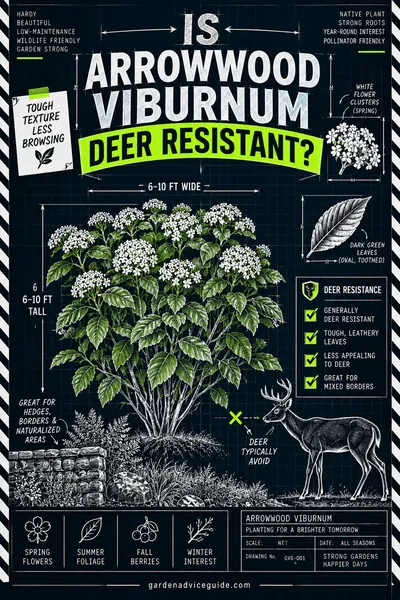
| Arrowwood viburnum | Frequently damaged | Soft smooth palatable new growth |
| Hydrangea | Frequently severely damaged | Large soft leaves, high water content |
| Arborvitae | Frequently severely damaged | Preferred winter browse |
| Yew | Frequently severely damaged | Deer eat it despite the toxicity |
The gap between winterberry and arrowwood viburnum is the useful comparison, because gardeners often pick between them for the same wet, native, bird-friendly spot. Both are natives with heavy fruit. One gets chewed to sticks and the other mostly doesn't. If you're weighing that trade, our full write-up on arrowwood viburnum and deer has the detail.
Worth being clear about the limits of the rating. "Seldom severely damaged" means winterberry is far down the menu and usually survives, not that it goes untouched. There's no shrub a starving deer won't test.
Why deer mostly leave winterberry alone
Winterberry has no thorns, no spines, and no strong scent, so its defenses are chemical and structural rather than obvious.
Bitter foliage. Holly leaves carry saponins and theobromine-family compounds that taste bad and upset a deer's stomach in quantity. It's the same chemistry that makes holly berries a problem for dogs.
Tough, wiry stems. Winterberry twigs are dense and springy rather than soft and juicy. Compare that to an arborvitae frond, which is soft, resinous, and easy to strip, and it's clear which one gets eaten in February.
Low water and protein content. Deer choose by calories per bite. Winterberry leaves are small, thin, and dry compared to a hosta or hydrangea leaf, so the return per mouthful is poor.
Timing. Winterberry is deciduous, which is a hidden advantage. It drops every leaf by late fall, so during the hungry months there's no foliage to eat, only twigs. Evergreen shrubs stay on the menu all winter, and that's exactly why arborvitae and yew get destroyed.
What deer actually do to a winterberry
Three separate kinds of damage, each with its own season and its own fix.
Spring browsing
Late April through June, deer take the soft new shoots. Damage looks ragged and torn, never clean cut, because deer have no upper front teeth and they grip and pull. A rabbit leaves a clean 45-degree cut like a pruner. Shredded stem ends mean deer.
On a mature shrub this is cosmetic. On a two-foot nursery plant it can remove the entire year's growth.
Winter twig browsing
January through March, when the woods are empty, deer will eat winterberry twigs. This one costs you berries, because the flower buds sit on new wood that forms in spring, and a shrub that spends March getting pruned puts its energy into recovery rather than flowering.
Antler rub, the one that kills
September through November, bucks scrape velvet off their antlers on flexible young stems. They look for a stem roughly 1 to 2 inches thick with no low branches, and winterberry's multi-stem habit provides a perfect stand of them.
A rubbed stem loses its bark all the way around. Everything above that point dies, usually the following spring rather than immediately, so people blame winter kill for what was actually a buck in October. If you find a young winterberry with bark stripped in vertical scrapes from about 1 to 3 feet up, that's the cause.
Male and female: the thing that ruins more winterberries than deer
Winterberry is dioecious, meaning individual plants are either male or female. Only females make berries, and they only do it if a compatible male is flowering nearby. Buy the wrong combination and you get a healthy green shrub with no berries at all, forever.
Two rules.
One male covers about five females, planted within roughly 50 feet. Wind and bees carry the pollen, and 50 feet is a comfortable working distance.
Bloom times have to overlap. Early-blooming cultivars need early-blooming males, and late ones need late males. This is where people go wrong, since a male that flowers two weeks after the female is useless.
| Female cultivar | Bloom timing | Mature size | Matching male |
|---|---|---|---|
| 'Red Sprite' (dwarf) | Early | 3-4 ft | 'Jim Dandy' |
| 'Afterglow' (orange-red fruit) | Early | 5-6 ft | 'Jim Dandy' |
| 'Winter Gold' | Early to mid | 6-8 ft | 'Jim Dandy' |
| 'Winter Red' | Late | 6-9 ft | 'Southern Gentleman' |
| 'Sparkleberry' (hybrid) | Late | 8-12 ft | 'Apollo' |
| 'Berry Heavy' | Late | 6-8 ft | 'Mr. Poppins' or 'Southern Gentleman' |
| 'Berry Poppins' (dwarf) | Late | 3-4 ft | 'Mr. Poppins' |
Practical shortcut: 'Jim Dandy' pollinates the early group, 'Southern Gentleman' pollinates the late group. If you plant one of each male you're covered regardless of which females you end up with.
Worked example: a 24-foot winterberry screen in zone 5
Here's a real plan with the numbers, for a wet low corner along a back fence where deer cross nightly.
Cultivar and spacing. 'Winter Red' matures at 6 to 9 feet tall and 6 to 8 feet wide. For a screen, space at about 70 percent of mature width, so 5 feet on center for a solid mass or 6 feet for a looser one. At 5 feet on center:
24 ft / 5 ft = 4.8, so 5 plants across the run, with the end plants set 2 feet in from the corners.
Sex ratio. Four 'Winter Red' females plus one 'Southern Gentleman' male, with the male placed second from one end so it's within 50 feet of every female. Both are late bloomers, so the timing matches. Put the male at the back of the group since it never fruits and is the least interesting plant in the row.
Different bed shapes and staggered double rows change the count, and the plant spacing calculator handles the arithmetic if your run isn't a straight line.
Protection, in materials. Each young plant gets a welded wire cylinder, 4 feet tall, 2 by 4 inch mesh, about 42 inches across so there's room to grow. Circumference is 3.14 x 3.5 ft = 11 feet of wire per plant. Five plants means 55 feet, so a 100-foot roll covers it easily. Two T-posts per cage means 10 posts.
The five-year calendar.
| Year | Height | Protection | Notes |
|---|---|---|---|
| 1 (spring plant) | 2-3 ft | Cage on, planting day | 1 inch of water per week, no fertilizer |
| 2 | 3-4 ft | Cage stays | First few berries on females |
| 3 | 4-6 ft | Cage stays | Real berry display begins |
| 4 | 6-7 ft | Cages off in spring, trunk guards each fall | Browse line forms naturally near 4 ft |
| 5+ | 7-9 ft | Nothing, or fall guards in bad years | Shrub outgrows the pressure |
What happens with no cages, for comparison. Same five plants, repellent sprayed every four weeks in the growing season only. Expect to lose one or two stems per plant to antler rub in the first two autumns, a thin berry display until year five because March browsing removes the wood that would have flowered, and full height around year seven instead of year four. Cages buy roughly three years.
Protecting a winterberry from deer
Browsing and rub are two different problems on two different calendars, and the methods don't overlap much.
| Method | Works against | When | Effort |
|---|---|---|---|
| Welded wire cylinder | Browsing and rub | Year-round, years 1 to 4 | Set once |
| Rigid trunk guards per stem | Rub only | Sept to Dec | Yearly |
| Plastic mesh wrap | Browsing | Nov to Apr | Yearly |
| Rotating repellent spray | Browsing | Every 3 to 4 weeks in season | Ongoing |
| Monofilament at 3 ft and 5 ft | Browsing, moderate pressure | Season | Low |
| 8 ft perimeter fence | Everything | Permanent | High up front |
The cylinder is the one that genuinely works, and it's not close. Leave it on until the shrub clears 5 feet with main stems thicker than about 2 inches, usually three to four years. It looks industrial for those years and it's the difference between a shrub and a stub.
Repellents work only on the terms deer set. Rotate two products with different active ingredients, since deer habituate to any single one within a season. Egg-based products work by smell and last longest. Capsaicin and garlic products work by taste. Reapply every 3 to 4 weeks in the growing season and after any rain over half an inch. Start before damage shows up, because repellents prevent a browsing habit and rarely break one.
None of that stops antler rub. Only a physical barrier does.
Growing conditions winterberry actually wants
Get four things right and winterberry is close to unkillable, and our full winterberry plant care guide works through each one in order.
Soil pH is the make-or-break factor. Winterberry needs acidic soil, roughly pH 4.5 to 6.5. Above about 6.5 it develops iron chlorosis: leaves go yellow with green veins, growth stalls, and berry set collapses. This is the single most common winterberry failure and it has nothing to do with deer. Test before you plant, and how to test garden soil covers the method. Elemental sulfur lowers pH slowly over a season or two, so plan ahead rather than trying to fix it in one spring.
Wet soil is a feature. Winterberry grows naturally in swamps and pond edges and tolerates standing water for weeks. That makes it one of the few good shrubs for a spot that stays soggy. It also handles ordinary garden soil fine, as long as the pH is right and it doesn't bake dry.
Sun drives berry count. Full sun gives the heaviest fruit. Part shade works but the display thins noticeably. In deep shade you'll get a green shrub and almost no berries.
Water for the first two seasons. One inch a week. After that it's self-sufficient in most of its range, though a dry August will cost you berry size.
Pruning is light. Winterberry flowers on new wood, so late-winter pruning is safe. Renewal prune by cutting a third of the oldest stems to the ground each year once the shrub is mature. It suckers, so it forms a colony over time, and pulling suckers is how you keep it in bounds.
Mulch 2 to 3 inches deep, pulled back 3 inches from the stems, kept flat rather than mounded against the trunk. Bed depths are in the mulch guide.
Why plant it despite the deer
Winterberry earns its spot for reasons the browsing ratings can't cancel.
- The berries hold from October into February, bright red on bare gray stems against snow. Nothing else in a northern garden does that.
- It feeds more than 45 bird species, including robins, bluebirds, cedar waxwings, and thrushes, and the fruit stays available deep into winter when almost nothing else is.
- It handles wet ground, clay, and pH as low as 4.5, which rules out most alternatives.
- It's a true native across eastern North America and supports native pollinators when it flowers in late spring.
- Cut branches last for weeks indoors, which is why florists buy winterberry stems every December.
The berries are mildly toxic to people and pets in quantity, causing stomach upset. Birds handle them fine after a few freeze-thaw cycles soften the fruit.
When to plant something else instead
Swap it out if two or more of these are true: deer cross daily and you've already lost stems to rub, you won't maintain cages for three or four years, your soil sits above pH 7 and you can't correct it, or the site bakes dry in summer.
| What you wanted | Better swap | Zones |
|---|---|---|
| Evergreen screen, deer resistant | Inkberry holly (I. glabra) | 4-9 |
| Red winter berries, alkaline soil | Red chokeberry (Aronia arbutifolia) | 4-9 |
| Native, wet soil, bird fruit | Buttonbush (Cephalanthus occidentalis) | 4-9 |
| Truly deer proof shrub | Boxwood or Japanese pieris | 5-8 |
| Winter interest, dry soil | Bayberry (Myrica pensylvanica) | 3-7 |
For a whole planting rather than one shrub, work from a resistant framework outward. Our lists of deer resistant shrubs and deer resistant evergreens cover the reliable options by zone, and plants deer love is worth a scan before you install anything new near a deer trail. Red twig dogwood is the shrub most often planted with winterberry for winter color and it is browsed far more, which our page on whether red twig dogwood is deer resistant covers in full.
FAQ
Do deer eat winterberry berries?
Sometimes, though it's not their first choice. Deer will take berries within reach of the ground once winter food gets scarce, usually from January onward. Birds strip most of the crop before then anyway. Berries above about 5 feet are safe from deer entirely, which is another argument for letting the shrub get tall.
Is 'Red Sprite' winterberry deer resistant?
It has the same chemistry as any other Ilex verticillata, so the resistance rating is identical. In practice 'Red Sprite' is more vulnerable because it's a dwarf that tops out at 3 to 4 feet, meaning the entire plant stays inside the browse line permanently. A full-size cultivar eventually grows out of reach. A dwarf never does.
Will winterberry grow back after deer eat it?
Yes, as long as the bark is intact around the stems. Winterberry suckers strongly from the base and pushes new shoots within weeks in the growing season. What it won't do quickly is fruit, since a browsed shrub spends its energy rebuilding. Antler rub is the exception: a stem girdled all the way around will not recover and should be cut to the ground.
How tall does winterberry need to be before deer stop mattering?
Above roughly 5 feet, with several stems thicker than 2 inches. At that point the growing tips are out of reach and the stems are too rigid for antler rub. Protected plants get there in three to four years. Unprotected ones in a high-pressure yard often never do.
Why does my winterberry have no berries?
Four usual causes, in order of likelihood: no male pollinator within 50 feet, a male whose bloom time doesn't overlap the female, the plant is itself a male, or soil pH is too high and the shrub is chlorotic. Deer browsing in late winter is a fifth possibility, since it removes the wood that would have flowered. Check the tag and check the pH before blaming anything else.
Does deer repellent work on winterberry?
Reasonably well for browsing, if you rotate two different active ingredients every 3 to 4 weeks and reapply after heavy rain. It does nothing for antler rub, which is a physical behavior rather than a feeding decision, so pair repellent with rigid trunk guards from September through December.
When should I plant winterberry?
Early fall is ideal in zones 5 through 9, giving roots six to eight weeks of warm soil before the ground cools. Spring works everywhere and is the better choice in zones 3 and 4, where a fall planting may not root in before hard frost. Either way, cage it the same day you plant it rather than waiting to see whether the deer find it.
Are winterberry berries safe around kids and dogs?
They're mildly toxic to people, dogs, and cats, and eating a quantity causes vomiting and diarrhea. A berry or two is unlikely to do real harm, but this is worth knowing before you plant one beside a play area. Birds are unaffected and the fruit is a major winter food source for them.