What Do Pumpkins Look Like When They First Start Growing?

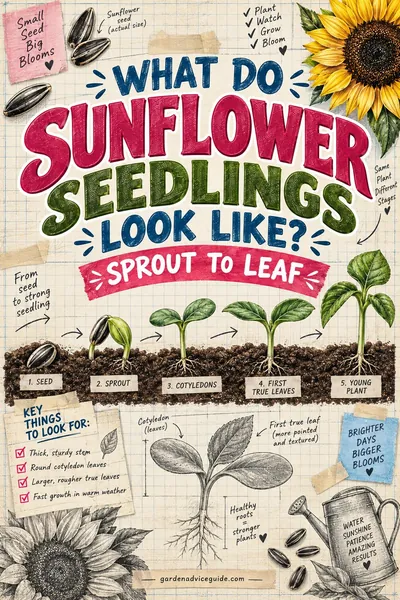
A pumpkin sprout pushes up as a bent white stem that straightens and opens two thick, smooth, oval seed leaves about 1.5 to 2 inches long, often still wearing the cracked seed coat like a hat. They look nothing like the finished plant. The scratchy, lobed, sometimes silver-splashed leaves everyone recognizes only show up a week later, as the first true leaf. And if what you are really asking is what do pumpkins look like when they first start growing as fruit, the answer is a marble-sized green ball sitting behind an unopened female flower, weeks before any vine has a real pumpkin on it.
Working out whether yours are on schedule? Our free seed starting calculator gives your sowing and transplant dates by zone, and germination counts forward from there.
Updated September 2026
Here is the problem this page solves. A pumpkin hill in its second week is a patch of dirt with a few unidentified green things in it, and you cannot check without digging up seeds you just planted. Knowing exactly what each stage looks like, when it should appear, and which plants in the bed are impostors keeps you from either panicking early or hoeing out your own crop.
The First Two Weeks, Stage by Stage
Pumpkins germinate fast in warm soil. Everything below assumes soil at 70 to 85°F at 2 inches deep, which is the range they actually want.
| Stage | What you see | Timing after sowing |
|---|---|---|
| Cracking | A raised crack or small dome in the soil, sometimes a pale loop of stem showing | Day 3 to 5 |
| Emergence | A bent white or pale green stem arching out of the soil, seed coat still attached at the tip | Day 5 to 7 |
| Seed leaves open | Two thick, smooth, oval leaves 1.5 to 2 in long, glossy and slightly rubbery, held flat | Day 6 to 10 |
| First true leaf | A single small leaf between the two seed leaves, rough and fuzzy, edges starting to lobe | Day 10 to 16 |
| Second and third leaves | Leaves 3 to 5 in across, clearly lobed and toothed, on hollow prickly stalks | Day 16 to 25 |
| Bush stage | A stiff upright clump 8 to 12 in tall and wide, no vine yet | Day 25 to 35 |
| Vining begins | A runner shoots sideways from the center of the clump | Day 30 to 45 |
The seed leaves are the surprise. They are far bigger and thicker than most vegetable cotyledons, smooth on both sides with no hairs, and shaped like a rounded oval or a wide teardrop. They stay on the plant for another three or four weeks and then yellow and drop, which is completely normal and not a disease.
The seed coat hat. A seedling that comes up still wearing the shell is a normal sight. It nearly always falls off on its own within a day or two. If it is still stuck after two days and the leaves cannot open, wet it with a drop of water, wait ten minutes, and ease it off with your fingernail. Pulling it dry tears the leaves.
The first true leaf changes everything. It arrives rough, hairy, and slightly scratchy, with three to five shallow lobes and a toothed edge. Rub it and it feels like fine sandpaper. That texture is the fastest way to confirm you have a pumpkin and not a weed.
What Do Pumpkins Look Like When They First Start Growing, Week by Week
Past the seedling stage, the plant changes shape completely three separate times. Here is the full sequence for a standard carving variety with a 100 to 110 day maturity.
| Week from sowing | What the plant looks like |
|---|---|
| 1 | Bare soil, then a bent stem and two oval seed leaves |
| 2 | First rough true leaf, plant about 3 in tall |
| 3 to 4 | Three to five lobed leaves, upright clump about 8 in across, prickly hollow stems |
| 5 to 6 | The clump throws its first runner sideways. Tendrils appear at leaf joints |
| 7 to 8 | Vines running 3 to 6 ft, leaves up to 12 in across, roots forming where nodes touch soil |
| 8 to 9 | First male flowers open on long thin stalks. No fruit yet, and this is normal |
| 9 to 11 | Female flowers appear, each with a tiny green pumpkin already behind it |
| 10 to 13 | Pollinated fruit swells from marble to softball to full size in about three weeks |
| 13 to 16 | Rind color turning, vine leaves thinning and mildewing, stem starting to cork |
Leaf size is not a problem. Mature pumpkin leaves regularly run 10 to 14 inches across on stalks as thick as your thumb. They wilt dramatically at midday in full sun and recover by evening. That afternoon flop is a heat response, not thirst, unless the plant is still wilted at sunrise.
The silver mottling scares everybody. Many varieties carry natural silver-white or pale gray patches along the leaf veins, especially on newer leaves. It is a genetic marking, not powdery mildew. The difference: mottling sits inside the vein pattern and cannot be rubbed off, while powdery mildew is a dusty white film on the leaf surface that smudges under a thumb and spreads outward in circles.
The prickles are normal too. Pumpkin stems and leaf stalks are covered in short stiff hairs that will scratch bare arms. Long sleeves for harvest day.
How Long Pumpkin Seeds Take, and What Slows Them
Soil temperature is the whole story. Pumpkin seed does not sit patiently in cold ground the way a pea does, it rots.
| Soil temp at 2 in | What happens |
|---|---|
| Below 60°F | Seed rots. Do not sow |
| 60 to 65°F | Slow and patchy, 2 to 3 weeks, heavy losses |
| 70 to 85°F | 5 to 10 days, near full germination |
| 85 to 95°F | Fastest, 4 to 6 days |
Three other things move the number:
Sowing depth. One inch is standard. Seed at 2 inches or deeper takes several extra days and may exhaust itself before reaching light. Seed pressed in too shallow dries out.
Moisture. Pumpkin seed needs steady moisture for the first week and then hates sitting wet. Water the hill once at sowing, then keep the top inch just damp until the sprouts show.
Seed age. Pumpkin seed stays viable four to six years stored cool and dry, but germination percentage slips each year. Sowing four or five seeds per hill and thinning to the best two or three covers you for that, and it is the standard method anyway. Our when to plant pumpkins guide has the sow-by dates and the hill layout.
Pumpkin Seedling or Something Else?
The vine crops all look alike at the seedling stage because they are close relatives. Here is how to sort them out, plus the weeds that get mistaken for them.
| Plant | How to tell it apart |
|---|---|
| Pumpkin | Thick oval seed leaves 1.5 to 2 in long. True leaves rough, hairy, broad, shallowly lobed, often silver mottled |
| Zucchini and summer squash | Nearly identical as seedlings. True leaves are more deeply cut and more upright, and the plant stays a bush instead of running |
| Cucumber | Noticeably smaller seed leaves, under an inch. True leaves are thinner, triangular, and much less hairy |
| Watermelon | Seed leaves narrower and more rectangular. True leaves are deeply cut, almost feathery, with rounded lobes |
| Cantaloupe | Small rounded seed leaves. True leaves nearly circular with shallow scallops, softly hairy |
| Volunteer from the compost | Genuinely a squash of some kind, usually a cross, growing where you did not plant it. Pull it or accept a surprise |
| Velvetleaf weed | Big soft heart-shaped leaves, but velvety rather than scratchy, and it grows straight up on a single stem with no runner |
| Bindweed and morning glory | Arrow or heart-shaped smooth leaves on a thin twining stem that starts reaching for something to climb almost immediately |
The single fastest test between pumpkin and zucchini at two weeks is honestly patience. They are close enough that even experienced gardeners cannot reliably call it until the plant either stays a tight bush (summer squash) or throws a runner (pumpkin and winter squash). Label your hills at sowing and save yourself the argument.
Between a squash family seedling and a weed, use the seed leaves: those two thick oval cotyledons are unmistakable, and no common garden weed produces anything that heavy.
Baby Pumpkins: What the Fruit Looks Like Starting Out
This is the other half of the question, and the more interesting half.
A pumpkin does not start as a flower that later becomes a fruit. The fruit is already there. A female pumpkin flower sits on a swollen green ball at its base, right where the flower joins the vine, and that ball is a miniature pumpkin, complete with ribs, about the size of a marble or a grape when the flower first opens.
Male flowers come first, and they have nothing behind them. For one to two weeks the vine produces only males, on long thin straight stalks, sometimes dozens of them. Nothing is wrong. The plant is advertising to pollinators before it commits to fruit.
Female flowers arrive next, usually on side shoots. Look at the base of the flower. Male flowers join their stem in a smooth taper. Female flowers sit on top of a distinct green swelling.
Here is what happens over the next few days:
| Day after the flower opens | Pollinated fruit | Unpollinated fruit |
|---|---|---|
| 0 | Marble-sized ribbed green ball, flower open one morning only | Same |
| 1 to 2 | Flower closes and shrivels. Ball still firm and green | Flower shrivels. Ball begins to soften |
| 3 to 5 | Ball has visibly grown, now golf ball to egg sized, shiny | Tip yellows, ball goes soft and wrinkled |
| 5 to 8 | Growing fast, dull green, ribs deepening | Drops off the vine, or rots at the tip |
| 10 to 14 | Softball to cantaloupe sized, dark matte green | Gone |
| 18 to 25 | Near full size, rind still green and easily scratched | Gone |
| 30 to 45 | Full size, color turning, rind hardening | Gone |
Losing the first few baby fruits is completely normal. A young vine aborts fruit it cannot support, and early female flowers frequently open before enough males are around to pollinate them. Aborted fruit yellowing and dropping in the first two weeks of flowering is not a disease.
A pumpkin flower opens for one morning only. If bees are scarce, hand pollinate at dawn: pick a male flower, strip the petals, and dust the pollen directly onto the center of an open female. One male can serve two or three females.
Ribbing shows from the very beginning. Even a marble-sized fruit already has the vertical grooves that will define the finished pumpkin. If you want a specific shape for carving, you can spot it early.
Once the fruit is sizing, tuck a piece of cardboard, a shingle, or a layer of straw under each pumpkin to keep it off wet soil, and stop turning it after the color starts changing. Our when to harvest pumpkins page covers the rind, stem, and thumbnail tests for ripeness.
Worked Example: One Hill in Zone 6, Sown June 5
Three seeds of a standard 105 day carving variety, sown 1 inch deep in a hill, soil measured at 74°F.
| Date | Days after sowing | What you see |
|---|---|---|
| June 5 | 0 | Bare hill, watered in |
| June 11 | 6 | Two bent white stems arching out of the soil, one still wearing its seed coat |
| June 13 | 8 | Both seedlings open, thick oval seed leaves about 2 in long. Third seed never came up |
| June 18 | 13 | First true leaf on both, rough and hairy, about 1.5 in across |
| June 26 | 21 | Four leaves each, 5 in across, upright clumps. Thin to the stronger plant, cut at soil level |
| July 6 | 31 | Stiff bush about 12 in tall and wide, leaves 8 in across with silver mottling on the veins |
| July 14 | 39 | First runner heads for the lawn. Tendrils at every node |
| July 25 | 50 | Vine 7 ft long, first male flowers open on long stalks |
| Aug 4 | 60 | First female flower with a marble-sized fruit behind it. Bees working by 7 am |
| Aug 6 | 62 | The flower shriveled, the little fruit is firm and clearly bigger. It took |
| Aug 9 | 65 | A second female aborts and drops. Normal on a vine already carrying fruit |
| Aug 18 | 74 | Fruit at cantaloupe size, dark matte green, ribs deep. Cardboard slipped underneath |
| Sept 1 | 88 | Full size, color shifting from green toward orange at the base |
| Sept 20 | 107 | Rind fully orange, stem dry and corky, thumbnail leaves no dent. Cut with 4 in of stem |
What that hill tells you. Six days to emergence at 74°F soil sits right in the middle of the predicted 5 to 10 days. Sixty days from sowing to the first female flower is normal for a standard variety, and it is why counting backward from Halloween matters more than counting forward from the last frost. And one plant carrying one good carving pumpkin from a hill is a perfectly respectable result. Two to four fruit per standard vine is the realistic range.
Give that vine room from the start. A standard carving plant wants 6 to 8 feet between hills and covers 60 to 100 square feet. Our plant spacing calculator will lay out a bed for the variety you are actually growing.
What Can Go Wrong in the First Month
Most of what a new pumpkin patch does is normal. These are the exceptions worth acting on.
- A seedling that emerges, then topples with a clean cut at the soil line. Cutworm. Dig an inch down within a few inches of the stem and you will usually find it curled up. A cardboard collar around each stem prevents it.
- Seedlings that flop over with a pinched, water-soaked spot at the base. Damping off, a soil fungus that thrives in cool, wet, crowded conditions. There is no cure for an affected plant, so improve airflow and stop overwatering. Our damping off guide covers prevention.
- Nothing comes up at all after two weeks. Soil was too cold, seed sat in wet ground and rotted, or it was sown too deep. Wait until soil hits 70°F and resow.
- Round holes chewed in the seed leaves and small striped or spotted beetles present. Cucumber beetles, which also spread bacterial wilt. Seedlings are most vulnerable in the first three weeks, so row cover over the hill until flowering is the best defense.
- Leaves wilting from the tip of a runner backward, with sawdust-like material at the stem base. Squash vine borer. Slit the stem lengthwise, remove the grub, and bury that section of vine so it roots again.
- Gray-brown flat insects and copper-colored egg clusters in neat rows on leaf undersides. Squash bugs. Crush the eggs weekly while the plant is small, since a heavy infestation on a young vine is very hard to reverse. Our squash bug guide has the trap board trick.
- Pale, spindly seedlings that stretch and fall over indoors. Not enough light. Pumpkins started inside need bright light within an inch or two of the leaves, and no more than 3 weeks indoors before transplanting, because their roots resent disturbance.
- Baby fruit yellowing and dropping. Usually no pollination, sometimes a young vine shedding load. Hand pollinate at dawn and it generally resolves.
FAQ
How long does it take for pumpkin seeds to sprout?
Five to ten days in soil at 70 to 85°F, and as little as four to six days above 85°F. Below 65°F, germination stretches to two or three weeks and losses climb. Below 60°F, the seed usually rots instead of sprouting, so soil temperature at 2 inches deep is the number to check before you sow anything.
What does a pumpkin seedling look like?
Two thick, smooth, oval seed leaves about 1.5 to 2 inches long on a stout stem, often still holding the cracked seed coat when it first emerges. The first true leaf follows about a week later and is a completely different thing: rough, hairy, broad, shallowly lobed, and toothed at the edges, sometimes with silver-white patches along the veins.
How do I tell a pumpkin seedling from a zucchini seedling?
Honestly, you often cannot at the seedling stage, since they are the same species in many cases. Zucchini true leaves tend to be more deeply cut and held more upright. The reliable difference shows up at four to six weeks: zucchini stays a bush while pumpkins send out a long runner. Label your hills at sowing.
What does a baby pumpkin look like when it starts growing?
A small ribbed green ball sitting at the base of a female flower, about the size of a marble or a grape the morning the flower opens. If it was pollinated, it firms up and grows visibly within three days. If it was not, the tip yellows, it goes soft, and it drops off within a week.
Why does my pumpkin plant have flowers but no pumpkins?
Almost always because the early flowers are all male. Vines produce male flowers for one to two weeks before any females appear, and males never make fruit. Look for a flower with a swelling behind it. If females are opening and still dropping, pollination is failing, so hand pollinate at dawn with a freshly opened male.
Are the white patches on my pumpkin leaves powdery mildew?
Not necessarily. Many varieties carry natural silver-white markings that follow the leaf veins and cannot be rubbed off. Powdery mildew is a dusty film sitting on the surface that smudges under your thumb, starts as round spots, and spreads to cover whole leaves. Mildew usually arrives late in the season, while the mottling is there from the first true leaves.
Why did my pumpkin seedling's first two leaves turn yellow and fall off?
That is the plant retiring its seed leaves, which is normal once three or four true leaves are working. It typically happens three to five weeks after emergence. Worry only if the true leaves are also yellowing, which points to overwatering, poor drainage, or a nitrogen shortage in a hungry crop.
How many pumpkins will one plant grow?
Two to four fruit on a standard carving variety, more on miniatures, and just one on a giant if you are growing for size and pruning everything else off. A young vine commonly aborts its first one or two female flowers before it settles into carrying fruit, so early drops are not a count against the season.