When to Fertilize After Overseeding

Feed a newly overseeded lawn twice, and the first feeding goes down the same day the seed does. Spread a starter fertilizer right after seeding, then follow with a nitrogen feeding 4 to 6 weeks later, once the new grass has been mowed once or twice. Cool-season lawns get one more light feeding in late fall, after top growth stops but while soil is still above 40°F.
So the honest answer to when to fertilize after overseeding is three dates, not one: day zero, week five, and late fall. Everything below is how to hit those three dates with the right product and the right rate.
Your dates depend on your seeding date, which depends on your frost date. Work them out in a minute with our free lawn care schedule, then come back and match the feedings to it.
Updated September 2026
When to fertilize after overseeding: the three-feed schedule
New grass has almost no root system. For its first two weeks it lives on what the seed packed inside itself, and after that it can only reach nutrients sitting in the top inch of soil. That single fact drives the whole schedule: small amounts, close to the surface, spaced out.
| Feeding | When | What to use | Rate per 1,000 sq ft |
|---|---|---|---|
| 1. Starter | Day 0, with the seed | Starter blend, high middle number (12-24-12, 18-24-12, 24-25-4) | 0.5 to 1 lb nitrogen, 1 to 1.5 lb phosphate |
| 2. Grow-in | 4 to 6 weeks after seeding | Balanced or high-nitrogen, at least half slow release | 0.5 to 0.75 lb nitrogen |
| 3. Late fall | After top growth stops, soil still above 40°F | Quick-release nitrogen, low or no phosphorus | 0.75 to 1 lb nitrogen |
Total for the season: roughly 2 to 2.5 lb of nitrogen per 1,000 square feet. That is a normal annual load for a cool-season lawn, just packed into the fall instead of spread across the year.
Three things that schedule assumes:
- You seeded in the right window. If you seeded too late, drop the third feeding and keep the second one light. Grass that is only three weeks old at first frost should not be pushed.
- You are working with cool-season grass. Bermuda and zoysia overseeded with winter ryegrass run on a different plan, covered further down.
- You are watering. Fertilizer without water is just salt sitting on the soil.
Why starter fertilizer goes down at seeding, not after
People wait, thinking a seed cannot use fertilizer before it sprouts. The nutrient the seed actually needs first is phosphorus, and phosphorus barely moves in soil. Broadcast it on the surface a month from now and most of it stays in the top half inch, well above a root that is already two inches down.
Put it down at seeding and it is exactly where the first roots will grow through it.
That is the whole reason starter fertilizers carry a fat middle number. Read a bag as N-P-K: nitrogen, phosphate, potash. A 12-24-12 starter is 12 percent nitrogen, 24 percent phosphate, 12 percent potash by weight. A regular lawn food might read 29-0-4, with no phosphorus at all, because established lawns rarely need it.
Timing details that matter on day zero:
- Spread seed first, then fertilizer, then rake or roll for seed-to-soil contact. Doing it in that order keeps you from raking your fertilizer into a windrow.
- Water it in the same day. A quarter inch of water dissolves the granules and moves nitrogen into the root zone.
- Do not double up. If your seed is coated with a starter charge, that coating is a small supplement, not a replacement for a real application.
Check your state rules before you buy phosphorus. More than a dozen states restrict phosphorus on lawns to protect waterways, and nearly all of them carve out an exception for new seeding or a documented soil test. The exception usually requires that you are establishing new turf, which overseeding is. Your state extension service publishes the current rule; the USDA extension directory will point you to yours.
If phosphorus is off the table where you live, a balanced product at half rate does most of the same work. The nitrogen matters more than people think, and the phosphorus matters less than the marketing suggests on soil that already tests adequate.
The 4 to 6 week feed: the one that builds the lawn
This is the feeding people skip, and it is the one that decides whether you have a lawn next July or a thin stand that dies in the first hot week.
By week four or five your seedlings have used up the starter, have real roots two to three inches deep, and are switching from making blades to making tillers. Tillering is how one grass plant becomes a clump, and clumps are what fill in a lawn. Tillering runs on nitrogen.
The trigger is a mowing, not a date. Feed after the new grass has been cut once or twice, which lines up with 4 to 6 weeks for most grass types. If you seeded Kentucky bluegrass, which germinates slowly, that same trigger might land at week seven. Follow the grass, not the calendar.
| Grass seeded | Typical first mow | Second feeding lands |
|---|---|---|
| Perennial ryegrass | Day 18 to 24 | Week 4 |
| Turf-type tall fescue | Day 21 to 28 | Week 4 to 5 |
| Fine fescue | Day 24 to 32 | Week 5 |
| Kentucky bluegrass | Day 35 to 45 | Week 6 to 7 |
| Ryegrass over dormant bermuda | Day 14 to 20 | Week 4 |
What to use: anything that delivers about half to three quarters of a pound of nitrogen per 1,000 square feet, with at least half of that nitrogen in slow-release form. Look for the words "slowly available" or "coated slow release" on the guaranteed analysis panel. Fast, uncoated urea in one shot on six-week-old seedlings produces a surge of soft blade growth and a jump in disease pressure.
Skip anything with a herbicide in it. That is not negotiable, and the next section explains why.
Weed and feed after overseeding is a lawn killer
Combination weed-and-feed products are the single most common way people undo a good overseeding job, because the bag looks like fertilizer and behaves like an herbicide.
- Pre-emergent combos (prodiamine, dithiopyr, pendimethalin) stop root development in any seed, and they cannot tell your grass seed from crabgrass seed. Applied over new seeding, they simply stop germination.
- Broadleaf combos (2,4-D, dicamba, MCPP) do not distinguish young grass from a weed as reliably as the label implies. Seedlings are thin-cuticled and take up far more of the active ingredient than mature turf.
The safe waiting period, in plain terms:
| Product type | Safe to use on new grass |
|---|---|
| Straight fertilizer, no herbicide | Day 0 and onward |
| Broadleaf weed killer (liquid, spot spray) | After 3 to 4 mowings, usually 6 to 8 weeks |
| Weed and feed with a broadleaf herbicide | After 3 to 4 mowings |
| Crabgrass pre-emergent (standard actives) | Next season, and 8 to 16 weeks before any future seeding |
| Siduron or mesotrione | Labeled safe at seeding, read the label |
The pull to spray is strongest around week three, when the lawn looks thin and every weed in it looks huge. Wait. Most of those weeds are summer annuals that the first frost removes for free, and the ones that stay will still be there in six weeks when you can safely treat them. For the longer version of that timing, see when to fertilize your lawn and the full lawn care schedule.
Worked example: a 6,000 square foot fescue lawn in zone 6
Central Ohio, first frost around October 15, turf-type tall fescue that thinned out in July. Seeding date is August 28. Here is the arithmetic and the calendar.
The bag math. The starter is a 24-25-4. You want 0.7 lb of nitrogen per 1,000 square feet.
- Nitrogen needed: 0.7 lb x 6 = 4.2 lb of actual nitrogen
- The bag is 24 percent nitrogen, so 4.2 / 0.24 = 17.5 lb of product
- Spread 17.5 lb across the whole lawn, which is a hair under 3 lb of product per 1,000 square feet
That same bag delivers 25 percent phosphate, so 17.5 x 0.25 = 4.4 lb of phosphate, which is about 0.73 lb per 1,000. Inside the normal starter range, and well under any lawn rule cap.
The calendar.
| Date | Action |
|---|---|
| Aug 28 (day 0) | Mow to 1.75 in and bag clippings, core aerate, spread 30 lb of tall fescue seed (5 lb per 1,000), then 17.5 lb of 24-25-4. Rake in. Water 3 times a day, 10 minutes each. |
| Sept 4 to 8 | First blades show. Cut back to 2 waterings a day. No fertilizer. |
| Sept 20 to 24 | First mow at 3 inches with a sharp blade. Deep watering every 2 to 3 days now. |
| Sept 28 to Oct 3 (week 5) | Second feeding. A 24-0-6 slow-release at 0.6 lb nitrogen per 1,000 means 0.6 x 6 / 0.24 = 15 lb of product. Water in a quarter inch. |
| Oct 10 to 20 | Second and third mows. Keep leaves off. No more feeding yet. |
| Nov 5 to 20 | Late fall feeding once top growth stops. A 32-0-4 at 0.9 lb nitrogen per 1,000 means 0.9 x 6 / 0.32 = 17 lb of product. |
| Following April | Nothing. Let the lawn green up on stored reserves. |
| Following late May | One light feeding, 0.5 lb nitrogen per 1,000. |
Season total: 0.7 + 0.6 + 0.9 = 2.2 lb of nitrogen per 1,000 square feet, delivered across ten weeks. That is the number to remember. A lawn getting all 2.2 lb in one October application would grow fast, root shallow, and lose half its stand to snow mold.
Fertilizing overseeded warm-season lawns
If you overseeded dormant bermuda or zoysia with perennial ryegrass for winter color, the feeding plan flips, because you are deliberately growing a temporary crop on top of a sleeping permanent one.
- At seeding: starter fertilizer at the same rate as above. The rye still needs phosphorus to root.
- Through winter: 0.5 lb nitrogen per 1,000 every 4 to 6 weeks while the rye is actively green, usually two or three feedings total.
- Stop by late winter: cut nitrogen off about 6 weeks before the bermuda breaks dormancy, generally February in the Gulf South and early March further north. Nitrogen after that point feeds the rye at exactly the moment the bermuda needs the light and space back.
- Never feed dormant bermuda. Nitrogen on brown, sleeping warm-season turf goes to winter weeds and can worsen spring dead spot.
The trade-off is real, and worth saying plainly: a heavily fed winter ryegrass stand delays bermuda green-up by two to four weeks and can thin the permanent lawn. If your bermuda struggled last summer, skip the overseeding entirely and let it rest.
Spring overseeding: the same three feeds, tighter
Spring overseeding of cool-season grass is a compromise, not a plan, but sometimes a dog or a plow leaves you no choice. The feeding schedule compresses:
- Starter at seeding, same rates.
- Second feed at 4 to 6 weeks, but keep it to 0.5 lb nitrogen per 1,000. Spring already gives new grass a growth surge from warming soil, and stacking heavy nitrogen on top produces lush blades over shallow roots right before summer.
- Nothing in June, July, or August. Feeding cool-season grass in summer heat is how you get brown patch. Water instead.
- Resume in September with the normal fall program.
The one product to consider in spring is mesotrione, sold as Tenacity, which is labeled for use at seeding and controls crabgrass that would otherwise swamp new seedlings. It is the only common way to seed and prevent crabgrass in the same week. Read the label rates carefully; it is applied at a fraction of what a granular pre-emergent uses.
How to tell you fed too much or too soon
New grass gives clear signals when the fertilizer is wrong. Learn these three and you can correct within a week.
Dark green stripes or a checkerboard. Spreader overlap. Not harmful, but it tells you the rate in those bands was double, and doubled nitrogen on seedlings can burn. Water heavily for a few days.
Tan or bronzed blade tips within 48 hours. Fertilizer burn. Granules sat on wet blades and pulled water out of the leaf. Irrigate deeply right away. Most seedlings recover; the ones that do not were already weak.
A sudden flush of soft growth, then round tan patches. Brown patch, especially on tall fescue when nights stay above 65°F. High nitrogen plus frequent shallow watering is the exact recipe. Cut nitrogen, water in the morning only, and raise the mowing height.
The opposite problem also shows up. New grass that stalls at two inches, yellows from the older blades inward, and refuses to thicken is usually short on nitrogen, not water. That is your cue that week five arrived and you missed it.
What a fed, unfed, and overfed overseeding looks like at 8 weeks
| At 8 weeks | Fed on schedule | Never fed after seeding | Overfed |
|---|---|---|---|
| Color | Even medium green | Pale, yellowing at the base | Very dark, almost blue-green |
| Height at mowing | 3.5 to 4 in, needs weekly cuts | 2.5 in, slow | 5 in, needs cutting twice a week |
| Tillers per plant | 3 to 5 | 1 to 2 | 2 to 3, soft and weak |
| Root depth | 3 to 4 in | 1.5 to 2 in | 1.5 to 2 in |
| Disease | Clean | Clean but thin | Brown patch or dollar spot |
| Next summer | Holds through heat | Thins by early July | Thins by late June |
That table is the argument for the middle feeding in one picture. Both failure modes end the same way, with a lawn that cannot survive its first summer, but they get there for opposite reasons.
The rest of the timing that surrounds this
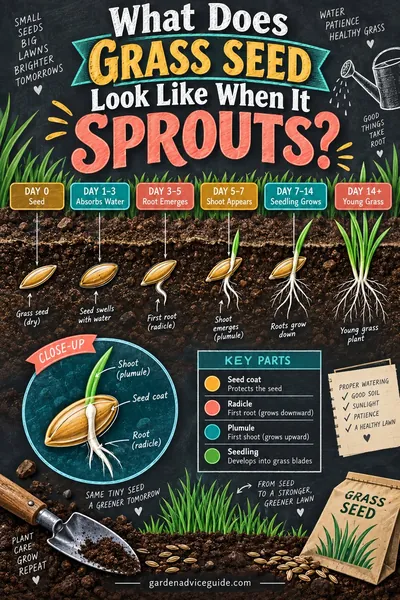
Fertilizer is one of four decisions in an overseeding job, and the other three set it up. Get your seeding date from when to overseed lawn in fall or, if you are working from soil temperature instead of frost dates, from when to plant grass seed. While you wait for germination, what grass seed looks like when it sprouts will tell you whether the specks you are seeing are your grass or a flush of weeds.
FAQ
How long after overseeding should I fertilize?
Put starter fertilizer down the same day you seed, then wait 4 to 6 weeks for the second feeding. Use the first or second mowing as your trigger rather than a strict date, since ryegrass reaches that point in about four weeks and Kentucky bluegrass can take seven.
Can I use regular lawn fertilizer instead of starter fertilizer?
You can, but it is a downgrade. Regular lawn food usually contains no phosphorus, and phosphorus is the nutrient new roots need most and the one that will not move down through soil later. If starter is unavailable or restricted in your state, apply a balanced product at half the normal rate and expect slightly slower establishment.
Is it too late to fertilize if I seeded three weeks ago and skipped the starter?
No. Apply a starter or balanced fertilizer now at the normal rate and water it in. You lose some of the phosphorus benefit because the roots have already grown past the top half inch, but the nitrogen still helps, and week three is well inside the useful window.
Will fertilizer make ungerminated seed sprout faster?
No. Germination runs on moisture and soil temperature, not nutrients. A seed has everything it needs to sprout packed inside it. If nothing is coming up, check that the top inch of soil is staying damp and that soil temperatures are in the 50 to 65°F range for cool-season grass.
Can I put down weed and feed six weeks after overseeding?
Only if the new grass has been mowed three or four times, and only if the product's herbicide is a broadleaf killer rather than a pre-emergent. Pre-emergent combos block root development in your new grass exactly as they do in weeds, so they stay off the lawn until next season.
How much nitrogen does a new lawn need in total?
About 2 to 2.5 lb of actual nitrogen per 1,000 square feet across the establishment season, split into two or three applications of 0.5 to 1 lb each. Divide your target by the decimal form of the first bag number to get pounds of product: 0.75 lb of nitrogen from a 30-0-4 means 0.75 / 0.30, or 2.5 lb of product per 1,000 square feet.
Should I fertilize new grass before or after mowing it?
After, and ideally on a dry lawn that you then water in. Mowing first removes long blades that would catch granules and hold them against wet leaf tissue, which is where fertilizer burn starts. Bag the first two or three cuts on newly seeded turf so clippings do not mat over the seedlings.
Does the late fall feeding really matter?
For cool-season grass it is the highest-value feeding of the year. Once top growth stops but soil stays above 40°F, roots keep working and nitrogen goes into stored carbohydrates instead of blade growth. That storage is what drives early green-up and what carries a first-year lawn through the following summer.