When to Harvest Bulb Onions

Harvest bulb onions when 50 to 80% of the tops have flopped over and started yellowing. That falling-over is the plant's own signal that the bulb is finished sizing up and is shifting into storage mode. For spring-planted onions in the North, that usually happens between late July and September; for fall-planted onions in the South, it's May or June.
Planning next season too? Find your first and last frost dates free so you can back-calculate your planting and harvest windows.
Here's the problem this article solves: pull onions too early and you get small bulbs with thick, wet necks that rot in storage. Leave them too long and the bulbs re-grow, split, or get attacked by soil fungi and sunscald. The window between those two mistakes is about two weeks wide, and the plants tell you exactly when you're in it. You just need to know the signals.
When to Harvest Bulb Onions: The Tops-Falling-Over Rule
An onion top doesn't flop because the plant is sick. It flops because the neck, the spot where leaves meet bulb, goes soft once the plant stops sending energy to new leaves and starts packing everything into the bulb. It's a built-in harvest flag.
The rule: start harvesting when roughly half the tops in the bed have fallen, and finish before you're much past 80%. You don't need to wait for every last plant. Onions in one bed mature days apart, and the early floppers are ready while the stragglers catch up.
A few clarifications people get wrong:
- Don't bend the tops over yourself. Old-school advice says to knock the tops down to "hurry them up." University trials have shown this doesn't speed maturity; it just bruises the necks and opens a door for rot. Let the plants fall on their own schedule.
- Yellowing counts, flopping counts, browning counts. A top that's still green but horizontal is a valid signal. So is a top that's upright but going yellow-brown from the tips down.
- A flower stalk is a different signal. If a plant sends up a thick round stalk with a bud on top, it's bolting. Harvest that one immediately and eat it first; bolted onions have a hard core through the middle and won't store.
When to Harvest Onion Bulbs: Typical Windows by Region
The calendar window depends on two things: when you planted, and where you garden. Here's the quick-reference table.
| Planting Method | Region | Typical Planting Time | Typical Harvest Window |
|---|---|---|---|
| Spring-planted sets or transplants | North (zones 3-6) | March-May | Late July to September |
| Spring-planted seed (direct sown) | North (zones 3-6) | March-April | August to September |
| Spring-planted transplants | Mid-country (zones 6-7) | February-April | July to August |
| Fall-planted transplants | South (zones 7-10) | October-December | May to June |
| Fall-planted sets | South (zones 8-10) | October-November | April to June |
Two patterns worth noticing in that table:
Northern gardeners harvest in late summer. A typical zone 5 gardener who set out transplants in mid-April will see tops starting to flop in early August, with the main harvest around mid-August, roughly 100-120 days after planting.
Southern gardeners harvest in late spring. Onions in Texas, Georgia, or southern California go in the ground in fall, grow through the mild winter, and bulb up as days lengthen. The famous Vidalia harvest in Georgia runs April into June, and backyard timing in the South tracks right along with it.
Direct-seeded onions run 3-5 weeks behind transplants of the same variety, which is why the seed row lands later in the table.
Day-Length Type Changes Everything
Onions don't bulb on a schedule; they bulb on a light meter. Each variety starts forming its bulb when daylight hits a specific number of hours, and that's why the same variety behaves completely differently in Minnesota and Texas.
- Long-day onions (Walla Walla, Ailsa Craig, Patterson, most classic storage onions) need about 14-16 hours of daylight to bulb. That happens in the North in June and July, so long-day types are the northern choice, harvested late summer.
- Short-day onions (Granex/Vidalia types, Texas Legend, Red Creole) bulb at about 10-12 hours. They're planted in fall in the South, bulb in early spring, and come out May-June. Texas A&M AgriLife Extension, which developed several of the standard short-day varieties, recommends them only for southern latitudes.
- Intermediate-day (day-neutral) onions (Candy, Superstar, Cabernet) bulb at 12-14 hours and are the flexible middle: they work across most of the middle of the country, harvesting mid to late summer in the North and early summer further south.
Why this matters for harvest timing: if you planted the wrong type for your latitude, the calendar windows above break. A short-day onion grown in Wisconsin hits its 10-12 hour trigger almost immediately in spring and bulbs while the plant is still tiny, so you get a ping-pong-ball onion "ready" in early July. A long-day onion in Alabama never gets 15-hour days, never bulbs, and just grows green tops all season. If your onions seem weirdly early and small, or endlessly leafy with no bulb, day-length mismatch is the first thing to check, not your harvest timing.
How to Check That Onions Are Actually Ready
The flopped tops are your main cue, but confirm with a look at the bulbs themselves. Ready onions show three things:
- Shoulders at the soil surface. Mature bulbs push themselves up so the top third sits above ground. That's normal and good; don't hill soil back over them.
- Papery skin forming. Brush the soil off one bulb and rub the surface. A ready onion has a dry, papery outer wrapper starting to set, in the variety's true color. An unready one is shiny, tight, and juicy-skinned all the way out.
- Necks softening. Pinch the neck an inch above the bulb. Ready plants feel soft and papery there; plants that need more time feel firm and full, like a green scallion.
If you're unsure, sacrifice one onion from the early-flopping group. Cut it in half top to bottom. Distinct, well-filled rings and a dry outer wrapper mean go. A thick, fleshy neck running deep into the bulb means give the bed another week.
A worked example: say you set out 60 Patterson transplants in zone 5 on April 20. Around August 3 you count 32 flopped tops, so you're at 53%, inside the window. You stop watering that day. On August 12, about 50 tops are down (83%), the forecast shows a dry week, and a test bulb shows papery skin. You harvest all 60 on August 13, which is 115 days from transplanting, right in the middle of Patterson's 104-120 day range. That's the whole system in one season.
Stop Watering 1-2 Weeks Before Harvest
Once you hit that 50% flopped mark, cut the water off completely.
Dry soil in the final stretch does three jobs: it firms the bulbs, it lets the outer scales dry into that protective papery wrapper, and it dramatically lowers the odds of neck rot and other fungal problems in storage. Onions that go into the bin wet-necked are the ones that turn to mush in November.
If rain is doing the watering for you, work around it: harvest at the early end of the window during a dry spell rather than waiting through a soggy week for the last few tops to fall. A slightly early, dry harvest stores better than a perfectly timed wet one.
How to Harvest Without Wrecking Your Storage Crop
The bulb you're lifting is 85-90% water wearing a paper jacket. Treat it like a peach, not a potato.
- Pick a dry morning after a rain-free stretch if you can.
- Loosen with a digging fork or trowel, sliding in a few inches from the row and levering up gently. In loose soil you can sometimes ease bulbs out by hand from underneath.
- Never pull by the tops. Yanking the flopped leaves tears the soft neck, and a torn neck is the number one entry point for storage rot. The top will often just rip off anyway and leave the bulb stuck.
- Lift, don't drop. Bruises don't show at harvest; they show in October as soft brown spots. Set bulbs into a tray or basket instead of tossing them.
- Leave the dirt on. Brush off loose clumps but don't wash the bulbs. Water is exactly what you're trying to remove for the next month.
- Get them out of direct sun within a few hours. A freshly dug bulb can sunscald on a hot afternoon. Move them to shade or straight to the curing spot.
Keep the tops attached for now. They'll feed the last of their energy into the bulb and give you a handle for braiding later if you want it.
Curing: The 2-4 Weeks That Decide How Long They Keep
Curing is just controlled drying, and it's the difference between onions that last three weeks and onions that last six months. The University of Minnesota Extension recommends curing onions in a warm, dry, well-ventilated spot until the necks are completely tight and dry, which typically takes two to four weeks.
The setup:
- Where: anywhere warm (75-85°F is ideal), dry, shaded, and breezy. A covered porch, an open garage with a box fan, a shed with the doors open. Outdoors in full sun works in dry climates for a few days, but shade is safer for the full cure.
- How: one layer deep, not touching, on screens, slatted shelves, or hardware cloth stretched over sawhorses so air moves underneath. Hanging in mesh bags or braided by the tops also works.
- Airflow beats heat. A fan on low in a humid climate does more than ten extra degrees of temperature.
- How long: 2-4 weeks. Humid regions need the long end.
You'll know curing is done when the necks are shriveled, papery, and tight (no give when you pinch, no green core when you trim one), the outer wrappers rustle, and the remaining roots are wiry and dry. Then clip the tops to about an inch, trim the roots, and they're ready for storage. Skip the neck check and you'll pay for it: any onion with a thick, soft neck should go to the kitchen, not the bin.
Store cured onions in mesh bags, open crates, or old pantyhose in a cool, dry, dark place, ideally 32-40°F, though a 50-60°F basement still does a decent job. Never store them in the fridge crisper long-term (too humid) or next to potatoes (each spoils the other faster).
Which Onions Store Longest: Pungent Beats Sweet
Not every onion is worth curing for the long haul, and the rule is simple: the ones that make you cry keep the longest.
Pungent, high-sulfur storage varieties (Patterson, Copra, Stuttgarter, Red Wing, most yellow storage onions) have thick dry skins, lower water content, and sulfur compounds that actively suppress rot organisms. Properly cured, they hold 6-10 months in a cool basement.
Sweet onions (Vidalia/Granex types, Walla Walla, Ailsa Craig, Candy) are mild precisely because they're low in those sulfur compounds and high in water. They store 4-8 weeks at best, no matter how well you cure them. That's not a failure; it's the variety. Eat the sweets first, from the day of harvest through early fall, and let the pungent keepers ride until spring.
Practical takeaway for next season: plant both. A southern gardener might do a bed of short-day Granex for eating May through July plus a row of the most pungent short-day type available for keeping. A northern gardener might do two-thirds Patterson for the winter bin, one-third Walla Walla or Ailsa Craig for summer burgers.
Onions and Garlic Come Out Weeks Apart
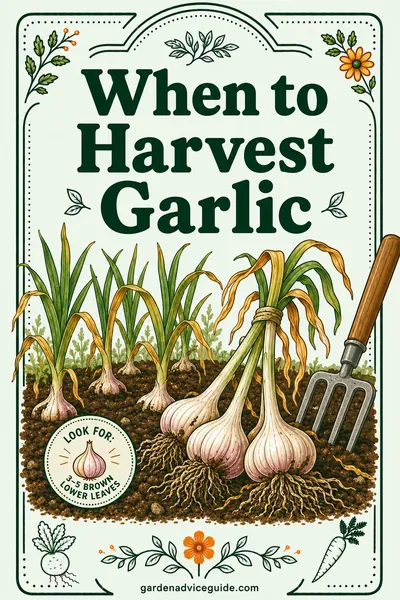
If you grow both alliums, note that they don't mature together. Garlic is usually ready in early to mid-summer, when about half its lower leaves have browned but several upper leaves are still green, weeks before your spring-planted onions flop. The signals look similar but the timing and the rules differ, so check our guide on when to harvest garlic rather than applying the onion rule to it. And once your beds are cleared in fall, that's the exact window to replant: here's when to plant garlic for next year's crop.
FAQ
Can I harvest onions before the tops fall over?
Yes, at any size, for fresh eating. A young pulled onion is just a scallion or a "spring onion." The 50-80% flopped rule only matters for onions you want to cure and store, because an immature bulb has a thick wet neck that won't seal and won't keep.
What if the tops fall over but the bulbs are still small?
The bulb won't get bigger after the top flops, so harvest and eat them. Small bulbs at flop-time usually trace back to one of four causes: the wrong day-length type for your latitude, late planting, crowding closer than 3-4 inches, or weed competition. Fix the cause next season; waiting longer this season only invites rot.
Should I knock the onion tops over to make them mature faster?
No. This old trick doesn't speed maturity and it bruises the necks, which shortens storage life. Extension trials have consistently found nothing to gain from it. Let the plants fall on their own; they know when they're done.
Can onions stay in the ground after the tops die back?
A week or so past full flop-over is fine in dry weather. Beyond that, especially in wet soil, bulbs start to re-sprout, split, stain, or pick up fungal infections through the dying neck. Onions keep far better cured on a shelf than parked in the ground.
What happens if it rains right before harvest?
Nothing fatal; just wait for a dry day or two so you're lifting from drier soil, and expect to lean on the longer end of the curing window. If a long soggy stretch is forecast at the 50-60% flopped mark, harvest before the rain rather than after it.
How do I know when curing is finished?
Check the necks: they should be completely dry, tight, and papery with no soft green core when you pinch or trim one, and the outer skins should rustle. That typically takes 2-4 weeks. If a neck is still thick and soft after four weeks, that onion isn't a keeper; use it in the kitchen.
Why are my onions bolting (flowering) instead of bulbing?
Bolting is triggered by cold snaps after the plant is already good-sized, common with fall-planted onions after a rough winter or oversized sets planted in spring. Harvest bolted plants right away and eat them fresh; the flower stalk leaves a hard core and ruins storage. Next time, plant sets smaller than a dime and stick to recommended planting dates for your area.
Do red, yellow, and white onions have different harvest times?
Color doesn't set the timing; day-length type and days-to-maturity do. A red long-day storage onion and a yellow one planted the same week flop within days of each other. Watch the tops and necks, not the color of the wrappers.
Updated August 2026