When to Mow New Grass After Seeding

Mow new grass the first time when the blades reach 3 to 4 inches tall, which usually lands 3 to 4 weeks after the seedlings break through. Cut it back to about 2.5 to 3 inches, taking off no more than a third of the blade in one pass. Height decides the date, not the calendar, so a patchy stand where the tallest blades are 4 inches and the youngest are 1 inch still gets mowed on schedule.
The mistake almost everyone makes is waiting too long. Grass left to flop over at 6 inches roots shallow, mats down, and takes a hard cut that stalls it for two weeks.
Work out your seeding date and your whole first-season calendar in a minute with our free lawn care schedule, then use the timings below to fill in the mowing dates.
Updated September 2026
When to mow new grass after seeding: the one-third height rule
Every mowing decision on a new lawn comes from one number: your target height. Pick the mowing height your grass type wants, add a third, and mow whenever the lawn reaches that taller number.
Tall fescue wants 3 inches. A third more is 4 inches. So you mow at 4 and cut back to 3, and you repeat that until the lawn is established. That's it. The rule is the same on a two-year-old lawn, but it matters far more on a three-week-old one, because seedlings have almost no root system to fund a recovery.
| Grass type | Target mowing height | Mow when it reaches | First mow, typical |
|---|---|---|---|
| Turf-type tall fescue | 3 to 3.5 in | 4 to 4.5 in | 3 to 4 weeks after sprouting |
| Perennial ryegrass | 2.5 to 3 in | 3.5 to 4 in | 3 weeks after sprouting |
| Kentucky bluegrass | 2.5 to 3 in | 3.5 to 4 in | 4 to 6 weeks after sprouting |
| Fine fescue | 3 to 4 in | 4 to 5 in | 4 to 5 weeks after sprouting |
| Bermudagrass (seeded) | 1 to 2 in | 1.5 to 2.5 in | 3 to 4 weeks after sprouting |
| Zoysia (seeded) | 1 to 2 in | 1.5 to 2.5 in | 5 to 7 weeks after sprouting |
| Centipede | 1.5 to 2 in | 2 to 2.5 in | 5 to 7 weeks after sprouting |
| Bahia | 3 to 4 in | 4 to 5 in | 4 to 6 weeks after sprouting |
Two things about that table are worth saying out loud.
First, warm-season lawns get mowed short but not early. A seeded bermuda lawn hits 1.5 inches fast in July heat, and it should still get four full weeks of undisturbed growth before a blade touches it.
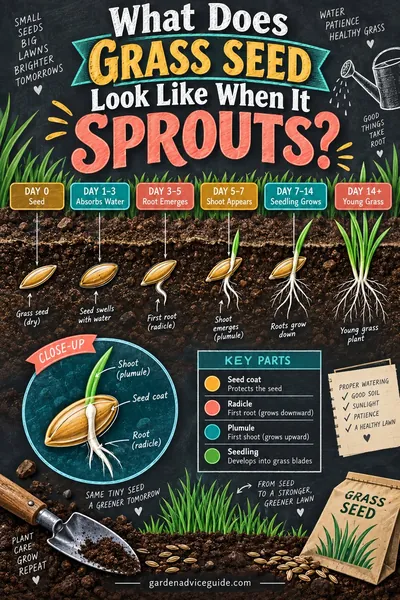
Second, the "typical" column counts from the day you see green, not the day you spread seed. Germination itself takes 5 to 10 days for ryegrass, 7 to 14 for tall fescue, and 14 to 28 for Kentucky bluegrass. Add that to the mowing wait and a bluegrass lawn can easily be seven weeks from seeding to first cut. If you're not sure whether the specks in your soil are grass or weeds yet, what grass seed looks like when it sprouts walks through the difference.
Why cutting early actually helps the lawn
It feels backward. The grass is fragile, so leaving it alone sounds kind. It isn't.
A grass plant that gets its tips cut responds by tillering, which means sending out new shoots from the base. Tillers are how one seedling becomes a clump and how a thin stand turns into turf. Uncut grass keeps pushing height instead, and height is the one thing a lawn doesn't need.
There's a light problem too. New grass seeded thickly grows into a dense mat of soft blades. The tallest ones shade the shortest ones, and the shortest ones are the late germinators you most want to save. That first cut opens the canopy and lets the stragglers catch up.
The costs of waiting stack up quickly:
- Blades over 5 inches lodge, meaning they fold over and lie flat. Flattened grass holds moisture against the crowns and invites damping off and pythium.
- The cut you eventually make removes far more than a third, which shocks the plant and browns the stand for a week or two.
- Weeds that germinated with your grass get an uncontested head start on height.
- The soil stays soft longer, so when you finally mow, the mower ruts it.
How to tell the lawn is ready: three checks in two minutes
Height is the main signal, but a young lawn gives you three more that take seconds.
The ruler check. Measure in three different spots, not one. New lawns are wildly uneven, and the bare patch by the driveway will still be at 1 inch when the shady corner is at 5. Mow when the majority of the stand hits the trigger height. The short areas lose nothing; the mower simply passes over them.
The tug test. Pinch a few blades between your fingers and pull gently. If the seedling comes out roots and all, the roots are still too short and shallow to survive a mower's suction and wheel drag. Give it another 4 to 7 days. If the blade tears and the plant stays anchored, you're clear.
The footprint test. Walk across the lawn and look back. If your shoes leave visible depressions in the soil, or if water squeezes up around the sole, it's too wet to mow. Stop watering for 24 to 48 hours and let the surface firm up. Mowing saturated ground on a new lawn tears out seedlings by the handful and leaves ruts you'll be looking at for years.
All three have to pass. Right height on soggy soil is still a no.
Setting up the mower for the first cut
Half the damage done to new lawns is done by the machine, not the timing.
Sharpen the blade. This is not optional. A dull blade doesn't slice a seedling, it whips it, tears the tip, and often yanks the whole plant out of loose soil. The torn tips turn white or tan within a day, and a lawn that looks frosted 24 hours after mowing was cut with a dull blade. Sharpen or swap the blade before the first cut of a new lawn, every time.
Raise the deck first, then check it. Deck labels lie. Set the mower on a flat driveway and measure from the concrete to the bottom edge of the blade with a ruler. On many walk-behind mowers, the "3 inch" notch reads closer to 2.5.
Bag the first two or three cuts. Clippings from a new lawn are soft and wet and mat into small dams that smother the seedlings underneath. Once the lawn has been cut three or four times, switch back to mulching and let the clippings return their nitrogen.
Pick a dry, cool part of the day. Late afternoon on a dry day is ideal. Skip mowing in the heat of midday and skip mowing wet grass entirely.
Use the lightest mower you own. A push mower beats a self-propelled machine, and both beat a riding mower, on a lawn under two months old. Weight plus turning is what tears young turf. If you must use a rider, mow in straight passes and do your turning on the driveway or a mature section.
Worked example: a fall-seeded fescue lawn in zone 6
Central Ohio, turf-type tall fescue, seeded on August 28 at 5 pounds per 1,000 square feet on a 6,000 square foot lawn. First frost lands around October 15. Here's how the mowing schedule actually falls out.
- Sept 5 to 8. First green haze. Germination took 8 to 11 days with soil at 70°F and three light waterings a day. Day zero for mowing math is September 6.
- Sept 20. Tallest blades measure 3.25 inches. Target is 3 inches, trigger is 4. Not yet. Cut watering back to one deeper soak every other day so the surface can firm.
- Sept 24. Ruler reads 4 to 4.25 inches in two of three spots. Tug test passes, blades tear rather than pull. No footprints from the walk. First mow. Deck measured at 3 inches, fresh blade, bag on. Total removed: about 1.1 inches, right at a quarter of the blade.
- Oct 1. Second mow at 4 inches back down to 3. Still bagging. Two days later, the second fertilizer feeding goes down, timed off this mowing rather than a date, per when to fertilize after overseeding.
- Oct 9 and Oct 18. Third and fourth mows. Switch to mulching on the fourth. Blow leaves off between cuts, since a wet leaf layer on three-week-old grass kills it in about a week.
- Nov 2. Final mow of the season, deck dropped to 2.5 inches to reduce matting under snow. That is the only time this lawn gets cut below 3 inches all year.
Math on that first cut, since the one-third rule is easy to get wrong: 4.25 inches down to 3 inches removes 1.25 inches. A third of 4.25 is 1.42. So 1.25 is under the limit and safe. Had that same lawn reached 6 inches before the first cut, a legal one-third pass would only get it to 4 inches, and it would take two more mows several days apart to reach 3. That's the real cost of waiting: three cutting sessions instead of one, and a stressed lawn through all of it.
The first three mows, step by step
- Two days before. Stop watering. Let the top inch dry so the soil supports the mower's weight. This single step prevents most seedling pull-out.
- The morning of. Sharpen or replace the blade. Measure the deck height on pavement. Attach the bag.
- Walk the lawn. Pick up sticks, stones, and anything the mower can throw. Note wet low spots and plan to skip them.
- Mow in straight lines. No tight turns on the turf. Overlap passes by a few inches so you aren't fighting a strip you missed.
- Empty the bag often. A packed bag makes the mower discharge poorly and drop clumps.
- Water lightly the same evening or the next morning. A quarter inch. The cut ends lose a bit of moisture and the plants appreciate a drink, but don't return to the three-times-a-day germination schedule.
- Change direction next time. Mow the second cut at right angles to the first. It keeps the grass from leaning and helps the stand thicken evenly.
- Repeat every 5 to 8 days. During establishment the lawn grows fast, and letting a week slide turns into a scalping.
How watering changes once you start mowing
Seeding-stage watering and mowing don't coexist. You can't keep the surface constantly damp and also keep the mower from sinking, so the first mow is the natural handoff point from frequent shallow watering to deep infrequent watering.
| Stage | Watering | Why |
|---|---|---|
| Seeding to germination | 2 to 3 times daily, 5 to 10 minutes each | Top half inch must never dry out |
| Germination to first mow | 1 to 2 times daily, 15 minutes | Roots reaching 1 to 2 inches deep |
| First mow to fourth mow | Every 2 to 3 days, about 0.5 in per session | Pushes roots down, firms soil |
| After fourth mow | Once or twice a week, 1 to 1.5 in total | Normal established schedule |
Skip watering for 48 hours before each of the first few cuts, then resume. Our watering guide covers how long your particular sprinkler needs to run to deliver a half inch, which is worth measuring once with a tuna can rather than guessing.
New sod is a different timeline
Sod arrives as mature grass, so the height trigger looks satisfied on day one. It isn't, because the roots have been sliced off and the lawn is living on a half inch of soil until it knits down.
Wait 14 to 21 days after laying sod, then test by lifting a corner. If it resists and you can see white roots reaching into the soil below, mow. If it peels up like a rug, wait another week. Set the deck high for that first cut, no lower than 3 inches for cool-season sod, and stop irrigating two days beforehand. The new sod watering schedule lays out the taper week by week.
The other difference: sod is heavy and holds water. Rutting risk is much higher than on a seeded lawn, so the light-mower rule matters even more.
Mistakes that undo a good seeding job
Scalping the first cut. Setting the deck at 1.5 inches on a lawn standing at 5 inches removes 70 percent of the leaf area. Grass regrows leaves from stored energy it doesn't have yet, and a large share of the stand simply stops.
Mowing wet grass. Wheels slip, seedlings pull, and cut blades stick to the deck and drop in clumps that smother patches.
Using a string trimmer along the edges. A trimmer set too low against a new lawn shaves the crowns off. Edge with the mower for the first month and leave the trimmer for later.
Mowing before the roots hold. The tug test exists for exactly this. Seedlings that come out with a light pull will come out by the hundreds under a mower.
Spraying weeds on mowing day. Broadleaf herbicides wait until the lawn has been mowed three or four times. Combination pre-emergent products wait until next season.
Letting leaves pile up between cuts. In fall, a new lawn under a wet leaf layer for even 5 to 7 days can go from green to slime. Blow or mow leaves off often. There's more on the fall sequence in when to overseed lawn in fall.
Reading the lawn after the first cut
Look at it the next day, and again three days later. A properly timed cut on a healthy stand looks slightly ragged for 24 hours, then greens up and visibly thickens over the next week.
Signs you cut too early or too hard:
- White or tan blade tips across the whole lawn. Dull blade. Sharpen it before the next pass.
- Bare tracks following your wheel lines. Soil was too wet. Skip the next cut and let it dry properly.
- Whole seedlings lying loose on the surface. Roots weren't ready. Overseed those spots lightly and wait an extra week before the next mow.
- Lawn stalls and yellows from the base up. Not a mowing issue. That's a nitrogen shortage, and the second feeding is due.
Signs it went right: new blades appear within 3 to 4 days, the color deepens, and the stand looks fuller a week later than it did before you cut it. That thickening is the tillering doing its job, and it's the whole reason you mowed in the first place.
FAQ
How long after seeding can you mow?
Count from germination, not from seeding. Most cool-season lawns are ready 3 to 4 weeks after the seedlings emerge, which is roughly 4 to 6 weeks after you spread the seed. Kentucky bluegrass takes the longest, sometimes 7 weeks total, because it germinates slowly.
How tall should new grass be before mowing?
3 to 4 inches for tall fescue, ryegrass, bluegrass, and fine fescue, and 1.5 to 2.5 inches for seeded bermuda, zoysia, or centipede. The rule behind those numbers is to mow at one-third taller than your target height, then cut back to target.
Can I mow new grass with a riding mower?
You can once the lawn is past four or five mowings, but not before. Riding mowers are three to five times heavier than a push mower and their turning motion tears young turf. If a rider is your only option, mow in straight passes and turn on pavement.
Should I bag or mulch the clippings on new grass?
Bag the first two or three cuts. Clippings from young grass are wet and soft and mat into patches that smother the seedlings below. After the third or fourth mow, switch to mulching so the clippings can recycle their nitrogen back into the soil.
What if part of my new lawn is tall and part is still bare?
Mow anyway, based on where the majority of the grass stands. The mower passes harmlessly over the short areas, and cutting the tall areas removes the shade that's holding the late germinators back. Reseed thin spots after the second mow.
Is it bad to mow new grass in fall right before frost?
No. Keep mowing as long as the grass is growing, and make the last cut of the year slightly lower, around 2.5 inches for cool-season lawns, to limit matting and snow mold under winter cover. Stop cutting once growth stops, and never mow frosted blades.
How soon after the first mow can I fertilize?
Right away, and the first mowing is actually the trigger for the second feeding on a newly seeded lawn. Apply about 0.5 to 0.75 pound of nitrogen per 1,000 square feet, at least half of it slow release, then water in a quarter inch.
Do I need to water right after mowing new grass?
A light quarter inch that evening or the following morning is plenty. Don't jump back to the germination watering routine, since the point of the first mow is to start pushing roots deeper with less frequent, deeper soakings. Check timing details against when to plant grass seed if you're still inside the establishment window.