Why Are My Seeds Not Germinating?

Nine times out of ten, seeds fail for one of three reasons: the soil is too cold for that crop, the seedbed dried out for a few hours during the germination window, or the seed went in too deep. Old seed, crusted soil, and rot make up most of the rest. Almost none of it is bad seed, and almost all of it is fixable before you sow again.
So the useful question is not "why are my seeds not germinating" in general. It's which of the nine causes below matches what you're actually seeing when you dig one up.
Sowing on the right date solves half of this before it starts. Get your zone dates from our free seed starting calendar so nothing goes into ground that's still 20 degrees too cold.
Updated September 2026
Why are my seeds not germinating? The 9 causes, ranked
Here's the whole list in the order they actually happen, with the tell that identifies each one.
| # | Cause | The tell when you dig a seed up | Fix |
|---|---|---|---|
| 1 | Soil too cold | Seed firm, plump, unchanged | Wait, or warm the soil |
| 2 | Seedbed dried out | Seed cracked open, tiny white root shriveled | Water daily, cover the bed |
| 3 | Sown too deep | Long pale sprout, no leaves, still buried | Resow at 2-3x seed width |
| 4 | Seed too old | Seed intact, some sprouted, most did not | Viability test before sowing |
| 5 | Rotted in wet soil | Seed mushy, gray or slimy, smells sour | Drain, water less, warm the mix |
| 6 | Soil crusted over | Sprout bent under a hard surface layer | Cover with vermiculite, not soil |
| 7 | Light requirement ignored | Seed intact, buried, fine on top | Surface sow, press only |
| 8 | Dormancy not broken | Seed hard, unswollen after weeks | Chill or nick the coat first |
| 9 | Eaten or moved | No seed at all where you sowed it | Screen, cover, or mouse-proof |
Now the detail, because the fix depends on the diagnosis.
1. The soil is too cold (the single biggest cause)
Every crop has a floor temperature. Below it the seed simply waits, and it waits in damp soil where fungi are perfectly happy, which is how "not germinating" turns into "rotted" after two weeks.
The gap between the floor and the sweet spot is much bigger than most people expect. Tomato seed takes about 6 days at 80°F and can take more than 40 days at 50°F. That's not a small delay. That's a whole different outcome.
| Crop | Minimum soil temp | Optimal soil temp | Days at optimal | Days at minimum |
|---|---|---|---|---|
| Lettuce | 35°F | 70°F | 2-3 | 15 |
| Spinach | 35°F | 70°F | 5 | 23 |
| Onion | 35°F | 75°F | 4 | 13 |
| Pea | 40°F | 75°F | 6 | 36 |
| Beet | 40°F | 85°F | 5 | 17 |
| Carrot | 45°F | 80°F | 6 | 17 |
| Radish | 45°F | 85°F | 4 | 11 |
| Cabbage, broccoli | 45°F | 85°F | 4 | 15 |
| Corn | 50°F | 95°F | 4 | 22 |
| Tomato | 50°F | 80°F | 6 | 43 |
| Bean | 60°F | 80°F | 8 | 16 |
| Pepper | 60°F | 85°F | 8 | 25 |
| Cucumber | 60°F | 95°F | 3 | 13 |
| Squash, pumpkin | 60°F | 95°F | 4 | 12 |
| Eggplant | 60°F | 85°F | 5 | 20 |
Two practical notes on using this.
Measure, don't guess. Push a cheap probe thermometer 2 inches into the bed at 9 a.m., not at 3 p.m. Morning is the honest reading, and 2 inches is where the seed lives. Air temperature tells you nothing useful in spring.
Indoors, the tray is colder than the room. A 70°F room gives you roughly 65°F soil, because evaporation off the surface cools the mix. That's fine for lettuce and disastrous for peppers. A seedling heat mat set to 80°F is the difference between pepper seed in 8 days and pepper seed in 25.
Cold is also why the same packet behaves differently in April and June. If your first sowing failed and your second worked, temperature was the variable.
2. The seedbed dried out during germination
This is the quiet killer, and it's the one people never suspect because the damage happens underground.
A seed absorbs water, swells, cracks its coat, and pushes out a root tip barely a millimeter long. That root has no reserves. If the top half inch of soil dries out at that moment, the root dies and the seed cannot restart. It gets one attempt.
The risk period runs from sowing until the sprouts show, and the length of it varies enormously:
- Radish, lettuce, squash: 3 to 7 days of watching
- Beans, cucumbers, brassicas: 5 to 10 days
- Beets, chard, peppers: 8 to 14 days
- Carrots, parsley, parsnips: 14 to 21 days
Carrots fail more than anything else in the garden for exactly this reason. Three weeks of keeping a half inch of soil damp through spring wind is a real job. Our full guide to how to grow carrots covers the board-over-the-row trick that makes it manageable.
What to do instead of hoping: water the seedbed lightly every single day it doesn't rain, use a fine rose or a mist setting so you don't wash seed sideways, and lay a board, damp burlap, or a row cover over the row to cut evaporation. Check under it daily and pull it the moment the first sprout appears, or you'll trade a dry failure for a stretched, pale one.
3. You sowed too deep
The rule is simple and nearly universal: plant a seed 2 to 3 times as deep as the seed is wide.
A lettuce seed is about 1/16 inch across, so it goes 1/8 inch deep, which is barely covered. A bean is 1/2 inch across, so it goes 1 to 1.5 inches. Burying a lettuce seed half an inch is like asking a person to swim up from the bottom of a pool with their hands tied.
| Seed | Typical depth | Rough guide |
|---|---|---|
| Lettuce, celery, snapdragon | 1/16 to 1/8 in | Press into surface |
| Carrot, onion, brassicas | 1/4 in | Dust of soil |
| Beet, chard, spinach | 1/2 in | Knuckle tip |
| Cucumber, squash, melon | 3/4 to 1 in | First knuckle |
| Bean, pea, corn | 1 to 1.5 in | Second knuckle |
| Large beans, sunflower | 1.5 to 2 in | Two knuckles |
The giveaway: you dig at day 14, and there's a pale, thread-like sprout an inch long with no leaves, still underground. It ran out of stored energy before it reached light. Resow shallower rather than waiting.
One nuance. In hot, dry midsummer conditions, go slightly deeper than the chart says (add about 1/4 inch) because the surface dries so fast. In cold, wet spring soil, go slightly shallower.
4. The seed is too old
Seed doesn't expire on a date. It fades, and it fades at wildly different speeds depending on the species.
| Seed type | Realistic years at good storage | Notes |
|---|---|---|
| Onion, leek, parsnip, parsley | 1 to 2 | Buy fresh every year |
| Corn, pepper, chives | 2 to 3 | Drops off sharply after year 2 |
| Bean, pea, carrot, spinach | 3 to 4 | Germination rate slips first |
| Beet, chard, tomato, pumpkin | 4 to 5 | Reliable stored cool |
| Cucumber, lettuce, radish, squash, brassicas | 5 to 6 | The long keepers |
"Good storage" means cool, dark, and dry: a sealed jar in the back of a closet or a refrigerator, not the garage or the shed. Heat and humidity together cut those numbers roughly in half.
Old seed usually doesn't fail completely. It fails partly, which is more confusing. You get 4 sprouts in a row of 20 and assume something else went wrong.
The rag doll test, with real numbers
Do this two weeks before sowing and you never have to wonder.
Count out 10 seeds. Fold them into a damp paper towel, slide it into a zip bag, and leave it somewhere around 75°F. Check on the day the packet says germination should finish, plus 3 days.
Say 6 of the 10 sprout. That's 60 percent viability. To get a normal stand, divide your usual seeding rate by 0.6, which means sowing about 1.7 times as thick. A row that normally takes 30 seeds now takes 50.
Below about 50 percent, it's usually not worth the row space, especially for slow crops like carrots and parsnips where you'll be babysitting the bed for three weeks either way.
5. The seed rotted before it sprouted
Dig one up. If it's soft, gray or brown, smells sour, and squashes between your fingers, it rotted. That's a moisture and temperature problem, not a seed problem.
Rot happens when soil is cold and wet at the same time. Cold slows germination, wet excludes air, and soil fungi are active at temperatures where your seed is not. Peas sown into 42°F mud are the classic case.
Fixes, in order of how much they help:
- Wait for the soil to hit the crop's optimal range, not its minimum. Two weeks of patience beats three weeks of rotting.
- Water less, and from below. For trays, set them in a shallow pan of water for 10 minutes, then remove. Constantly soggy surfaces are the problem.
- Improve drainage in beds. Raised rows 4 inches high dry and warm faster than flat ground.
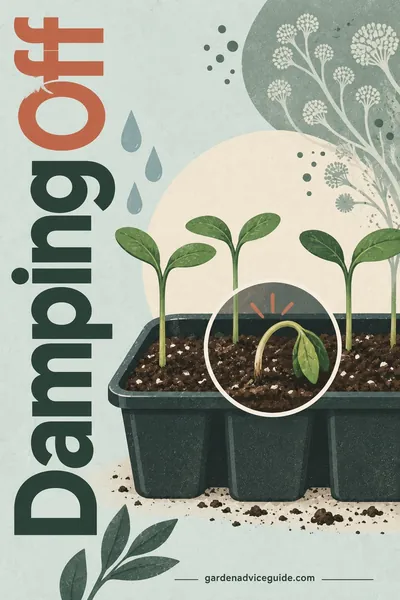
- Use fresh, clean seed-starting mix. Reused potting soil carries the fungi that cause both seed rot and damping off, the related problem where seedlings do sprout and then collapse at the soil line a week later.
That distinction matters. Nothing coming up at all is a germination problem. Sprouts that appear and then flop over is damping off, and it has a different fix list.
6. The soil crusted over the top
Clay and silty soils form a hard cap after heavy rain or overhead watering followed by sun. The seed germinates fine and then hits a lid.
You'll see sprouts bent sideways under a plate of dried soil, sometimes with the seed coat still stuck on. Carrots, onions, and lettuce are too weak to break through it. Beans and peas usually can.
The fix is what you cover the seed with, not the soil itself. Fill the seed furrow with vermiculite, fine compost, or a half-and-half mix of compost and coarse sand instead of native soil. None of those crust. It costs almost nothing on a garden-sized row and it eliminates the problem entirely.
Also: water with a fine spray, never a hard stream, for the first two weeks, and shade the row with a board or cover during a hot dry spell.
7. Some seeds need light, and you buried them
A small but important group needs light to trigger germination. Cover them and they wait in the dark forever.
Sow these on the surface and press them down, don't cover: lettuce, celery, dill, poppy, snapdragon, petunia, columbine, coleus, sweet alyssum, feverfew, nicotiana, and most tiny flower seed generally.
These prefer darkness and want a proper covering: calendula, nasturtium, phlox, larkspur, pansy, viola, coriander, and most large seed.
The general rule that keeps you out of trouble: the smaller the seed, the closer to the surface it belongs. A seed the size of dust has no energy to climb.
For surface sowing, press firmly with your palm or a flat board so the seed makes real contact with damp soil. Contact matters more than covering. Then mist rather than water, since a stream will float them away.
8. The seed needed dormancy broken first
Vegetable seed rarely does this. Perennials, natives, and some flowers absolutely do, and if you skip the step nothing happens no matter how perfect your conditions are.
Cold stratification copies a winter. Mix the seed with damp sand or a damp paper towel in a bag and refrigerate at 33 to 40°F for the required stretch:
| Plant | Cold period needed |
|---|---|
| Milkweed | 30 days |
| Echinacea (coneflower) | 30 to 60 days |
| Lavender | 30 days |
| Perennial rudbeckia | 30 days |
| Native prairie and woodland seed | 60 to 90 days |
| Many tree and shrub seeds | 90 to 120 days |
Scarification handles hard, waterproof coats. Nick the coat with a nail file away from the eye, or soak in room-temperature water for 8 to 24 hours. Sweet pea, morning glory, moonflower, nasturtium, okra, and lupine all respond well. A seed that has been soaked properly looks visibly swollen. If it looks exactly the same after 24 hours in water, it needs the file.
Sowing outdoors in late winter does the cold job for you at no effort, which is the whole idea behind winter sowing in jugs.
9. Something ate them or moved them
Dig where you sowed. If there's no seed there at all, you've got a different problem.
- Mice and voles clear whole rows of peas, beans, corn, and sunflower overnight, usually leaving small holes and a bit of scuffed soil.
- Birds take large surface seed and pull emerging sprouts.
- Ants carry off small seed, especially in dry weather.
- Hard rain floats seed out of the row and stacks it at the low end of the bed. If everything sprouted in one clump at one end, that's water, not wildlife.
Row cover pinned at the edges solves birds and most rain movement. For mice, sow when the soil is warm enough that germination takes days rather than weeks, since the shorter the seed sits, the less it gets found.
Worked example: a pepper tray that failed, and the one that didn't
Real numbers from two identical sowings, because temperature is the variable people underestimate most.
Tray A. Sown March 1, 24 cells, fresh pepper seed, 1/4 inch deep in seed mix, set on a bookshelf in a 68°F room. Actual soil temperature measured in the cell: 64°F, four degrees above the pepper minimum. Watered from the top every other day.
Result at day 14: 3 sprouts. At day 25: 9 sprouts out of 24, uneven and weak. Several cells dug up showed soft, discolored seed.
Tray B. Same seed, same mix, same day, same depth. Placed on a seedling heat mat set to 80°F with a humidity dome. Soil temperature 79°F. Bottom watered twice, dome pulled at first sprout.
Result at day 8: 19 sprouts. At day 12: 22 of 24.
Same seed. Same gardener. The only difference was 15 degrees of soil temperature and watering from below instead of above. Tray A also lost three weeks of the season, which for peppers in a short-summer zone is the difference between a real harvest and a handful of green fruit in October.
The correction that costs nothing: if you have no heat mat, put the tray on top of the refrigerator or near (not on) a heat source, and check with a probe thermometer instead of assuming. Pepper and eggplant are the two crops where this always pays.
How long should you wait before giving up?
Use the packet's stated days as the starting point, then add a margin based on how cold your soil actually is.
| If your soil is | Expect germination in | Give up after |
|---|---|---|
| At or above the optimal temp | The packet's low number | Packet days + 5 |
| 10°F below optimal | Roughly double the packet days | Packet days x 2 + 7 |
| 20°F below optimal | Triple or worse | Dig one up at packet days x 2 |
| Below the crop minimum | Never | Resow when warm |
The most useful move at that point is not more waiting. It's digging up three seeds from different spots in the row and reading them against the table at the top of this page. Thirty seconds of digging tells you more than another week of staring at bare soil.
Once seedlings are up and growing, the next two jobs are moving them safely outdoors and getting spacing right. See hardening off seedlings for the week-long transition, and when to transplant seedlings for the size and timing signals.
Frequently asked questions
How long do seeds take to germinate?
Between 2 days and 4 weeks depending on the crop and the soil temperature. Radish and lettuce can be up in 2 to 4 days in warm soil, while carrots and parsley routinely take 14 to 21. The same seed in cold soil can take three times as long, which is why a packet's stated days only apply near the optimal temperature.
Can I still use seeds from last year?
Usually yes. Most vegetable seed holds up for 3 to 5 years stored cool and dry, though onion, leek, parsnip, and parsley drop off after a single year. Run a 10-seed rag doll test two weeks before you sow, and if fewer than 6 sprout, sow the row thicker to compensate.
Should I soak seeds before planting?
Only for large, hard-coated seed. Peas, beans, corn, beets, and nasturtiums benefit from 8 to 12 hours in room-temperature water, and it can shave 2 to 3 days off germination. Never soak tiny seed like carrot or lettuce, and never soak longer than 24 hours, which causes the seed to drown and rot.
Why did my seeds sprout and then die?
That's damping off, not a germination failure. A fungal complex in the soil pinches the stem at the soil line and the seedling falls over while still green. It's driven by wet surfaces, cool temperatures, and stale air, and it can't be reversed once a plant has toppled. The full prevention checklist is in our guide to damping off.
Do I need to cover seeds with plastic wrap?
A dome or a loose plastic cover helps a lot indoors because it stops the surface from drying while you're at work. Remove it the moment the first sprout shows. Left on, it traps stagnant humid air and invites the exact fungi that cause seed rot and collapse.
Why are my seeds not germinating outdoors when the same packet worked indoors?
Almost always soil temperature and surface drying. An indoor tray sits at a steady 70°F or more with a dome holding humidity. An outdoor bed in April might be 48°F at seed depth and dry out by noon on a windy day. Measure your soil at 2 inches in the morning and compare it against the crop's minimum before you blame the seed.
Does old seed produce weaker plants?
Not usually. Germination rate drops with age, but a seed that does sprout generally grows into a normal plant. Aged seed may sprout a few days later and less evenly, so thin harder than usual to remove the stragglers rather than nursing them along.
How deep should tiny seeds go?
Two to three times their own width, which for lettuce, snapdragon, or petunia means barely covered or not covered at all. Press them onto damp soil with a flat board so they make firm contact, then mist. Firm contact matters far more than a layer of soil on top.
The short version
Dig up a seed before you do anything else. Firm and unchanged means the soil is too cold. Cracked with a dried root tip means the bed dried out. A long white sprout with no leaves means you planted too deep. Mushy and gray means it rotted in cold wet soil. Missing entirely means something ate it.
Each of those has a different fix, and none of them require buying better seed. Line your sowing dates up with your zone using our free seed starting calendar, measure the soil rather than guessing, and keep the top half inch damp for the whole germination window. That covers roughly 80 percent of failed rows.