Winter Blooming Shrubs

Winter blooming shrubs fill the one stretch of the year when a garden has nothing else to say. The most dependable group runs from sasanqua camellia and mahonia in late fall, through wintersweet and winter jasmine in December and January, to witch hazel and edgeworthia in February and March. Which of them you can grow comes down almost entirely to your zone: witch hazel is the cold climate answer, hardy to zone 4 or 5, while wintersweet, edgeworthia and most camellias start at zone 7. Every one of these flowers on wood made the previous summer, so they share one pruning rule, and every one of them needs to be planted where you will actually see it from a window or a path in February.
This page covers each shrub's bloom window, its size and siting, how its flowers handle a hard freeze, and which ones belong in your zone.
Check your number before you shop. Look up your USDA zone with our free growing zones lookup, because the gap between a zone 6 and a zone 7 garden decides half of this list.
Updated September 2026
Winter Blooming Shrubs at a Glance
| Shrub | Zones | Bloom window | Fragrance | Height x width | Light |
|---|---|---|---|---|---|
| Hybrid witch hazel (Hamamelis x intermedia) | 5 to 8 | Late January to March | Mild to strong, by cultivar | 12 to 15 x 12 to 15 ft | Sun to part shade |
| Ozark witch hazel (H. vernalis) | 4 to 8 | January to March | Strong, spicy | 6 to 10 x 8 to 12 ft | Sun to part shade |
| Common witch hazel (H. virginiana) | 3 to 8 | October to December | Light | 15 to 20 x 15 to 20 ft | Sun to part shade |
| Wintersweet (Chimonanthus praecox) | 7 to 9 | December to February | Very strong, spicy sweet | 10 to 15 x 8 to 12 ft | Sun to light shade |
| Winter jasmine (Jasminum nudiflorum) | 6 to 10 | January to March | None | 3 to 4 x 4 to 7 ft | Sun to part shade |
| Edgeworthia, paperbush (Edgeworthia chrysantha) | 7 to 9 | February to March | Sweet, strong | 4 to 6 x 4 to 6 ft | Part shade |
| Mahonia x media, Charity and Winter Sun | 7 to 9 | November to February | Moderate | 6 to 10 x 4 to 6 ft | Part to full shade |
| Leatherleaf mahonia | 6 to 9 | January to March | Moderate | 4 to 8 x 3 to 5 ft | Part to full shade |
| Sasanqua camellia (Camellia sasanqua) | 7 to 9 | October to January | Faint | 6 to 12 x 5 to 10 ft | Sun to part shade |
| Ackerman hybrid camellias | 6b to 9 | October to December | Faint to none | 6 to 10 x 5 to 8 ft | Part shade |
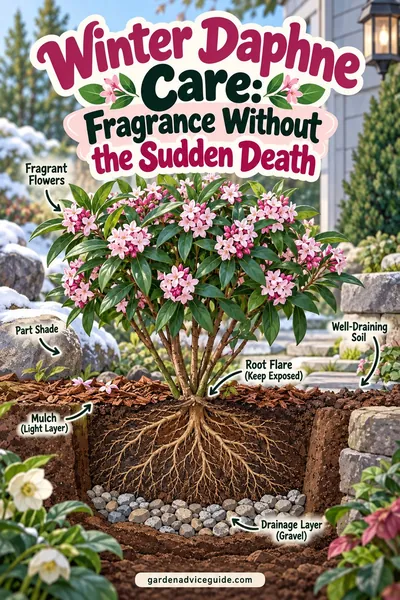
Two related shrubs have their own pages and are only mentioned here. Winter daphne is the most fragrant February bloomer of all. Every part of it is poisonous, and its siting is unforgiving enough that it gets a full treatment in our winter daphne care guide. Winterberry holly carries red fruit rather than flowers through the same months, and our winterberry plant care page covers the male and female pairing it needs. For general camellia hardiness and mature size next to every other evergreen, see the camellia row on our shrubs by zone page.
The Winter Bloom Calendar
Bloom dates shift by about two weeks per zone, earlier in warm zones and later in cold ones, and a mild spell can open buds weeks ahead of schedule. Read the calendar below as the order of events rather than exact dates.
| Month | What is in flower |
|---|---|
| October and November | Common witch hazel, sasanqua camellia, Ackerman hybrid camellias, early mahonia |
| December | Sasanqua camellia finishing, Mahonia x media, wintersweet starting in zones 8 and 9 |
| January | Wintersweet, winter jasmine, Mahonia x media, Ozark witch hazel, early hybrid witch hazel in zone 8 |
| February | Hybrid witch hazel, winter jasmine, leatherleaf mahonia, edgeworthia opening, camellia japonica in zones 8 and 9 |
| March | Hybrid witch hazel finishing in zones 5 and 6, edgeworthia, winter jasmine, spring blooming hardy camellias starting |
A planting that includes a fall witch hazel or a sasanqua, one December to January shrub, and one February to March shrub gives you something in flower from Thanksgiving to the first daffodils in any zone from 7 up.
Witch Hazel: The Cold Climate Winter Bloomer
Witch hazel is the most important shrub on this page for anyone gardening in zones 4 through 6, because it is the only group here that flowers reliably in the middle of a northern winter. The flowers are small clusters of four narrow, strap shaped petals in yellow, orange or red. From a distance they read as a haze of color along bare branches, which is where the name gets its charm, and up close many of them smell of citrus and spice.
The feature that makes witch hazel work in cold climates is what the petals do at night. When temperatures fall well below freezing, each petal rolls up tight like a coiled ribbon. When the day warms, they unroll again. That movement protects the flowers so well that a single bloom period often lasts three to four weeks, and in a cold, steady winter it can stretch past a month. A thaw followed by a hard freeze, which ends the display on most early flowering shrubs, usually just pauses a witch hazel.
Which witch hazel to plant
There are three groups sold in American nurseries, and they bloom in different seasons.
Common witch hazel (Hamamelis virginiana) is the native species of eastern North America and the source of the familiar astringent. It is the hardiest, to zone 3, and it blooms in fall, from October into December, often while its yellow leaves are still dropping. It is a large, open shrub or small tree, 15 to 20 feet at maturity, and a good choice for a woodland edge or a naturalized corner.
Ozark witch hazel (H. vernalis) is native to the Ozark region and blooms from January into March. The flowers are small, in yellow, orange or red, and strongly fragrant for their size. It stays smaller, 6 to 10 feet, and spreads into a thicket by suckering, which makes it useful for a native hedge or a slope. It is hardy to zone 4.
Hybrid witch hazel (H. x intermedia) is a cross between the Japanese and Chinese species, and it is where the showy named cultivars live. Flowers are larger and brighter than either native, and it blooms from late January to March. Hardiness runs zones 5 to 8.
| Hybrid cultivar | Flower color | Fragrance | Notes |
|---|---|---|---|
| Arnold Promise | Clear yellow | Strong | One of the later blooming yellows, a reliable standard with yellow fall color |
| Pallida | Pale sulfur yellow | Strong | Early blooming, glows against dark evergreens |
| Jelena | Coppery orange | Moderate | Wide spreading habit, excellent orange and red fall color |
| Diane | Deep red | Light | The classic red, best fall color of the group, hard to see from far off |
| Aphrodite | Orange | Moderate | Large flowers, vigorous |
| Ruby Glow | Coppery red | Light | Upright habit |
A useful rule when choosing: yellow flowers are the most fragrant and the easiest to see from a distance, while red and deep orange cultivars are striking up close and nearly invisible from a window 40 feet away. If the shrub is going at the back of the yard, choose yellow.
Siting and growing witch hazel
- Light. Full sun to part shade. More sun means more flowers and better fall color, and a spot that gets low afternoon winter sun behind the plant lights up the petals like filaments.
- Soil. Moist, well drained, slightly acidic and rich in organic matter. It does not want to dry out during its first few summers, and it dislikes soggy clay. A soil test tells you what you are working with, and our guide on how to test garden soil walks through pulling a sample.
- Space. Hybrid witch hazels grow into a wide vase, often as broad as they are tall. A plant that looks tidy in a 3 gallon pot needs a circle 12 to 15 feet across in ten years. Give it the room rather than shearing it later.
- Background. Plant it in front of dark evergreens, a dark fence or a brick wall. Yellow flowers against a bare sky disappear.
- Mulch. A 2 to 3 inch layer of shredded bark or leaf mulch over the root zone keeps the soil evenly moist through summer. Our mulch guide covers depth and materials.
Two witch hazel problems that are easy to fix
Dead leaves hiding the flowers. Ozark witch hazel, Chinese witch hazel and some hybrid cultivars hold their dried brown leaves well into winter, especially while young. The flowers open behind them and get lost. Pull the dead leaves off by hand in early winter on a small plant. It takes ten minutes and doubles the display.
Suckers from the rootstock. Many hybrid cultivars are grafted onto a common or Ozark witch hazel root. Shoots that come up from below the graft grow fast, have slightly different leaves, and bloom at the wrong time, often in fall. Cut them off flush at the base whenever they appear, or the rootstock slowly takes over the plant.
Wintersweet
Wintersweet (Chimonanthus praecox) is the most fragrant shrub that flowers in the dead of winter, and it is almost unknown outside of collectors' gardens. The flowers are about an inch across, waxy and translucent pale yellow with a purple to maroon center, and they hang along bare branches from December through February. A single branch cut and brought indoors scents a whole room with a spicy, sweet perfume.
It is hardy in zones 7 to 9, and in zone 6b it can succeed against a warm, sheltered south wall. It grows into a large, multi stemmed deciduous shrub, 10 to 15 feet tall and 8 to 12 feet wide, and in summer it is plain: rough green leaves and nothing more. Put it at the back of a border or along a side path where you pass in winter and do not need it to perform in July.
Growing notes that matter:
- Be patient with young plants. Wintersweet can take several years to reach flowering size, and plants raised from seed can take considerably longer. A larger nursery plant grown from a cutting shortens the wait.
- Full sun ripens the wood. Flowers form on growth made the previous summer, and that wood flowers most heavily after a warm, sunny season. In zone 7, the south side of a building is the best spot.
- Drainage over richness. Average, well drained soil is fine. Once established it handles dry summers well.
- Named forms. Luteus has larger, clear yellow flowers without the purple center and blooms slightly later. Grandiflorus has larger, deeper yellow flowers with somewhat less fragrance.
In a hard freeze, open flowers turn brown and drop, but the unopened buds farther along the branch continue to open when the weather turns mild, so a cold snap interrupts the show rather than ending it.
Winter Jasmine
Winter jasmine (Jasminum nudiflorum) is the easiest shrub on this page and the one most likely to already be growing in an old neighborhood. It produces bright yellow flowers about an inch across on bare green stems from January into March, and in zone 8 it often starts in December. The flowers have no fragrance, which surprises people who expect a jasmine to smell. What it offers instead is volume: a mature plant is a fountain of yellow at a time of year when yellow is scarce.
It is hardy in zones 6 to 10. The stems stay green all winter, so even out of bloom it does not look dead. Left alone it forms a mounding, sprawling shrub 3 to 4 feet tall and 4 to 7 feet wide, and wherever a stem touches soil it roots. That habit makes it excellent on a bank for erosion control, cascading over a retaining wall, or tied up a trellis, where it can climb 10 feet or more with support.
Winter jasmine tolerates poor soil, part shade and dry conditions once established, and it flowers most heavily in sun. It is not closely related to star jasmine, which is not a true jasmine at all. If you are sorting out the jasmine names on nursery tags, our page on star jasmine hardiness zone lays out the differences.
For an evergreen version in warm climates, primrose jasmine (Jasminum mesnyi) is hardy in zones 8 to 10 and carries larger, semi double yellow flowers from late winter into spring.
Edgeworthia, the Paperbush
Edgeworthia (Edgeworthia chrysantha) earns its place for most of the winter before it ever opens a flower. In fall, after the leaves drop, the shrub forms clusters of silky, silvery white buds that hang down from the tips of every branch like small tassels. They stay that way from November through February, and against the cinnamon brown bark they look deliberate and sculptural. In late winter, usually February into March, the buds open into rounded heads of tubular flowers, creamy white outside and golden yellow inside, with a sweet fragrance that carries on a mild day.
It is hardy in zones 7 to 9. At the cold edge of zone 7, an unusually severe winter can damage the buds, so give it a sheltered spot out of wind there. It grows into a rounded shrub 4 to 6 feet tall and wide, with branches that fork in threes, a pattern so regular that the plant's Japanese name refers to it. The inner bark has long been used to make fine paper in Japan, which is where the common name paperbush comes from.
Edgeworthia wants conditions that suit a woodland plant:
- Part shade. Morning sun and afternoon shade is ideal. Hot afternoon sun in zones 8 and 9 scorches the large summer leaves.
- Moist, rich, well drained soil. It dislikes both drought and standing water, so mulch the root zone and water during dry summer spells, especially in the first two years.
- Very little pruning. The branching habit is the ornament. Remove only dead or crossing wood, right after bloom.
The summer leaves are long, blue green and almost tropical looking, and they turn a clear yellow in fall. Snow Cream is the most common cultivar. Red flowered forms sold as Akebono or Red Dragon exist and are generally considered a little less vigorous.
Mahonia
Mahonia fills a slot no other shrub here covers: an evergreen that flowers in winter in real shade. The leaves are divided into spiny, holly like leaflets, the flowers come as upright or arching spikes of bright yellow, and blue black berries follow that birds strip quickly. Botanists have moved these plants into the genus Berberis, but nurseries still sell them as mahonia.
| Mahonia | Zones | Bloom | Size | Notes |
|---|---|---|---|---|
| Mahonia x media, Charity, Winter Sun, Lionel Fortescue | 7 to 9 | November to February | 6 to 10 x 4 to 6 ft | Upright flower spikes, the showiest winter mahonia, a major winter nectar source for hummingbirds in mild regions |
| Leatherleaf mahonia (M. bealei) | 6 to 9 | January to March | 4 to 8 x 3 to 5 ft | Fragrant pale yellow flowers. Considered invasive in parts of the Southeast, where birds spread the seed into woodlands |
| Oregon grape (M. aquifolium) | 5 to 9 | March to April | 3 to 6 x 3 to 5 ft | Native to the Pacific Northwest, the cold hardy option, but it flowers at the tail end of winter |
| Soft Caress (M. eurybracteata) | 7 to 9 | Fall | 3 x 3 ft | Soft, spineless, fine textured leaves. Blooms earlier than the others |
Check your state's invasive plant list before planting leatherleaf mahonia. Where it is a problem, Mahonia x media is the better choice for winter bloom.
Mahonia grows best in part shade to full shade with protection from hot afternoon sun, which bleaches the leaves in the South. In sun and cold, the foliage often turns purple red in winter, which is normal. It handles dry shade under trees once established. Older plants get leggy, with foliage only at the top of bare canes. Fix that right after flowering by cutting the tallest canes down to different heights, some to a few inches above the ground, and the plant resprouts from below the cuts. Spread the job over two or three years so the shrub never looks scalped.
The spines and bitter compounds make mahonia one of the shrubs deer leave alone most reliably, and it shows up on our deer resistant shrubs list for that reason.
Sasanqua Camellia
Sasanqua camellia opens the winter season. Most cultivars bloom from October through December, and some carry on into January, with single, semi double or peony form flowers in white, pink and red against glossy evergreen leaves. Compared with the more familiar japonica camellia, sasanquas have smaller leaves, tolerate more sun, grow faster, and often carry a faint sweet scent.
The easiest way to tell the two apart in flower is to watch how they finish. A sasanqua drops its petals one at a time, leaving a scattering of color on the ground under the shrub. A japonica drops the whole flower at once.
| Sasanqua cultivar | Flower | Typical bloom | Habit |
|---|---|---|---|
| Yuletide | Single red with yellow stamens | Late fall into December | Upright, compact |
| Setsugekka | Large semi double white | Fall | Upright, vigorous |
| Kanjiro | Semi double rose pink | Fall into early winter | Fast, upright, good for screening |
| Mine no yuki | Peony form white | Fall into early winter | Spreading, graceful |
| Shishi Gashira | Semi double rose red | Late fall into winter | Low and spreading, often listed under Camellia hiemalis |
Japonica camellias take over from January to March in zones 8 and 9, which is how a Southern garden keeps camellias in flower from October to spring with two species.
Growing notes that apply to both:
- Acidic soil. Around pH 5.5 to 6.5, rich and well drained.
- Shelter from winter morning sun. Flowers that freeze overnight and then warm quickly in direct morning sun brown worst. A west or north facing spot with bright light often looks better in bloom.
- Freeze damage is flower damage. Open flowers brown at temperatures in the upper 20s, and buds already showing color are more vulnerable than tight buds. The shrub itself is fine, and the tight buds open later.
- Prune right after bloom. Camellias set next year's buds in summer. Any shaping should be done by late spring.
- Watch for tea scale. Yellow speckling on top of the leaves with a white, cottony coating underneath is the most common camellia pest. Pruning out the worst branches and improving airflow is the first step.
Cold Hardy Camellia Cultivars
For decades camellias stopped at zone 7. That changed after a series of severe winters in the late 1970s killed many camellias around Washington, DC, and breeders went looking for survivors. The results are camellias rated to zone 6b, which pushes winter flowers into gardens that could never grow them before.
Ackerman hybrids. Bred at the U.S. National Arboretum by William Ackerman, largely from crosses with the hardy tea oil camellia (Camellia oleifera). Most are fall bloomers, flowering from October into December, and most carry "Winter's" in the name.
| Ackerman cultivar | Flower |
|---|---|
| Winter's Star | Single, lavender pink |
| Winter's Charm | Peony form, lavender pink |
| Winter's Interlude | Anemone form, pink |
| Winter's Snowman | Anemone form, white |
| Winter's Waterlily | Formal double, white |
| Winter's Joy | Semi double, pink |
| Polar Ice | Anemone form, white |
| Snow Flurry | Anemone form, white |
Spring blooming hardy japonicas. A separate breeding line selected for cold tolerance produced japonica camellias rated to zone 6b that flower from late winter into spring, including the April series (April Tryst, April Blush, April Dawn, April Remembered) and Korean Fire, a single red grown from plants collected on islands off the coast of Korea. In zone 6 they open after the worst cold has passed, which is exactly why they succeed.
How to make a hardy camellia work in zone 6:
- Plant in spring, not fall. The roots need a full growing season in the ground before the first winter.
- Choose a sheltered spot on the north or east side of a building, out of winter wind and early morning sun.
- Mulch 3 inches deep over the root zone once the ground has frozen.
- Water deeply in late fall until the ground freezes. Evergreen leaves lose water all winter, and a dry plant takes the worst leaf burn.
- Expect flower loss in a hard winter. A fall bloomer hit by an early hard freeze simply finishes early. The shrub survives, and that is what the zone 6b rating promises.
For frost events at either end of the bloom season, our page on how to protect plants from frost covers the materials and timing that keep buds intact through a single cold night.
Winter Blooming Shrubs by Zone
- Zone 3: common witch hazel for fall bloom. True midwinter flowers are not realistic in the open ground here.
- Zone 4: add Ozark witch hazel for January to March bloom.
- Zone 5: add hybrid witch hazel, the widest choice of color and fragrance, and Oregon grape at the tail end of winter.
- Zone 6: add winter jasmine, leatherleaf mahonia where it is not invasive, and Ackerman and April series camellias in a sheltered spot. Wintersweet against a warm wall in 6b.
- Zone 7: add wintersweet, edgeworthia, sasanqua camellia and Mahonia x media. This is the zone where a full December to March sequence becomes easy.
- Zones 8 and 9: everything above, though the witch hazels start to struggle at the warm end, since they want real winter cold. Add japonica camellia and primrose jasmine, and site edgeworthia and mahonia out of afternoon sun.
- Zone 10: most of this list lacks the winter chill it needs. Winter jasmine and primrose jasmine are the dependable choices.
Where to Plant Winter Blooming Shrubs
A winter flowering shrub planted in the wrong spot is a summer shrub you never look at. The siting rules are different from the rest of the garden because you experience winter from indoors and along a few regular paths.
- Plant where you look. Beside the front walk, outside the kitchen window, along the driveway, next to the back door. Nobody walks to the far corner of the yard in February.
- Put fragrance in still air. Scent from wintersweet, witch hazel, edgeworthia and mahonia hangs in a sheltered pocket near a wall or a corner and blows away in an open, windy spot.
- Give flowers a dark backdrop. Yellow and pale flowers vanish against a gray sky or a pale house. Plant them in front of evergreens, a dark stained fence or a brick wall. Red twig dogwood makes a strong partner too, since its bright stems peak in the same months, and our page on whether red twig dogwood is deer resistant covers growing it where deer browse.
- Use low winter sun. In winter the sun sits low in the southern sky. A shrub placed so that the sun shines through it toward your window lights up in a way it never does in summer.
- Layer the calendar. Pair a fall bloomer and a late winter bloomer in the same view so the spot is never empty for long.
Pruning: One Rule for the Whole Group
Every shrub on this page sets its flower buds on growth made during the previous summer. Prune in fall or early winter and you cut off the flowers. The rule is simple: prune right after flowering, and finish by late spring.
| Shrub | What to do after bloom |
|---|---|
| Witch hazel | Very little. Remove dead, crossing or rootstock suckers. Never shear |
| Wintersweet | Remove a few of the oldest stems at the base, shorten flowered shoots |
| Winter jasmine | Cut flowered stems back to strong buds. Every few years, remove a third of the oldest stems at ground level |
| Edgeworthia | Dead or crossing wood only. The branching pattern is the ornament |
| Mahonia | Cut the tallest leggy canes down to staggered heights to renew from the base |
| Camellia | Light shaping by late spring. Thin the interior for airflow |
Cutting a few branches for a vase while the shrub is in bloom counts as pruning at the right time. Witch hazel, wintersweet and edgeworthia all perfume a room. Flowering witch hazel and mahonia branches also freshen a porch pot, and our front door winter planter ideas show how to set cut stems so they stay upright.
FAQ
What shrubs bloom in winter?
The most reliable winter blooming shrubs are witch hazel, wintersweet, winter jasmine, edgeworthia, mahonia, winter daphne and camellias. Sasanqua camellia and common witch hazel cover fall into early winter, wintersweet and winter jasmine cover December and January, and hybrid witch hazel and edgeworthia cover February and March. Which ones you can grow depends on your zone, with witch hazel the only choice for true midwinter flowers in zones 4 and 5.
What is the best winter blooming shrub for a cold climate?
Hybrid witch hazel for zones 5 and up, and Ozark witch hazel for zone 4. Both bloom from January into March, and their petals roll up during hard freezes and unroll on mild days, so one cold night does not end the display. Common witch hazel is hardy to zone 3 but blooms in fall rather than in the depth of winter.
When does witch hazel bloom?
It depends on the species. Common witch hazel blooms from October into December. Ozark witch hazel blooms from January into March, and hybrid witch hazel blooms from late January into March, later in colder zones. A single plant usually stays in flower three to four weeks, longer in steady cold weather.
Why is my witch hazel not blooming?
The usual causes are too much shade, pruning at the wrong time, or a young plant that is not yet mature. Witch hazel flowers most heavily in sun, and it sets buds on the previous summer's growth, so fall pruning removes them. On grafted plants, check that suckers from the rootstock have not taken over, since those shoots grow fast and may bloom in fall instead of winter.
Does winter jasmine smell?
No. Winter jasmine flowers have no fragrance, even though it is a true jasmine. It is grown for the sheer volume of bright yellow flowers on green stems from January to March. For winter fragrance, choose wintersweet, witch hazel, edgeworthia or winter daphne instead.
Can camellias grow in zone 6?
Yes, if you choose the right cultivars. The Ackerman hybrids from the U.S. National Arboretum, such as Winter's Star and Winter's Snowman, are rated to zone 6b and bloom in fall. The April series japonicas and Korean Fire are rated to zone 6b and bloom in spring. Plant them in spring in a spot sheltered from wind and early morning sun, and expect some flower loss in a hard winter.
Do winter flowers survive frost?
Most do, with some damage. Witch hazel petals curl up and are rarely harmed. Wintersweet, winter jasmine and camellia flowers that are already open turn brown in a hard freeze, but the unopened buds behind them continue to open when the weather warms. A single cold snap usually interrupts the bloom rather than ending it.
When should I prune winter blooming shrubs?
Right after they finish flowering, and no later than late spring. All of these shrubs set next season's flower buds on growth made during summer, so pruning in fall or early winter removes the flowers. Most of them need very little pruning at all, and witch hazel and edgeworthia look best with almost none.