Evergreen Trees by Zone: Spruce, Fir, Pine and Cypress Picks

Picking evergreen trees by zone works differently from picking almost anything else, because most conifers fail at the warm end of their range long before they fail at the cold end. Zones 2 through 5 are spruce, fir and northern pine country, where Colorado blue spruce, white fir, balsam fir and eastern white pine are all at home. Zones 6 and 7 are the overlap, with the widest choice of spruce, fir, pine, hemlock, true cedars and Japanese cedar. Zones 8 through 10 trade the northern conifers for loblolly and longleaf pine, Deodar cedar, Arizona cypress, Italian cypress, Momi fir and broadleaf evergreens such as American holly. The cold number on the tag tells you what survives January. The warm number tells you what survives August, and for a conifer that is usually the one that matters.
Start with the number. Find your USDA hardiness zone with our free lookup, then read both ends of every range below, because an evergreen tree is a forty year decision.
Updated September 2026
What a zone range means for an evergreen tree
A hardiness range such as "zones 3 to 7" is really two separate limits.
The cold limit is about winter lows. Most northern conifers are tougher than the zone map requires. Colorado blue spruce and white spruce shrug off minus 40°F. The cold limit rarely rules out a spruce, fir or pine anywhere in the lower 48 states.
The warm limit is about summer nights, humidity and soil heat. Spruce and fir evolved in cool mountain and northern forests. In a zone 7b or zone 8 summer, nights stay warm, humidity stays high, and fungal cankers and needle casts that are minor problems up north become fatal. A balsam fir planted in Atlanta does not freeze. It slowly declines and dies from heat and root rot, usually within a few years.
Winter wind and sun cause most cold zone damage. Evergreens keep losing water through their needles all winter while frozen ground stops the roots from replacing it. Brown needles on the south and west side in March are winter burn, a drying injury rather than cold injury. Siting out of the prevailing winter wind and watering deeply until the ground freezes prevents most of it.
Soil drainage is part of hardiness. Fir, most pines and all the cypresses rot in soggy clay. A tree rated to your zone can still die in your yard if water stands around the roots after a rain. Test drainage before planting by digging a hole 12 inches deep, filling it with water, and timing it. If it takes more than a few hours to drain, pick a tree that tolerates wet soil, and check your pH with our guide to how to test garden soil while you are at it, since hemlock and fir want acid soil and eastern red cedar does not care.
Light is not optional. Nearly every conifer below wants full sun, meaning 6 or more hours of direct sun. The exceptions are hemlock, which grows in partial shade, and a few firs that appreciate afternoon shade in the warm end of their range. If you are not sure what a spot actually gets, our guide to full sun vs partial sun vs partial shade shows how to count the hours.
Spruce by zone
Spruce is the cold climate evergreen tree. It is hardy, dense, stiff needled and usually pyramidal, and it holds its lower branches to the ground for decades when it has room. Its weakness is heat and humidity, and the further south you go in zone 7, the shorter the list gets.
| Spruce | Zones | Mature height x spread | Growth rate | Soil | Notes |
|---|---|---|---|---|---|
| Norway spruce (Picea abies) | 3 to 7 | 40 to 60 x 25 to 30 ft | Medium to fast | Adaptable, tolerates clay | Weeping branchlets. The most heat tolerant common spruce and the best choice in zone 7 |
| Colorado blue spruce (P. pungens) | 2 to 7 | 30 to 60 x 10 to 20 ft | Slow | Well drained | Best in dry, cold climates. Cytospora canker and needle cast in the humid East |
| White spruce (P. glauca) | 2 to 6 | 40 to 60 x 10 to 20 ft | Medium | Moist, well drained | Toughest in wind and cold. Struggles south of zone 6 |
| Black Hills spruce (P. glauca var. densata) | 2 to 6 | 20 to 40 x 10 to 15 ft | Slow | Adaptable | Denser and more compact than white spruce. Excellent in the northern Plains |
| Serbian spruce (P. omorika) | 4 to 7 | 40 to 50 x 15 to 20 ft | Medium | Adaptable, tolerates some alkalinity | Narrow and graceful. Handles city conditions better than most spruce |
| Oriental spruce (P. orientalis) | 4 to 7 | 50 to 60 x 15 to 20 ft | Slow | Tolerates poor soil | The shortest, glossiest needles of any spruce. Skylands has gold new growth |
| Engelmann spruce (P. engelmannii) | 2 to 5 | 40 to 60 x 15 to 20 ft | Slow | Moist, cool | A mountain West tree. Rarely happy at low elevation or in heat |
Two spruce rules save a lot of disappointment. First, Colorado blue spruce is the most requested spruce and the one most likely to fail in the Midwest and East, because humid summers bring Rhizosphaera needle cast and Cytospora canker, which kill the lower branches first. In those regions, Norway, Serbian and Black Hills spruce stay healthier. Second, dwarf spruce belongs on a different list. Dwarf Alberta spruce and the small globe forms are shrubs, and they are covered with the other small conifers in our shrubs by zone guide.
Fir by zone
Fir has soft, flat needles, upright cones and a classic narrow spire. It is the evergreen tree people picture in a mountain meadow, and it is pickier than spruce. Most firs need cool summers, acid soil and excellent drainage.
| Fir | Zones | Mature height x spread | Heat tolerance | Soil | Notes |
|---|---|---|---|---|---|
| White fir or concolor fir (Abies concolor) | 3 to 7 | 30 to 50 x 15 to 30 ft | Best of the common firs | Tolerates drier, less acid soil | Blue green needles with a citrus scent. The best fir for most of the Midwest |
| Balsam fir (A. balsamea) | 3 to 5 | 45 to 75 x 20 to 25 ft | Poor | Moist, acid | A northern forest tree. Declines quickly in heat |
| Fraser fir (A. fraseri) | 4 to 7 | 30 to 50 x 20 to 25 ft | Poor below mountain elevations | Acid, very well drained | Root rot in heavy or wet soil. Best in the North or at elevation |
| Korean fir (A. koreana) | 5 to 7 | 15 to 30 x 10 to 20 ft | Moderate | Acid, well drained | The small yard fir. Purple cones on young trees. Silberlocke has curled silver needles |
| Nordmann fir (A. nordmanniana) | 4 to 7 | 40 to 60 x 20 to 25 ft | Moderate | Adaptable | Glossy dark needles. Takes more heat than Fraser or balsam |
| Momi fir (A. firma) | 6 to 9 | 40 to 50 x 20 to 30 ft | Good | Acid, well drained | The fir for the humid South. Tolerates heat that kills other firs |
| Douglas fir (Pseudotsuga menziesii) | 4 to 6 | 40 to 80 x 15 to 25 ft | Poor in humid heat | Moist, well drained | Not a true fir. The Rocky Mountain form is hardier and more drought tolerant than the coastal form |
If you are choosing a fir because you love it as a cut Christmas tree, the species that hold needles longest indoors are not always the ones that grow best in a yard. Our guide to types of Christmas trees covers the cut tree side of that decision, and if you want fir and spruce by the door this winter, our front door winter planter ideas show how to use cut evergreen boughs or a small living evergreen in a pot. For a living tree in the ground, concolor fir is the safe choice in zones 4 through 7, Korean fir fits a small lot, and Momi fir is the answer in zone 8.
Pine by zone
Pine has the widest range of any evergreen tree group, from the northern Plains to the Gulf Coast. Needles come in bundles of two, three or five, and most pines want full sun, sandy or well drained soil, and plenty of room. Pines tend to lose their lower limbs with age, so plan on a tree that becomes open at the base rather than a dense wall of green.
| Pine | Zones | Mature height x spread | Growth rate | Best region | Notes |
|---|---|---|---|---|---|
| Eastern white pine (Pinus strobus) | 3 to 8 | 50 to 80 x 20 to 40 ft | Fast | Northeast, Midwest, Appalachians | Soft blue green needles. Damaged by road salt and ozone. Blister rust near currants and gooseberries |
| Swiss stone pine (P. cembra) | 3 to 7 | 30 to 40 x 15 to 25 ft | Slow | Northern states | Dense and narrow for a pine. Blister rust resistant. A good small lot pine |
| Scotch pine (P. sylvestris) | 3 to 7 | 30 to 60 x 30 to 40 ft | Medium to fast | Northern states | Orange upper bark. Pine wilt kills mature trees in much of the Midwest and southward |
| Austrian pine (P. nigra) | 4 to 7 | 50 to 60 x 20 to 40 ft | Medium | Tolerates salt and poor soil | Heavily planted, and now hit hard by Diplodia tip blight in the Midwest |
| Ponderosa pine (P. ponderosa) | 3 to 7 | 40 to 60 x 25 to 30 ft in yards | Medium | Dry West and Plains | Long needles, puzzle piece bark. Wants dry, well drained soil |
| Limber pine (P. flexilis) | 4 to 7 | 30 to 50 x 15 to 35 ft | Slow | Mountain West, northern Plains | Vanderwolf's Pyramid is a narrower, bluer form for yards |
| Lacebark pine (P. bungeana) | 4 to 8 | 30 to 50 x 20 to 35 ft | Slow | Wide range | Bark peels in patches of cream, green and gray. Often multi trunked |
| Japanese black pine (P. thunbergii) | 5 to 8 | 20 to 40 x 20 to 30 ft | Medium | Coastal sites | Excellent salt tolerance. Also susceptible to pine wilt |
| Virginia pine (P. virginiana) | 5 to 8 | 15 to 40 x 10 to 30 ft | Fast | Mid Atlantic, upper South | Thrives on poor, dry, clay soil. Irregular habit |
| Loblolly pine (P. taeda) | 6 to 9 | 60 to 90 x 25 to 35 ft | Fast | Southeast | The Southern workhorse. Sheds lower limbs as it grows |
| Spruce pine (P. glabra) | 7 to 9 | 40 to 60 x 20 to 30 ft | Medium | Southeast | Soft needles and the most shade tolerant Southern pine |
| Longleaf pine (P. palustris) | 7 to 10 | 60 to 100 x 30 to 40 ft | Slow start, then fast | Coastal Plain | Spends several years in a grassy clump before it grows up. Sandy soil |
| Slash pine (P. elliottii) | 8 to 10 | 60 to 80 x 30 to 40 ft | Fast | Gulf Coast, Florida | Handles wet sandy soil |
| Italian stone pine (P. pinea) | 8 to 10 | 40 to 60 x 40 to 60 ft | Medium | California, dry Southwest | Flat umbrella crown with age. Needs dry summers |
| Pinyon pine (P. edulis) | 4 to 8 | 10 to 30 x 10 to 20 ft | Slow | Arid Southwest | Tiny, tough, drought proof. Suffers in wet climates |
Pine is where local disease pressure matters more than the zone map. Before you plant Scotch, Austrian or Japanese black pine, call your county extension office or check its website, because pine wilt and Diplodia tip blight have made some of these trees poor investments across entire states. Eastern white pine is the other pine to site carefully: keep it away from roads that get salted, where the spray browns the needles every winter.
A note on fall needle drop, since it causes a lot of worried phone calls. Every pine sheds its oldest needles each year. On eastern white pine the inner needles turn yellow and fall in September and October, sometimes dramatically, while the needles at the branch tips stay green. That is normal. Yellowing at the tips, or on new growth, is the pattern that signals a real problem.
Hemlock by zone
Hemlock is the evergreen tree for shade. It has short, flat needles with two white bands underneath, drooping branch tips and a soft, feathery look that no spruce or pine can match. It is also the most demanding tree on this page.
| Hemlock | Zones | Mature height x spread | Light | Notes |
|---|---|---|---|---|
| Eastern or Canadian hemlock (Tsuga canadensis) | 3 to 7 | 40 to 70 x 25 to 35 ft | Full sun to full shade | Needs moist, acid, well drained soil and shelter from drying wind |
| Carolina hemlock (T. caroliniana) | 5 to 7 | 45 to 60 x 20 to 25 ft | Sun to part shade | Slightly more tolerant of dry soil and urban sites |
| Weeping hemlock (T. canadensis Sargentii) | 4 to 7 | 10 to 15 x 20 to 30 ft | Part shade | Wider than tall. A specimen for a slope or pond edge |
| Western hemlock (T. heterophylla) | 6 to 8 | 70 to 100 x 20 to 30 ft | Part shade | Pacific Northwest only. Dislikes eastern heat |
Hemlock woolly adelgid is the deciding factor. This tiny sap feeding insect, visible as white cottony tufts at the base of the needles in late fall through spring, has killed hemlocks across the eastern United States from Georgia into New England and parts of the Great Lakes region. Both eastern and Carolina hemlock are susceptible. Landscape trees can be protected with systemic treatments applied by a licensed arborist, and many are, but it is an ongoing commitment rather than a one time fix. Check whether your county is inside the infested area before choosing hemlock for a long term planting.
Hemlock also dislikes exposed, windy, hot sites, road salt and compacted soil. It is at its best on the north or east side of a house, at a woodland edge, or along a stream, where the ground stays cool and damp.
Cypress and cedar by zone
The cypress and cedar group is where most of the warm zone choices live. Several of these trees are sold under confusing common names, so the botanical name in the table is worth checking on the tag.
| Tree | Zones | Mature height x spread | Climate fit | Notes |
|---|---|---|---|---|
| Italian cypress (Cupressus sempervirens) | 7 to 10 | 40 to 60 x 3 to 6 ft | Dry heat, Mediterranean climates | The pencil thin exclamation point. See the section below |
| Arizona cypress (Cupressus arizonica) | 7 to 9 | 30 to 40 x 15 to 25 ft | Hot, dry, well drained | Blue gray foliage. Carolina Sapphire and Blue Ice are popular forms |
| Hinoki falsecypress (Chamaecyparis obtusa) | 4 to 8 | 50 to 75 ft for the species. Gracilis 15 to 20 x 4 to 6 ft | Moist, sheltered | Fans of glossy foliage. Wants protection from wind and hot afternoon sun |
| Atlantic white cedar (Chamaecyparis thyoides) | 4 to 8 | 40 to 50 x 10 to 20 ft | Wet, acid soil | A native for boggy ground where most conifers drown |
| Japanese cedar (Cryptomeria japonica) | 5 to 9 | 50 to 60 x 20 to 30 ft | Moist, humid summers | Soft reddish bark, fast growth. Some forms bronze in cold winter wind |
| Deodar cedar (Cedrus deodara) | 7 to 9 | 40 to 70 x 20 to 40 ft | Southeast and West | Graceful drooping tips. Shalimar and Kashmir are hardier, into zone 6 |
| Atlas cedar (Cedrus atlantica) | 6 to 9 | 40 to 60 x 30 to 40 ft | Wide range | The blue form, Glauca, is the classic silver blue specimen tree |
| Cedar of Lebanon (Cedrus libani) | 5 to 7 | 40 to 70 x 30 to 50 ft | Well drained, sunny | Flat, layered branches with age. Needs a very large space |
| Eastern red cedar (Juniperus virginiana) | 2 to 9 | 30 to 40 x 8 to 20 ft | Almost anywhere | The toughest tree here. Takes drought, wind, alkaline soil and salt. Alternate host of cedar apple rust |
| Taylor juniper (J. virginiana Taylor) | 3 to 9 | 20 to 30 x 3 to 5 ft | Almost anywhere | A narrow column of eastern red cedar that works where Italian cypress will not |
| Incense cedar (Calocedrus decurrens) | 5 to 8 | 30 to 50 x 8 to 10 ft | Adaptable | Narrow and upright. Handles eastern heat better than most western conifers |
True cedars, the Cedrus group, are big, broad trees. A young Atlas or Deodar cedar looks modest in a nursery pot and reaches 30 to 40 feet across. They belong in a large lawn, not beside a driveway.
Bald cypress and dawn redwood often show up on evergreen lists because they are conifers, but both drop their needles every fall. They are fine trees, and they are covered on our fast growing shade trees page along with the fast screening conifers sold for privacy hedges and their spacing.
Italian cypress by zone, and where it fails
Italian cypress is the most searched evergreen tree name in warm climates, and it is also the most often planted in the wrong place.
- Zones 7 to 10 on paper, dry summers in practice. It thrives in California, Arizona, Nevada, west Texas and similar Mediterranean or desert climates. In the humid Southeast, Seiridium canker, spider mites and root rot in wet soil kill it far more often than cold does.
- Zone 7 is the cold edge. Hard winters cause needle browning, and ice or wet snow splays the tall stems open. Wrapping a loose spiral of soft tree tie or wire around the column in late fall keeps the stems together.
- It needs sharp drainage and full sun. Plant it on a slight rise if the soil is heavy, and never where irrigation soaks the base daily.
- It gets taller than people expect. The common form reaches 40 to 60 feet. Compact cultivars such as Tiny Tower stay much shorter, around 20 to 25 feet tall and 2 to 3 feet wide.
- In the humid East, plant a substitute. Taylor juniper gives the same narrow column shape and handles humidity, cold and clay far better.
Broadleaf evergreen trees by zone
Broadleaf evergreen trees keep their leaves all winter but carry true leaves rather than needles. They are the main evergreen canopy choice in zones 7 through 10.
| Tree | Zones | Mature height x spread | Notes |
|---|---|---|---|
| American holly (Ilex opaca) | 5 to 9 | 15 to 30 x 10 to 20 ft | Native, slow, spiny leaves. Needs a male tree nearby for red berries, which are toxic to children and pets |
| Foster holly (Ilex x attenuata Foster No. 2) | 6 to 9 | 20 to 30 x 8 to 10 ft | Narrow pyramid with heavy berry crops. Good in tight spaces |
| Yaupon holly, tree form (Ilex vomitoria) | 7 to 10 | 15 to 25 x 10 to 20 ft | Native to the Southeast. Takes drought, salt and poor soil |
| Carolina cherry laurel (Prunus caroliniana) | 7 to 10 | 20 to 30 x 15 to 25 ft | Fast and dense. Seeds around freely, and the leaves and seeds are toxic |
| Southern magnolia (Magnolia grandiflora) | 7 to 9 | 60 to 80 x 30 to 40 ft | The classic Southern evergreen shade tree. Cold hardy cultivars reach zone 6 |
| Live oak (Quercus virginiana) | 8 to 10 | 40 to 80 x 60 to 100 ft | Enormous spread. A century tree for large lots |
| Loquat (Eriobotrya japonica) | 8 to 10 | 15 to 25 x 15 to 25 ft | Large leathery leaves, fall flowers, fruit in frost free areas |
| Strawberry tree (Arbutus unedo) | 7 to 10 | 15 to 30 x 15 to 25 ft | Red peeling bark. Best in the dry West and Pacific coast |
Southern magnolia and live oak are the two giants here, and their growth rates, spread, root behavior and setbacks from a house are covered in detail in our fast growing shade trees guide. Evergreen shrubs such as boxwood, camellia and cherry laurel shrub forms are a separate list in shrubs by zone.
Heat tolerant substitutes for zones 7b to 9
If you garden in the humid South and love the look of a northern conifer, plant the tree that gives the look without the decline.
| If you want | Northern tree that struggles | Plant this in zones 7b to 9 |
|---|---|---|
| A dense blue pyramid | Colorado blue spruce | Arizona cypress Carolina Sapphire, or Blue Atlas cedar |
| A classic fir spire | Balsam or Fraser fir | Momi fir, or Japanese cedar |
| A soft needled pine | Eastern white pine | Spruce pine |
| A graceful shade tolerant conifer | Eastern hemlock | Japanese cedar in light shade, or American holly for true shade |
| A narrow column | Italian cypress in a humid climate | Taylor juniper |
| A big evergreen canopy | Norway spruce | Southern magnolia, or loblolly pine |
Mature spread and where to put an evergreen tree
The mature spread of a conifer is measured at the ground, and unlike a deciduous shade tree, you cannot limb it up to walk underneath without ruining its shape. A Norway spruce 30 feet across at the base occupies 30 feet of your yard for its whole life.
Plant the trunk at least half the mature spread, plus 5 feet, from any wall, driveway, walk or fence. A spruce with a 25 foot spread goes at least 17 or 18 feet from the house. For root behavior and setbacks from septic fields and sewer lines, which apply to every large tree, use the setback table in our fast growing shade trees guide.
Look up, too. A tree that will reach 60 feet has no place under a power line. Choose a narrow or small form such as Korean fir, Swiss stone pine, Taylor juniper or incense cedar for tight spots, and our small yard landscaping ideas page shows how to fit one tree into a compact plan.
Use evergreens for wind, but place them with care. A row of evergreen trees on the north and west sides of a property cuts winter wind across an area that extends several times the trees' height downwind, with the strongest protection within about 2 to 5 tree heights. Snow also drops out of the wind just downwind of the row, so keep driveways and walks out of that strip. Space spruce and fir 10 to 15 feet apart in a windbreak row, and pines 12 to 18 feet apart, and stagger a second row if you have the width.
Mind the winter shade. An evergreen tree on the south side of a house blocks the low winter sun you want through the windows, and it shades a vegetable garden far more in spring and fall than in June. Put tall evergreens on the north and west, and keep the south side open.
Planting an evergreen tree and getting it through the first winters
Most evergreen trees that die in their first two years die from drying out, not from cold.
- Plant at the right time. In zones 3 to 6, plant conifers from late August to early October, while the soil is still warm enough for roots to grow, or in early spring. In zones 7 to 10, fall through early winter is best. Broadleaf evergreens in cold zones do better planted in spring.
- Find the root flare. The point where the trunk widens into roots should sit at or slightly above the soil surface. Container and balled trees are often buried too deep at the nursery, so scrape soil away until you find it.
- Dig wide, not deep. Make the hole two to three times as wide as the root ball and no deeper. Set the ball on undisturbed soil so it does not sink.
- Remove what does not belong. Cut away the wire basket and burlap from at least the top third of a balled tree, and remove all plastic twine. Tease out circling roots on container trees.
- Backfill with the native soil. Heavy amendments in the hole make roots circle rather than spread.
- Mulch a wide ring. Two to three inches of shredded bark or wood chips out to the drip line, pulled a few inches back from the trunk. Our mulch guide covers materials and depths.
- Water deeply and keep watering. Soak the root ball and surrounding soil once or twice a week for the first two growing seasons, more often in heat. Keep watering through fall until the ground freezes, because a conifer that goes into winter dry is the one that browns in March. Our watering guide gives the amounts by season and soil type.
- Skip fertilizer the first year. Roots need to establish before the tree can use it.
- Stake only if needed. Stake a tall tree in a windy site loosely, and remove the stakes after one growing season.
For the first two or three winters in zones 3 to 6, a burlap screen on stakes along the windward side of a young tree cuts winter burn. Leave space between the burlap and the needles so air moves, and never wrap an evergreen in plastic. Anti desiccant sprays help some broadleaf evergreens, but results on conifers are mixed, and they are no substitute for fall watering.
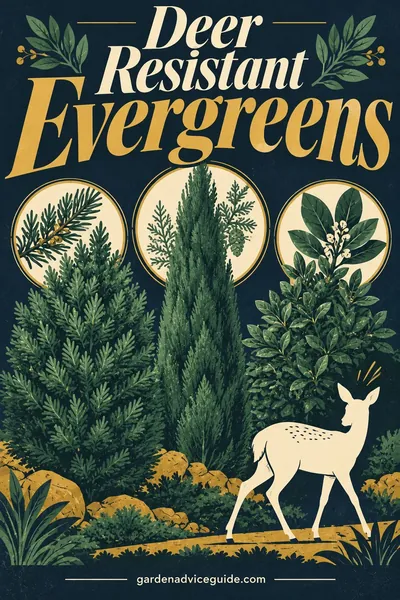
If browsing animals visit your yard, some of the trees on this page need protection for their first several winters. That is a separate question from hardiness, and our deer resistant evergreens page covers it fully, including which trees need fencing.
Evergreen trees by zone: the shortlist
- Zones 2 and 3: white spruce, Black Hills spruce, Colorado blue spruce, Norway spruce in zone 3, balsam fir, concolor fir, eastern white pine, Swiss stone pine, Scotch pine, ponderosa pine, eastern hemlock in sheltered sites, eastern red cedar.
- Zone 4: everything above plus Serbian spruce, Oriental spruce, Fraser fir, Nordmann fir, Austrian pine, limber pine, lacebark pine, Hinoki falsecypress, Atlantic white cedar, weeping hemlock.
- Zone 5: add Korean fir, Japanese black pine, Virginia pine, Japanese cedar, cedar of Lebanon, Carolina hemlock, incense cedar, American holly.
- Zone 6: add Momi fir, Atlas cedar, loblolly pine, Foster holly, hardy Deodar cedar cultivars, cold hardy southern magnolia. Balsam fir drops off the list.
- Zone 7: add Italian cypress in dry climates, Arizona cypress, Deodar cedar, spruce pine, longleaf pine, yaupon holly, Carolina cherry laurel, southern magnolia, strawberry tree. White spruce, Fraser fir and Colorado blue spruce struggle.
- Zone 8: Momi fir, Japanese cedar, Deodar cedar, Atlas cedar, Arizona cypress, loblolly, longleaf and slash pine, spruce pine, eastern red cedar, Taylor juniper, American holly, southern magnolia, live oak, loquat.
- Zones 9 and 10: slash pine, longleaf pine, Italian stone pine and Italian cypress in dry climates, Arizona cypress, Deodar cedar and loblolly pine in zone 9, yaupon holly, live oak, southern magnolia in zone 9, loquat, strawberry tree.
Frequently asked questions
What evergreen trees grow best in zone 5?
Norway spruce, Serbian spruce, Black Hills spruce, concolor fir, Korean fir, eastern white pine, Swiss stone pine, eastern hemlock, Japanese cedar, Hinoki falsecypress, eastern red cedar and American holly all perform well in zone 5. Colorado blue spruce grows there too, but in humid parts of zone 5 it often suffers from needle cast and canker, so Norway or Serbian spruce is the healthier choice.
Which evergreen trees handle heat in zones 8 and 9?
Loblolly, longleaf, slash and spruce pine, Deodar and Atlas cedar, Arizona cypress, Japanese cedar, Momi fir, eastern red cedar, American holly, southern magnolia and live oak. Most spruce, true firs other than Momi fir, and hemlock decline in the heat and humidity of zones 8 and 9, even though winter cold is no problem for them.
What zone does Italian cypress grow in?
Zones 7 to 10, and it performs best where summers are dry. It thrives in California and the desert Southwest and struggles in the humid Southeast, where canker, spider mites and root rot shorten its life. In zone 7, snow and ice can splay the stems, so tie the column loosely in late fall. In humid climates, Taylor juniper is a better narrow column.
What is the fastest growing evergreen tree for cold zones?
Eastern white pine and Norway spruce are the fastest common evergreen trees in zones 3 through 6, often growing 2 feet a year or more once established. Both need space: white pine reaches 50 to 80 feet and Norway spruce spreads 25 to 30 feet at the base. For faster growth in warm zones, loblolly pine and Japanese cedar lead the list.
Which evergreen tree grows in shade?
Eastern hemlock is the most shade tolerant evergreen tree and grows in full shade to full sun, and Carolina hemlock handles part shade. American holly, Japanese cedar and Hinoki falsecypress tolerate partial shade. Spruce, fir, pine and cypress all need full sun and grow thin and open in shade, dropping their lower branches first.
Why are the inner needles on my pine turning yellow in fall?
That is normal seasonal needle drop. Every conifer sheds its oldest needles, and pines, especially eastern white pine, do it visibly each September and October. The yellowing is on the inside of the branches, while the tips stay green. Worry only if the new growth at the branch tips turns yellow or brown, which points to disease, root problems or drought.
When is the best time to plant an evergreen tree?
Late August through early October in zones 3 to 6, or early spring, so roots can grow while the soil is warm and the tree is not under summer stress. In zones 7 to 10, fall through early winter is ideal. Water deeply every week through the first two growing seasons and keep watering in fall until the ground freezes.
How far from the house should I plant a spruce or fir?
At least half the tree's mature spread plus 5 feet, measured from the trunk to the wall. A spruce that matures 25 feet wide goes at least 17 to 18 feet away. Because conifers keep their branches to the ground and cannot be limbed up without losing their shape, plan for the full width at the base, not the narrow tree in the nursery pot.