Small Yard Landscaping Ideas That Fit Real Spaces

Small yard landscaping ideas succeed or fail on one number: the mature width of every plant you buy. A yard under about 1,500 square feet has room for roughly 5 to 7 species, planted in groups of 3 to 5, and almost no room for a shrub that ends up 6 feet across. Cut the species list, check the tag for mature size instead of pot size, and give every square foot a single job. That is most of the work.
Check your zone before you shop. Our free frost date and hardiness zone lookup tells you which of the compact shrubs below survive your winters and when it is safe to plant them.
Updated September 2026
A note on numbers. This page gives you timing, quantities and spacing, not dollar figures. Seed, plant and material pricing varies by region, by supplier and by season, and we do not set any of it. Work out what you need here, then price the list at two or three local suppliers.
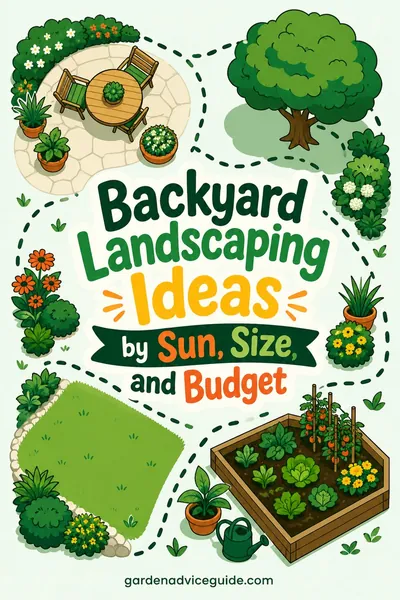
The second most common mistake in a small yard is chopping it into three or four little zones. A 400 square foot patio with a fire pit corner, a raised bed corner, and a seating corner reads as clutter. One generous use plus a perimeter of planting reads as a room. Small spaces reward subtraction.
Small Yard Landscaping Ideas Sorted by What the Space Has to Do
Find the row that matches your actual yard rather than the photo you saved. The last column names what actually drives the material bill in that situation, because the same design costs very different amounts depending on region, delivery access, and the pot size you buy.
| Yard situation | The move that works | Mature width ceiling | What drives the material bill |
|---|---|---|---|
| Under 400 sq ft, fully enclosed | One paved surface wall to wall, plants in a 24 to 36 in perimeter bed | 3 ft | The paving choice, and almost nothing else. Poured concrete, pavers and natural stone sit at three very different levels |
| 400 to 800 sq ft, some sun | Patio on one side, one deep corner bed, no lawn | 4 ft | Patio square footage first, plant pot size second |
| 800 to 1,500 sq ft with kids | Small durable turf panel, planting pushed to the edges | 5 ft | Sod versus seed for the turf panel, and whether the beds get bought soil |
| Narrow strip beside a fence | Single row of columnar or fan trained plants, gravel path | 2 to 3 ft | The cheapest situation on this list. Few plants, and gravel is the least expensive surface you can buy |
| Small yard in deep shade | Wood chip surface, shade perennials in drifts, skip grass | 3 ft | Also cheap. Chips are often free from a tree crew, so the perennials are the whole bill |
| Small front yard | Low structure only, sight lines kept open at the drive | 3 ft | Plant size. Front yards tempt people into buying mature specimens, which is where the money goes |
| Roof deck or paved courtyard | Large containers, one small tree in a 24 in box minimum | 3 ft | The containers and the bought soil to fill them, which together usually beat the plants |
The mature width ceiling in that table is the number to write on your shopping list. It is a design rule rather than a botanical fact: a shrub wider than the ceiling will eventually need shearing twice a year to stay in bounds, which turns a low upkeep bed into a chore. If you love a plant that outgrows the ceiling, give it the whole bed and plant nothing else in that section.
Measure the usable area, not the lot size
Lot size is close to meaningless for planning. What matters is the area you can actually plant or occupy after subtracting the house footprint, the driveway, the AC pad, the utility easement, and the walkways. Pace the yard heel to toe, count 2.5 feet per step, sketch it on graph paper at one square per foot, then shade out everything you cannot touch.
Two clearances that surprise people:
- An outdoor condenser unit needs 24 to 36 inches of clear space on the service side and 4 to 5 feet of open air above it. Check your unit's own manual, since the required clearance varies by model and the manufacturer's figure is the one that governs a warranty claim.
- Gas meters, electric meters, and sewer cleanouts have to stay reachable. Most utilities want 3 feet of clear working space in front of a meter, and burying a cleanout under a new bed will cost you a lot on the day it backs up.
Before any digging deeper than about 12 inches, call 811 or file online for a free utility locate. It is required in every state, it takes two to three business days, and it applies to fence posts and tree pits as much as to a patio excavation.
Mature width is the whole game
Nursery stock is sold at a size that flatters the pot, not the plant. A one gallon shrub that looks like a tuft is often 5 feet across in year six. Plan spacing from the tag's mature width, using this rule: space two shrubs at the average of their mature widths. A plant listed at 3 feet wide and one listed at 5 feet wide go (3 + 5) / 2 = 4 feet apart, measured trunk to trunk.
Then plan the bed depth from the same number. A shrub with a 4 foot mature width needs a bed at least 4 feet deep to sit in without touching the fence behind it or the lawn in front. This is why a 24 inch strip along a fence can hold columnar plants and vines and almost nothing else.
The bed will look thin for two seasons. Fill the gaps with annuals or cheap divisions rather than with more shrubs. Every small yard that looks overgrown today was correctly planted at the wrong spacing five years ago.
Compact Plants That Stay Small on Purpose
Look for the words dwarf, compact, nana, or a named cultivar rather than the species name. A species boxwood is a 10 foot plant. A dwarf cultivar of the same species is a 2 foot plant. The label is the difference.
| Plant | Mature size | Sun | Zones | Pet and child safety |
|---|---|---|---|---|
| Dwarf globe arborvitae | 3 to 4 ft round | Full to part sun | 3 to 8 | Foliage is mildly toxic if chewed; low risk |
| Compact inkberry holly | 3 to 4 ft | Sun to part shade | 5 to 9 | Berries cause vomiting in pets and children |
| Dwarf fothergilla | 2 to 3 ft | Sun to part shade | 5 to 8 | No known toxicity |
| Little bluestem grass | 2 to 3 ft | Full sun | 3 to 9 | Non toxic |
| Dwarf mondo grass | 4 to 8 in | Part to full shade | 6 to 11 | Non toxic |
| Compact nandina | 2 to 3 ft | Sun to part shade | 6 to 9 | Berries are toxic to pets and to birds; pick a fruitless cultivar |
| Dwarf hydrangea cultivars | 2 to 3 ft | Morning sun | 4 to 9 | Mildly toxic to dogs, cats, and horses |
| Creeping thyme | 3 in tall, 12 in wide | Full sun | 4 to 9 | Non toxic and walkable |
| Autumn fern | 18 to 24 in | Shade | 5 to 9 | Non toxic |
| Dwarf Japanese pieris | 2 to 4 ft | Part shade | 5 to 8 | Seriously toxic to pets and children; avoid where either plays |
If a dog or a small child uses the yard, treat the last column as a hard filter rather than a footnote. Nandina berries, pieris, and any yew are worth leaving on the shelf entirely in a space that small, because in a 400 square foot yard there is no such thing as planting something out of reach. For a longer plant list that also handles browsing pressure, see our guide to deer resistant shrubs.
Layout Moves That Make a Small Yard Read Larger
None of these add square footage. They change how the eye reads the space, which is the only thing available.
Run the main line on the diagonal
The longest sightline in a rectangle is corner to corner. A 20 by 30 foot yard has a 36 foot diagonal, calculated as the square root of (20 squared plus 30 squared), which is the square root of 1,300. Turning the patio, the path, or the lawn panel about 45 degrees buys you 6 feet of apparent length at zero cost. It also creates two triangular corners that make excellent deep planting beds.
Hide something so there is a reason to walk over
A yard you can read in one glance feels finished and small. Put a screen, a tall grass, or a single upright shrub two thirds of the way down so one corner is not visible from the door. The brain assumes the space continues. This is the single cheapest trick in small yard design and it costs one plant.
Use fewer species in bigger groups
Three plants of one kind read as an intentional mass. One each of three kinds reads as a collection. In a small yard, plant in odd numbered groups of 3 or 5 and repeat the same group at the far end of the bed. Repetition is what makes a 20 foot bed look designed rather than shopped.
Make every surface do two jobs
A bench with storage under it, a retaining wall built at 18 inches so it doubles as seating, a wide step used as a plant shelf. In a small yard the furniture is part of the hardscape budget, so buy the piece that solves two problems. A 6 foot bench seats three people and stores cushions, and it takes the same footprint as a bench that does neither.
Go vertical before you go smaller
Wall space is free floor space. A fence panel with two espaliered apples, a trellis of climbing hydrangea, or a row of wall mounted planters adds planting area without taking a square foot from the ground. Anchor anything heavy into posts rather than into fence boards, and get permission first if the fence is shared. For crops, a vertical setup pairs well with the approach in our container gardening guide.
Quantities and Cost for a Small Yard, Worked Through
Here is a real example so you can substitute your own numbers. The yard is 22 by 34 feet, which is 748 square feet total.
Step 1, split the area. A 12 by 16 foot patio takes 192 square feet. Perimeter beds 4 feet deep along three sides of the remaining space take about 230 square feet. What is left, roughly 326 square feet, becomes a small lawn panel or a gravel court.
Step 2, count the plants. At an average 4 foot spacing, a bed holds about one shrub per 16 square feet, so 230 / 16 = 14 shrubs. Fill between them with perennials at 18 inch spacing, which is one per 2.25 square feet across maybe 90 square feet of gaps, so about 40 perennials. Buy 5 species, not 14.
Step 3, price the plants. Call two nurseries and ask the price for the same species in one gallon and in three gallon, then do the multiplication yourself: 14 shrubs and 40 perennials. The lever that matters here is pot size, not species. A three gallon shrub typically costs more than double the one gallon of the same plant, so buying the 14 shrubs at one gallon roughly halves the largest line on your list and costs you about two seasons of size. Nothing else you decide in this step moves the number as much.
Step 4, mulch. 230 square feet of bed at 3 inches deep: one cubic yard covers 108 square feet at that depth, so 230 / 108 = 2.1 cubic yards. Add 10 percent for settling and spillage, which brings it to 2.3, so order 2.5 yards. Ask the yard for the per-yard price and the delivery charge as two separate lines. On a load this small the delivery charge is often as big as the mulch itself, which is why a small job costs more per yard than a large one, and it is why splitting a delivery with a neighbor is the single best saving available on this step. Our mulch guide covers which type to use where.
Step 5, edging. The bed perimeter is roughly 80 linear feet. Steel edging is sold by the foot, so multiply your own perimeter by the shelf price and you have the line exactly. A cut spade edge costs nothing at all and takes about 45 minutes a year to refresh, which makes it the cheapest decision in this whole worked example.
Run your own numbers through those five steps and you have a materials list, not an estimate. Take that list to two suppliers, keep the patio surface as its own separate quote, and you will know what your yard costs rather than what an average yard costs.
Frequently Asked Questions
How many different plants should a small yard have?
Five to seven species for a yard under 1,500 square feet, repeated in groups. That gives you one or two evergreens for winter structure, one flowering shrub, two perennials, and a ground cover. More species is not more interest, it is more maintenance and less rhythm. If you want variety, get it from a container or two that you replant seasonally.
Can I have a lawn in a small backyard?
You can, but be honest about the size threshold. A turf panel under about 200 square feet is hard to mow well, wears out fast where people walk the same line, and needs the same fertilizer and water schedule as a big lawn for far less payoff. Under 200 square feet, a paved surface, gravel, or a tough ground cover usually serves better. Between 200 and 500 square feet, a lawn works if it gets 4 or more hours of sun and gets its own schedule; ours is in the lawn care schedule.
What is the smallest tree I can plant near a house?
Keep any tree at least half its mature canopy width away from the foundation, and further if you have a slab or shallow footings. For a small yard, look for trees listed under 20 feet tall at maturity, such as serviceberry, Japanese maple cultivars, redbud cultivars, or crabapple. Check the mature spread on the tag, then measure that distance from the wall before you dig. Utility lines overhead cap the height for you.
Is gravel a good idea in a small yard?
Gravel is cheap, drains well, and stays put in a space with no slope. It works best over a compacted base with a woven geotextile beneath it, at 2 to 3 inches deep, edged so it does not migrate into beds. It gets hot in full sun, it is hard on bare feet, and it is a chore to remove later. Use 3/8 inch angular gravel for walking surfaces, since round pea gravel rolls underfoot.
How do I stop weeds without spraying in a tight space?
In a small yard the mechanical options actually win, because the area is small enough to keep up with. Mulch at 3 inches, edge cleanly, and hand pull after rain when the soil releases roots. Sheet mulching with cardboard under the mulch kills existing turf in one season. If you do reach for a product, the label directions are the legal requirement, not a suggestion, and that includes the setback from edible plants and any wait before pets return to the area. Our guide on how to get rid of weeds walks through the non chemical sequence.
When is the best time to plant a small yard makeover?
Tie it to your frost dates rather than to a month. Fall planting, roughly 6 weeks before your average first fall frost, is best for shrubs and trees in most of the country, because roots grow while the soil is still warm and the plant is not carrying leaves. Spring planting after your average last frost works too, but you commit to watering through the first summer. In the hottest zones, the fall through winter window is the only safe one. Look yours up with the frost date and hardiness zone lookup, and see the growing zones tool for what your zone will actually support.
How much does a small yard makeover cost if I hire it out?
Installed landscaping is priced per square foot of treated area, and hardscape runs well above planting for the same square footage. The spread between a low quote and a high one on the identical yard is usually wider than people expect, and it is driven by four things: access, meaning whether a machine can reach the back yard or every ton goes through a gate in a wheelbarrow; region, since labor rates vary enormously; the stone or paver you choose, which can differ several times over for the same coverage; and whether the site needs drainage or grading work before anything else happens. Get three quotes, hand each contractor the same written scope with square footages and the exact material named, and ask every one of them what they have assumed about access and drainage. A bid well below the others has almost always left out base preparation, drainage, or haul-away. Doing the planting yourself and hiring only the hardscape is the split that saves the most, since hardscape is where the specialized tools and the code and drainage judgment live. For more layout options first, start with our overview of landscaping ideas.