How to Compost

Compost needs exactly four things: carbon, nitrogen, air, and water. Nearly every failed pile in the world traces back to one of those four being off, and usually it's air or nitrogen. Get the four right and the pile does the work without you.
The practical version is this: pile 2 to 3 parts dry brown material to 1 part wet green material by volume, keep it as damp as a squeezed-out sponge, and make sure air can move through it. That's the whole recipe. Everything else is speed.
Planning where the finished compost goes? Work out how many cubic feet your beds actually need with our free raised bed soil calculator before you start hauling.
Updated August 2026
The Four Things a Pile Needs
Microbes build compost. They're doing the eating, and like anything else alive they need food, water, and oxygen. Carbon and nitrogen are the food.
Carbon (the browns). Dry, dead, papery stuff. Fall leaves, straw, shredded cardboard, wood chips, paper. Carbon is the energy source and it's also what gives the pile structure, which is where the air gets in.
Nitrogen (the greens). Wet, fresh, living stuff. Grass clippings, kitchen scraps, coffee grounds, spent plants, manure from plant eaters. Nitrogen is the protein microbes use to build their own bodies, and it's what makes a pile heat up.
Air. Composting microbes that need oxygen work fast and produce almost no smell. The ones that work without oxygen are slow and produce the classic rotten-garbage stink. A pile that has gone anaerobic hasn't stopped composting, it has just switched to the version you don't want.
Water. Around 40 to 60 percent moisture, which in practice means a handful squeezed hard should feel damp and might release a drop or two, but shouldn't drip a stream. Too dry and everything stops. Too wet and the water fills the air pockets, which brings you right back to the smell problem.
Notice that air and water fight each other for the same pore space. That tension is the reason most compost problems exist.
How to Compost: The Browns to Greens Ratio That Makes It Work
You'll see the ratio written as 25:1 or 30:1 carbon to nitrogen. That number is chemistry, measured in a lab, and it's not something you can eyeball with a bucket of leaves. Ignore it.
The usable version is 2 to 3 parts browns to 1 part greens by volume, judged by the loose bucket, not by weight. Two buckets of shredded leaves to one bucket of kitchen scraps. Three buckets of leaves if the greens are very wet, like fresh grass clippings or melon rinds.
Two rules of thumb keep you honest:
- If it's dry and it used to be brown, it's a brown.
- If it's wet, fresh, or it stinks when it sits in a bag, it's a green.
Coffee grounds break that rule and confuse everyone. They're brown in color and count as a green, because they're nitrogen rich.
| Browns (carbon) | Notes | Greens (nitrogen) | Notes |
|---|---|---|---|
| Dry fall leaves | The best free brown there is. Shred with a mower to speed things up | Grass clippings | Very high nitrogen. Add in thin layers or they mat into slime |
| Straw | Great structure, slow to break down. Not hay, which carries weed seed | Kitchen fruit and vegetable scraps | Chop them. Whole apples take months |
| Shredded cardboard | Remove tape and glossy labels first | Coffee grounds and paper filters | Brown in color, green in behavior |
| Paper, uncoated | Shred it. Sheets mat into a wet layer | Fresh plant trimmings | Skip anything diseased |
| Wood chips and sawdust | Untreated only. Slow, best in small amounts | Manure from chickens, rabbits, horses, cows | Never from dogs, cats, or pigs |
| Pine needles | Fine in moderation. They're slow and slightly acidic | Eggshells | Nearly neutral, add for calcium. Crush them |
| Dryer lint | Only from natural-fiber loads | Spent coffee, tea leaves, and old bread | Bread attracts animals in an open pile |
| Corn stalks and cobs | Chop or crush. Cobs are slow | Weeds, before they set seed | Only if the pile gets genuinely hot |
Most people run short on browns, not greens, because greens show up every day from the kitchen and browns show up once a year in the fall. The fix is to stockpile bagged leaves each autumn and pull from that bag all year.
Hot Composting vs Cold Composting, Honestly
Almost everyone reading this is cold composting, whether they planned to or not. That's fine. Cold composting works. It just takes a year.
Hot composting is a real technique with real requirements, and it's a commitment. You need enough volume to hold heat, a balanced mix built all at once, and a schedule of turning. Skip any one of those and you have a cold pile in a fancy bin.
| Hot composting | Cold composting | |
|---|---|---|
| Time to finished compost | 6 weeks to 3 months | 6 months to 2 years |
| Peak temperature | 130 to 160 F | Ambient, maybe 90 F briefly |
| Kills weed seeds | Yes, above about 140 F held for several days | No |
| Kills most plant pathogens | Mostly, in the hot center only | No |
| Minimum size | About 3 ft x 3 ft x 3 ft | Any size |
| Build style | All at once, in one batch | Add as you go |
| Turning | Every 3 to 7 days at first | Never, or once out of curiosity |
| Effort | High for a month, then done | Nearly zero |
| Best for | Weedy material, big fall cleanups, a gardener in a hurry | Kitchen scraps and normal household volume |
The honest recommendation: if you have a single household's kitchen scraps and a bag of leaves, cold compost. It costs nothing and asks nothing. Save hot composting for the year you have a huge cleanup, or the year you want to compost weedy material without seeding your beds.
One thing to be clear about with cold piles: they do not kill weed seeds or most disease organisms. Keep both out of a cold pile from the start.
Why a Hot Pile Has to Be at Least 3 Feet Cubed
A pile heats up because the microbes inside it are producing heat faster than the pile loses it to the air. That's it. It's a race between generation and loss.
Heat is generated by volume. Heat is lost through surface area. A small pile has a terrible ratio of volume to surface area, so it sheds heat as fast as it makes it and never climbs.
Roughly 3 ft x 3 ft x 3 ft, which is 27 cubic feet, is the smallest pile that reliably insulates its own core. Below about 2.5 feet on a side, a home pile in most climates simply will not sustain 140 F no matter how good the mix is. That's physics, not technique.
A few practical consequences:
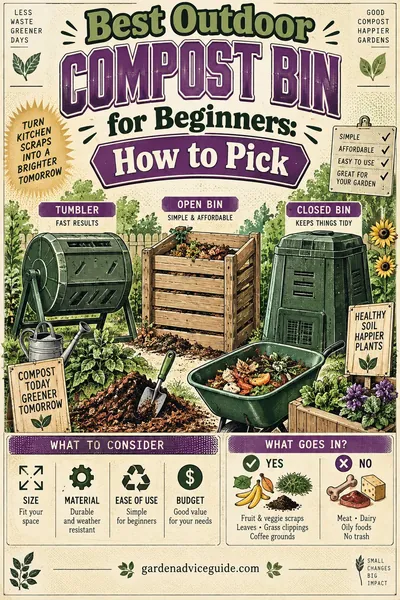
- A tumbler under about 40 gallons will almost never reach true thermophilic temperatures. Tumblers are convenience devices, not hot composters. They're still worth owning.
- In cold weather you need more volume, not less, to hit the same temperature.
- A pile much bigger than about 5 feet on a side compacts under its own weight and goes anaerobic in the middle.
So the working window for a hot pile is a cube between 3 and 5 feet on a side.
Troubleshooting a Compost Pile
Every common problem here comes back to one of the four inputs. Find your symptom, and the cause column tells you which one is off.
| Symptom | What it means | The fix |
|---|---|---|
| Smells like ammonia | Too much nitrogen. Excess is off-gassing as ammonia because there isn't enough carbon to lock it in | Mix in browns, a lot of them. Two buckets of shredded leaves per bucket of the wet material |
| Smells rotten, like sewage or sour garbage | Anaerobic. Too wet, too compacted, or both. Oxygen is gone | Turn it and add coarse browns for structure. Straw and wood chips work better than leaves here. Cover it if it's rain-soaked |
| Warm for a week, then cold | Normal for a batch that's used up its easy nitrogen, or it dried out | Turn it. If it's dry, water as you turn. If it stays cold and looks finished, it may be done |
| Never got hot at all | Too small, too dry, or too few greens | Check size first (needs 27 cubic feet), then moisture, then add greens |
| Soggy, water pooling, matted layers | Too much water, not enough structure | Turn in dry browns. Never build a pile in a low spot that collects runoff |
| Bone dry, material looks unchanged | Below about 40 percent moisture, microbes are dormant | Water in layers while turning. A dry pile needs far more water than you think, often 10 gallons or more |
| Attracting rats, raccoons, or flies | Food waste on the surface, or meat, dairy, or grease went in | Bury every kitchen addition 8 inches deep under browns. Use a closed bin. Remove any animal products |
| Full of ants | Too dry | Water it thoroughly and turn |
| White fuzzy growth through the pile | Fungal mycelium, doing its job | Nothing. That's a healthy pile |
| Still recognizable after a year | Pieces too big, or a cold pile with no nitrogen | Chop finer, add greens, and give it another season |
What Not to Compost, and the Actual Reason
The blanket lists you see online rarely say why, and the why matters, because a couple of these are safe in a commercial facility and not in your backyard.
Meat, fish, and bones. They attract rats, raccoons, and dogs, and they putrefy rather than compost in a low-oxygen home pile. Commercial facilities handle them because they hold high heat for days. Your bin doesn't.
Dairy, oil, and grease. Fats coat particles and repel water, which blocks the microbes from getting to the material at all. They also go rancid and smell, and they draw the same animals meat does.
Dog, cat, and pig waste. These carry pathogens that infect humans, including roundworm and Toxoplasma. Roundworm eggs in particular survive temperatures and durations a home pile never reaches, and they persist in soil for years. This is a hard no for anything that touches a food garden.
Diseased plants. A cold pile does not kill fungal spores or bacterial pathogens, so composting a blighted tomato plant is a way to store the disease and then spread it evenly across every bed next spring. Trash or burn them instead. If you're running a genuinely hot pile and you're confident about the temperature, some pathogens die, but blight and clubroot are not worth the gamble.
Treated, painted, or stained wood. Older pressure-treated lumber can contain chromated copper arsenate, and newer treatments still use copper compounds at levels that are fine for a fence post and not fine for a vegetable bed. Paints and stains carry their own additives. Untreated wood only.
Weeds that have set seed, in a cold pile. The seeds survive and you plant them yourself later.
Glossy or coated paper and receipts. Coatings and thermal print chemistry don't belong in food-garden soil.
Charcoal briquette ash. Briquettes contain binders and sometimes lighter fluid. Ash from clean untreated firewood is fine in small amounts, and it raises pH, so go easy on it and check your soil first with our guide to testing garden soil.
How to Tell When Compost Is Finished
Finished compost passes three checks, and the first two take about ten seconds.
The look. Dark brown to near black, crumbly, uniform. You should not be able to identify what anything used to be, with the possible exception of eggshells, avocado pits, and corn cobs, which outlast everything and can just be screened out and thrown back in the next pile.
The smell. Sweet, earthy, like a forest floor after rain. Not sour, not sharp, not like ammonia, not like anything you'd recognize as garbage. If you have to think about whether the smell is okay, it isn't finished.
The temperature. A finished pile sits at ambient temperature and stays there after you turn it. If turning makes it heat up again, there's still undigested material in there.
There's a fourth test worth doing before you use compost on seedlings. Fill two small pots with your compost, sow a few fast seeds like radish or lettuce in each, and keep them damp. If germination is normal and the seedlings look healthy after two weeks, the compost is mature. If germination is poor or the seedlings look stunted and yellow, the compost is still active and will pull nitrogen out of the soil as it finishes. Let it cure another month.
That immaturity problem is the single most common way good compost causes harm. Unfinished compost is not fertilizer, it's competition.
Worked Example: One 3x3 Bin Over a Season
Here's a real timeline for a single bin, 3 ft x 3 ft x 3 ft, built the cold way by a household of two, starting in April.
April. Bin gets a 6-inch base of coarse straw for drainage and airflow. Then a bucket of kitchen scraps (about 2 gallons) goes in, covered with roughly 6 gallons of shredded leaves from last fall's stockpile. Ratio is about 3 to 1 by volume. Total in the bin: about 4 cubic feet.
May through August. Every 3 to 4 days, another 2 gallons of scraps goes in, always buried in the center and covered with about 5 gallons of leaves or shredded cardboard. Grass clippings get added in 2-inch layers only, never more, because a thick layer of clippings mats into a wet sheet that water can't pass through. By the end of August, roughly 26 additions have gone in. The bin looked full in June and is only two-thirds full now, because the bottom is collapsing as it breaks down. That settling is the sign it's working.
Total materials for the season: about 52 gallons of greens (7 cubic feet) and about 140 gallons of browns (19 cubic feet). About 26 cubic feet in, which is roughly one full bin.
September. The leaf stockpile runs out right as fall cleanup provides more. The bin gets one turn, mostly to check moisture. The center is damp and dark, the outer 6 inches are dry and still recognizable. Those dry edges get moved to the middle and watered.
October through February. Nothing gets added. The pile freezes and thaws. It drops to about 40 percent of its original height.
Late April, one year in. About 9 cubic feet of finished compost, dark and crumbly, plus a screening bowl of corn cobs and avocado pits that go into the new pile. That 9 cubic feet is enough to top-dress a 4 ft x 8 ft raised bed with about 3 inches of compost, or to amend roughly 100 square feet of garden at 1 inch.
The takeaway from the numbers: roughly 26 cubic feet in gives you about 9 cubic feet out. Compost loses about two-thirds of its volume. Plan for that when you size a bin, and plan on two bins if you want a finished batch every year without stopping additions.
Using Finished Compost
Compost is a soil conditioner first and a fertilizer a distant second. It's typically somewhere near 1-1-1 in nutrient terms, which is weak, but it improves structure, water holding, and biological activity in a way no bagged fertilizer does.
Three ways to use it that actually pay off:
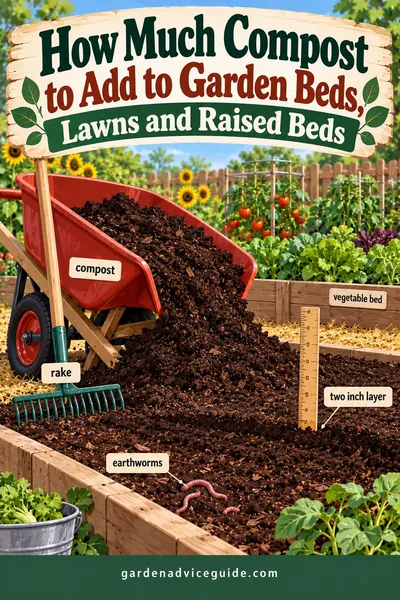
- Top-dress beds with 1 to 2 inches in spring or fall and let worms work it in. Digging it in is optional and often unnecessary, and our page on how much compost to add to a garden turns that depth into a cubic yard figure.
- Mix into new raised beds at about 25 to 30 percent by volume, with the rest topsoil and something for drainage. Run the numbers for your bed size with the raised bed soil calculator so you buy once.
- Feed heavy fall plantings. A shovelful worked into the planting hole gives fall containers and perennials a steadier start than a shot of liquid feed, which matters for things like fall mums that have to root fast in cooling soil.
One caution: compost is not pH-neutral by default, and finished compost from lots of wood or ash can run alkaline. If you're growing something fussy, test rather than guess.
Frequently Asked Questions
How long does compost take?
A cold pile takes 6 months to 2 years, with about a year being typical for a home bin built as material comes in. A properly built and turned hot pile finishes in 6 weeks to 3 months. Chopping material smaller is the single biggest speed factor in both cases.
Do I need a bin, or can I just make a pile?
An open pile works fine and gets more air than most bins. A bin matters when you want to keep animals out, keep the pile tidy in a small yard, or hold heat in cold weather. A three-sided pallet bin costs nothing and does all three reasonably well.
Can I compost in winter?
Yes, though it slows to a crawl or stops entirely once the pile freezes. Keep adding through winter and bury each addition. Everything you add is banked, and the pile restarts on its own in spring. A pile with more volume stays active longer into the cold.
Why is my compost pile not heating up?
In order of likelihood: it's too small (under about 27 cubic feet), it's too dry, or it doesn't have enough nitrogen. Check size and moisture before you add anything, because those two account for most cold piles. A pile that heated and then cooled is usually just finished with the easy material and needs a turn.
Can I put weeds in the compost?
Weeds before they flower are excellent greens. Weeds that have set seed only belong in a pile you know hit 140 F and held it, which rules out cold composting. Perennial roots like bindweed and quackgrass survive most home piles and are better off in the trash.
Should I add worms to my compost pile?
Not to a hot pile, because the heat will kill them. Worms find a cold outdoor pile on their own and their presence is a sign it's working. A dedicated worm bin is a different system entirely, run at room temperature with a much narrower diet.
How do I stop compost from smelling?
Ammonia means too much nitrogen, so add browns. A rotten or sour smell means no oxygen, so turn it and add coarse material for structure. Both fixes work within a day or two. A well-run pile smells like soil, and if yours doesn't, one of those two things is the reason.
Is bagged compost the same as homemade?
It's usually more consistent and always more expensive, and quality varies widely between brands. Bagged compost is a fine way to fill a new bed fast. Homemade compost tends to have more biological life and costs nothing except the leaves you were raking anyway. Most gardens use both.