Organic Gardening Tips That Work in a Real Backyard

Organic gardening comes down to three habits: feed the soil instead of the plant, keep the ground covered, and catch problems in the first week instead of the third. Do those three things and most of the sprays and rescues you were bracing for never become necessary. Everything else on this page is detail that makes those three easier.
The organic gardening tips that pay off fastest, in order: add 1 to 2 inches of compost a year, mulch 2 to 3 inches deep, rotate plant families on a 3 to 4 year cycle, plant at the right soil temperature, and scout your beds twice a week. That sequence is deliberate. Soil work prevents pest problems that sprays can only chase.
Building or refilling a bed this season? Work out exactly how much compost and topsoil you need with our free raised bed soil calculator so you buy once and mix it right.
Updated September 2026
Organic Gardening Tips That Do the Most Work, Ranked
If you only change a few things this year, change these. They're listed by how much trouble each one prevents per hour spent.
| Rank | The habit | What it actually prevents | Time cost |
|---|---|---|---|
| 1 | 1 to 2 inches of compost yearly | Compaction, drought stress, weak growth, most nutrient deficiencies | One afternoon per season |
| 2 | 2 to 3 inches of mulch, kept topped up | 80 to 90 percent of weed seedlings, splash-borne leaf disease, fast drying | Two hours per bed, once |
| 3 | Scouting twice a week | Aphid colonies, hornworms, and squash bugs while they're still countable | 5 minutes per visit |
| 4 | Crop family rotation, 3 to 4 years | Soilborne disease buildup, root knot nematodes, repeat pest pressure | Planning only |
| 5 | Planting at the right soil temperature | Rot, stalled seedlings, and the pest waves that hit weak plants | Cost of a soil thermometer |
| 6 | Correct spacing | Powdery mildew, blight, and the crowding that hides pests | Planning only |
| 7 | Flowers for beneficial insects | Aphid and caterpillar outbreaks, poor fruit set | One border strip |
| 8 | A soil test every 3 years | Guessing, over-liming, and locked-up nutrients | One sample |
Notice what isn't on the list: any product. Organic gardening gets sold as a shopping list of approved sprays, and that framing is backwards. The sprays are the last 5 percent, and you need less of them each year that the first four habits are in place.
Feed the Soil, Not the Plant
Conventional fertilizing works like an IV drip. You supply soluble nutrients, roots take them up, and when they're gone you supply more. Organic fertilizing works like a pantry. You add material that soil life digests slowly, and the microbes hand nutrients to roots over months.
That difference has a practical consequence people miss: organic amendments need soil biology to be active, and soil biology needs warmth and moisture. Below about 50 F soil temperature, microbial activity crawls. Blood meal spread on frozen ground in March does nothing until the soil wakes up.
Three inputs cover almost everything a home garden needs.
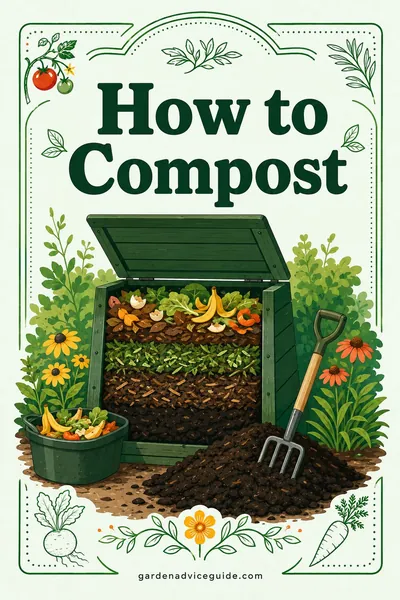
Compost. The backbone. It's a weak fertilizer, roughly 1-1-1, but it builds structure, holds water, and feeds the microbes that release everything else. Our full guide to composting covers the browns to greens ratio and how to fix a stalled pile.
Mulch. Straw, shredded leaves, or wood chips on paths. Mulch is slow-release compost that also blocks weeds and buffers soil temperature. Our mulch guide has depth and material specifics per bed type.
A targeted amendment when a test says so. Not before. Guessing at nutrients is how gardens end up with phosphorus levels three times what any vegetable can use.
Organic Amendments and How Fast They Release
| Amendment | Typical N-P-K | Release speed | Best use |
|---|---|---|---|
| Finished compost | About 1-1-1 | Slow, all season | Yearly top-dress on everything |
| Composted manure | 1-1-1 to 2-1-2 | Slow to medium | Bed prep, at least 4 months before harvest |
| Blood meal | 12-0-0 | Fast, 2 to 6 weeks | A nitrogen rescue on yellowing greens |
| Feather meal | 12-0-0 | Slow, 4 to 6 months | Pre-plant nitrogen for corn or heavy feeders |
| Alfalfa meal | 3-1-2 | Medium, 4 to 8 weeks | Balanced general feed, also feeds microbes |
| Fish emulsion | 5-1-1 | Very fast, days | Seedlings and containers, diluted |
| Bone meal | 3-15-0 | Slow | Only where a test shows low phosphorus |
| Kelp meal | 1-0-2 | Slow | Trace minerals, stress tolerance |
| Greensand | 0-0-3 | Very slow, years | Long-term potassium on sandy soil |
| Wood ash | 0-1-3 | Fast on pH | Raises pH, use sparingly and test first |
Two cautions worth repeating. Bone meal and rock phosphate get recommended reflexively for tomatoes and bulbs, and most established garden soil already has plenty of phosphorus. Excess phosphorus suppresses the mycorrhizal fungi that help roots find it in the first place. And wood ash raises pH fast, so check where you stand with our guide to testing garden soil before you spread any.
Keep the Ground Covered All Year
Bare soil is the default problem in a home garden. It crusts, it dries, it grows weeds, and every hard rain splashes soilborne fungal spores up onto lower leaves. That splash is how early blight gets onto tomatoes most years.
Mulch fixes all of it at once. Aim for 2 to 3 inches over vegetable beds and 3 to 4 inches around shrubs, pulled back 2 inches from any stem so the crown stays dry.
Match the mulch to the bed:
- Straw for vegetable beds. Light, easy to move, breaks down in one season. Buy straw, not hay, since hay carries weed seed.
- Shredded leaves for anything. Free every October. Shred with a mower first or whole leaves mat into a water-shedding sheet.
- Wood chips for paths, perennials, and fruit trees. Too slow for annual beds where you're digging every few weeks.
- Living mulch, meaning a cover crop, for beds that sit empty over winter.
Cover crops are the most underused organic tool in home gardens. Sow crimson clover or hairy vetch in early fall, roughly 4 weeks before your first frost, and they fix nitrogen through winter. Winter rye handles later sowings and colder zones. Buckwheat is the summer option, flowering in 30 to 45 days, which makes it perfect for a bed between a spring and fall crop. Cut cover crops down before they set seed, then leave the residue on the surface or turn it in two to three weeks before planting.
If you'd rather stop digging entirely, sheet mulching gets you there. Our no-dig gardening walkthrough covers cardboard, compost depth, and what to do about existing perennial weeds.
Rotate Families, Not Crops
Rotation only works if you rotate by botanical family, because pests and diseases target families. Moving tomatoes to where the peppers were is not a rotation. They're both nightshades, and they share early blight, verticillium wilt, and bacterial spot.
The six families that matter in most vegetable gardens:
| Family | Members | Watch for | Soil role |
|---|---|---|---|
| Nightshade | Tomato, pepper, eggplant, potato | Blight, verticillium, hornworm, Colorado potato beetle | Heavy feeder |
| Brassica | Broccoli, cabbage, kale, radish, turnip | Clubroot, cabbage worm, flea beetle | Heavy feeder |
| Cucurbit | Cucumber, squash, melon, pumpkin | Powdery mildew, vine borer, cucumber beetle | Heavy feeder |
| Legume | Peas, beans | Powdery mildew, Mexican bean beetle | Adds nitrogen |
| Allium | Onion, garlic, leek, shallot | White rot, thrips | Light feeder |
| Umbellifer | Carrot, parsley, dill, celery | Carrot rust fly | Light feeder |
A workable 4-bed rotation runs nightshades, then brassicas, then legumes, then roots and alliums, and back around. The legume year matters because it resets nitrogen before the heavy feeders come back. The full sequence and a bed map are in our crop rotation guide.
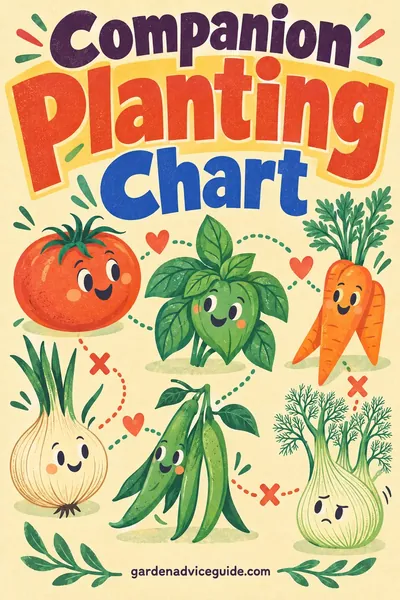
Companion planting stacks on top of rotation rather than replacing it. Some pairings are genuinely useful (basil and tomatoes share the same season and water needs, alliums near carrots confuse carrot rust fly, flowering umbellifers pull in parasitic wasps), and some are internet folklore. The companion planting chart sorts the ones with a real mechanism from the ones without.
Time Everything by Soil Temperature
Timing is pest control. A plant put out too early sits cold, stalls, and gets eaten, because pests find stressed plants first. The same variety planted two weeks later into warm soil often outgrows the pressure entirely.
Stop using calendar dates alone. Use soil temperature at 2 inches deep, taken mid-morning, plus your frost window.
| Crop | Minimum soil temp | Ideal soil temp | Plant relative to last frost |
|---|---|---|---|
| Peas, spinach | 40 F | 50 to 65 F | 4 to 6 weeks before |
| Lettuce, radish | 40 F | 55 to 65 F | 4 weeks before |
| Broccoli, cabbage transplants | 45 F | 55 to 70 F | 3 to 4 weeks before |
| Carrots, beets | 45 F | 60 to 75 F | 2 to 4 weeks before |
| Beans | 60 F | 70 to 80 F | 1 week after |
| Tomato transplants | 60 F | 65 to 75 F | 1 to 2 weeks after |
| Cucumbers, squash | 65 F | 70 to 85 F | 2 weeks after |
| Melons, okra | 70 F | 75 to 85 F | 2 to 3 weeks after |
Those windows shift by several weeks between zone 5 and zone 8, which is why one national planting date is useless. Look up your own dates with the frost dates tool and the when to plant planner, then work backward for anything you're starting indoors.
Timing also lets you dodge specific pests. Squash vine borer adults fly for a few weeks in early to midsummer in most of the country, so a squash sown after that flight often escapes them completely. Row cover on cucurbits from planting until first female flowers blocks cucumber beetles during the window that matters, and comes off in time for pollination. Neither trick needs a spray.
Once you're timing well, succession planting doubles what a small bed produces. Sow lettuce and beans every 2 to 3 weeks instead of all at once.
Organic Pest Control, in the Right Order
The mistake is reaching for a spray first. Even organic-approved sprays are broad enough to kill beneficial insects, and killing beneficials is how a small aphid problem becomes a permanent one. Work down this ladder and stop as soon as it's handled.
| Step | Action | Works on | Notes |
|---|---|---|---|
| 1 | Scout twice weekly, check leaf undersides | Everything | Catches problems while a finger squish still works |
| 2 | Handpick and drop in soapy water | Hornworms, squash bugs, bean beetles, slugs | The single most effective organic method there is |
| 3 | Strong water spray | Aphids, spider mites, whiteflies | Repeat every 2 to 3 days for a week |
| 4 | Physical barriers | Flea beetles, cabbage worm, root maggot, borers | Row cover, collars, copper tape for slugs |
| 5 | Encourage predators | Aphids, mites, caterpillars, thrips | Flowering borders, no broad-spectrum sprays |
| 6 | Targeted biologicals | Caterpillars only (Bt), fungus gnats (Bt israelensis) | Very narrow, safe for bees |
| 7 | Insecticidal soap or horticultural oil | Soft-bodied insects on contact | Evening only, no residual, may burn leaves in heat |
| 8 | Neem, pyrethrin, spinosad | Persistent outbreaks | Last resort, all harm bees, apply at dusk |
Three rules make step 7 and 8 safer. Spray at dusk so the residue dries before bees are active again. Never spray open flowers. And accept that pyrethrin and spinosad are broad-spectrum insecticides that happen to be organic-approved, not gentle ones.
For the two most common calls, our detailed walkthroughs cover thresholds and timing: getting rid of aphids and getting rid of slugs.
Building the predator side is slower but permanent. Sweet alyssum, dill, cilantro, yarrow, and fennel feed the tiny parasitic wasps and hoverflies that do most of the actual aphid control in a healthy garden. Leave one dill plant to flower and you'll see the difference the following season. The pollinator planting guide covers bloom succession so something is flowering from April through October.
Natural Weed Control That Isn't Just Pulling
Weeds are a light problem before they're a labor problem. Deny them light and most never appear.
- Mulch at 3 inches stops the vast majority of annual weed seedlings. Thin spots are where weeds come back, so top it up midseason.
- Never turn soil you don't have to. Every deep turn brings a new batch of dormant seed up into the light.
- Hoe when they're small. A sharp stirrup hoe run just under the surface on a dry day kills seedlings in seconds. Wait until they're 4 inches tall and you're pulling by hand.
- Water the plants, not the paths. Drip lines and soaker hoses feed roots and leave the gaps dry.
- Cut perennial weeds repeatedly rather than digging. Bindweed and quackgrass regrow from every root fragment a shovel makes.
Vinegar and salt recipes come up constantly. Household vinegar burns young annual leaves and does nothing to perennial roots, and salt accumulates in soil where it damages structure and kills what you plant next. More options and their real limits are in our weed control guide.
Water Deep, Early, and at the Roots
Watering habits do more disease damage in organic gardens than almost anything else. Overhead watering in the evening leaves leaves wet all night, which is exactly the condition powdery mildew and blight need.
The rule is 1 inch per week, including rain, delivered in one or two deep soakings rather than daily sprinkles. Deep watering pulls roots down where soil stays moist. Daily light watering keeps roots in the top inch where they cook.
Here's the conversion that makes it usable: 1 inch of water over 1 square foot is about 0.62 gallons.
Water in the morning, at soil level, and mulch afterward to hold it. For per-crop amounts and container adjustments, the watering guide has the numbers.
Worked Example: One 4x8 Raised Bed, One Organic Season
A single bed, 4 ft x 8 ft, 10 inches deep. That's 32 square feet and about 26.7 cubic feet of volume.
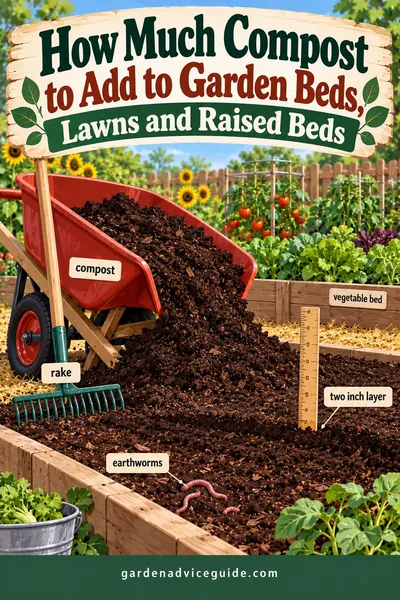
March, bed prep. A soil test comes back at pH 6.3 with adequate phosphorus and low nitrogen, which is typical for a bed built two years ago. No lime needed, no bone meal needed. The bed gets 3 cubic feet of finished compost spread on top, which works out to 1.1 inches deep over 32 square feet, plus 1 pound of alfalfa meal (a 3 pound per 100 square foot rate scaled down). Nothing gets dug in. Worms move it down within a month.
April. Soil at 2 inches reads 48 F, so peas and spinach go in along the north end. Tomato seeds started indoors 7 weeks ago sit under lights.
Mid-May. Soil hits 62 F. Four tomato plants go in at 24-inch spacing down the center, staggered, which is a real constraint in a 4-foot-wide bed. Spacing is where beginners lose to disease, so run your layout through the plant spacing calculator before you commit. Straw mulch goes down 3 inches deep, which takes about 8 cubic feet for 32 square feet, pulled back 2 inches from each stem.
Late May. Peas finish. Bush beans go in behind them, which is the legume slot doing double duty.
June. Scouting on a Tuesday finds 6 aphids on a growing tip. They get wiped off with a thumb. No spray. Sweet alyssum planted at both corners in April is flowering, and hoverflies are already working it.
July. One hornworm shows up, handpicked. A second one has white rice-shaped cocoons on its back, so it stays put: those are braconid wasp pupae, and letting that caterpillar die naturally releases dozens of wasps that hunt the rest.
Weekly water. 32 square feet at 1 inch per week needs about 20 gallons. That's two 10-gallon soakings, Monday and Thursday, through a soaker hose under the mulch. In an August heat wave it goes to three.
September. Tomatoes wind down. The bed gets sown with crimson clover as a cover crop 5 weeks before the first frost.
Season totals. 3 cubic feet of compost, 1 pound of alfalfa meal, 8 cubic feet of straw, about 400 gallons of water, and zero pesticide applications. The following March, that clover gets cut down and the whole cycle starts with slightly better soil than it did the year before. That's the actual mechanism behind organic gardening: the inputs shrink every year because the soil does more of the work.
Mistakes That Cost People a Season
Treating organic as a product swap. Buying an approved spray to replace a conventional one skips the part that does the work. Soil and timing come first.
Adding compost to the planting hole only. It creates a pot of rich soil inside poor soil, and roots circle instead of spreading. Top-dress the whole bed.
Using unfinished compost. Compost still actively breaking down pulls nitrogen out of the soil to finish the job, which stunts everything nearby. If it doesn't smell like a forest floor, let it cure another month.
Spraying neem in midday heat. Oil plus sun equals burned leaves, and midday is when bees are working. Dusk, always.
Skipping the soil test. Three years of guessed amendments can push phosphorus or pH somewhere no vegetable is happy, and both take years to walk back.
Saving seed from hybrids. Seed from an F1 hybrid does not come true. Save from open-pollinated and heirloom varieties instead, using the isolation distances in our seed saving guide.
Frequently Asked Questions
How long does it take for a garden to become organic?
Growing organically starts the day you stop applying synthetic inputs. Certification is different: the USDA National Organic Program requires 36 months with no prohibited substances before land can be certified, which matters if you plan to sell. For a home garden, the soil change is what you'll notice, and it takes about two to three seasons of compost and mulch before the difference in water holding and pest pressure is obvious.
Is organic gardening more work?
More planning up front, less firefighting later. The first two seasons take extra hours in bed prep, mulching, and scouting. After that, a well-mulched bed with healthy soil needs less watering, less weeding, and fewer interventions than a conventional bed of the same size. The work moves earlier in the season rather than disappearing.
Can I use Miracle-Gro or similar in an organic garden?
Standard synthetic soluble fertilizers are not organic-approved, and their bigger issue is that they bypass the soil biology you're trying to build. Roots fed soluble nitrogen invest less in mycorrhizal partnerships. If you need a fast correction, fish emulsion and blood meal both act within days and stay inside the system.
What are the best organic gardening tips for beginners?
Start with three: top-dress 1 to 2 inches of compost every year, mulch 2 to 3 inches deep and keep it topped up, and walk your beds twice a week looking under leaves. Those three habits prevent more problems than any product on a shelf. Add crop rotation in year two once you know what you actually grow.
Do I need to buy special seeds?
No. Certified organic seed is grown without synthetic inputs, which is a good thing to support, but a conventional seed grown organically produces an organic vegetable. What matters more is choosing disease-resistant varieties suited to your region, since resistance genetics do pest control work that no spray matches.
Is neem oil safe for bees?
Not fully. Neem is less harmful than many alternatives, but it damages bees on direct contact and can affect larvae through contaminated pollen. Apply only at dusk, never on open flowers, and let it dry overnight. The same caution applies to spinosad and pyrethrin, both organic-approved and both genuinely toxic to pollinators while wet.
How do I fix poor soil organically?
Compost, mulch, and cover crops, in that order, applied yearly. Clay soil improves through added organic matter and reduced tilling, not sand, since sand plus clay makes something close to concrete. Sandy soil improves through the same organic matter, which holds water and nutrients. Both take two to three seasons, and both improve faster if you stop turning the soil and let roots and worms build the structure.
Can I garden organically in containers?
Yes, with one adjustment: container mixes run out of nutrients faster because water flushes them through. Use a compost-rich mix, top-dress with worm castings or compost every 6 to 8 weeks, and supplement with diluted fish emulsion during heavy fruiting. Containers also dry out faster, so check moisture daily in summer rather than following a schedule.