How to Get Rid of Roly Polies in the Garden

Roly polies die without constant damp, so the fix is to take away the damp: water in the morning instead of the evening, pull mulch back 1 to 2 inches from every stem, and clear the boards, pots, and bricks lying on soil within about 3 feet of the plants they're chewing. That drops the population the bed can support. Traps and baits only remove the ones out feeding tonight.
Before you do any of that, check that roly polies are actually the culprit. They're primarily decomposers, and they're famous for showing up at damage somebody else started. Learning how to get rid of roly polies matters far less than learning when they're worth bothering with at all.
Evening watering is the single biggest roly poly multiplier in a home garden. Switch your schedule with our free watering guide, and the soil surface will be dry by the time they come out.
Updated September 2026
What a roly poly actually is (and why it changes the fix)
A roly poly is not an insect. It's a terrestrial crustacean, closer kin to a crab or a shrimp than to a beetle, and that one fact explains almost everything about controlling it.
Crustaceans breathe through gills. Roly polies carry modified gill structures on the underside of the abdomen, and those structures have to stay wet to move oxygen. There's no waterproof waxy layer over the shell to hold moisture in. Put a roly poly on a dry sunny patio at noon and it will be dead within hours.
So their entire daily routine is built around finding damp, dark shelter before dawn. Everything they do is a moisture decision, which means every real control is a moisture decision too.
They also need calcium for that hard segmented shell, which is why you find them packed along concrete foundations, under old mortar, around limestone gravel, and in compost heaps full of eggshells. That's not damage. That's shopping.
Pill bug or sowbug? Two different animals
People use "roly poly" for both, and they behave differently enough to be worth separating.
| Pill bug (Armadillidium vulgare) | Sowbug (Porcellio and relatives) | |
|---|---|---|
| Rolls into a ball | Yes, tight and complete | No, it flattens and runs |
| Tail end | Smooth, rounded | Two short pointed appendages |
| Shell look | Domed, glossy, slate colored | Flatter, duller, often rougher |
| Moisture need | High, but the ball helps it hold water | Higher still, dies faster in dry air |
| Plant damage | The one usually blamed, and usually right | Almost always just a decomposer |
The one that rolls is the one you're more likely to catch on a seedling. Sowbugs are even more tied to rotting material and even less likely to touch a healthy plant.
Do roly polies eat plants, honestly?
Mostly no. Their normal diet is decaying leaves, spent roots, mulch, animal droppings, and dead insects. A garden with a big roly poly population is usually a garden with good organic matter breakdown happening, which is what you want.
They cross into pest territory in three specific situations, and you can predict all three:
- Very high population plus very soft tissue. Newly germinated seedlings, particularly beans, squash, cucumber, melon, and lettuce. Stems at that stage are barely more than water.
- Fruit resting on wet soil. Strawberries are the classic. Also low-hanging melon, cucumber, and winter squash where the skin touches damp ground.
- Tissue something else already opened. A slug hole, a bruise, a split from irregular watering, or a soft spot from blossom end rot. Roly polies widen those wounds and get the blame for making them.
If your damage doesn't fit one of those three, the roly polies you're seeing are probably passengers, not drivers.
Telling roly poly damage from the usual suspects
Get this right before you spend a Saturday on it. The fixes are completely different.
| What you see | Most likely cause | The tell |
|---|---|---|
| Ragged, rasped edges and shallow pits at the soil line, worst on seedlings | Roly polies | Damage stops a few inches above soil, no slime |
| Irregular holes anywhere on the leaf, silvery trails | Slugs | Dried mucus catches the light at dawn |
| Stem cut clean through, plant lying flat and untouched | Cutworms | A gray-brown grub curled in the top inch of soil |
| Shallow pits chewed into strawberries touching the ground | Roly polies or slugs | Check the underside of the fruit and the mulch under it |
| Leaves skeletonized, veins left behind | Beetles | Damage well above soil level |
| Seedlings collapsed at the soil line with a pinched, water-soaked stem | Damping off, a fungus | No chewing marks at all |
Roly polies come out at night, so a flashlight at 10 p.m. settles most arguments. So does lifting the board or pot they're sheltering under at noon.
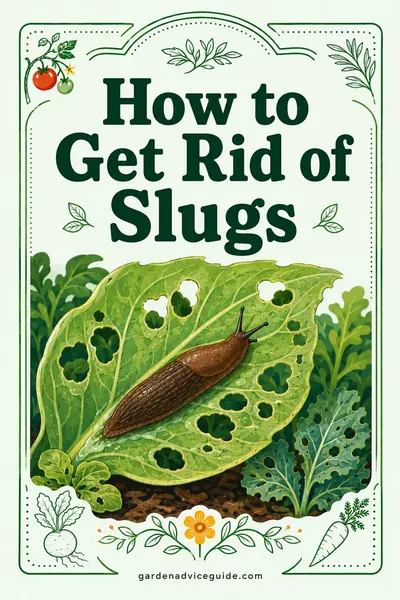
For slugs specifically, the overlap is large enough that it's worth reading how to get rid of slugs alongside this page. The habitat fixes are nearly identical, which means one weekend of work handles both.
How to get rid of roly polies in five steps
Work down this list in order. The first two steps are free and they do more than everything below them combined.
- Move watering to early morning. A surface that dries by dusk is a surface roly polies can't cross comfortably at night. Evening watering leaves the top inch damp through their entire active period.
- Pull mulch back 1 to 2 inches from every stem. You keep the water-saving benefit of mulch across the bed and remove the humid tunnel that runs right up to the plant you care about.
- Clear the daytime shelter within about 3 feet. Boards, bricks and pavers lying flat on soil, upturned saucers, plastic pot rims, black sheeting, cardboard, leaf piles against a fence, and stacked empty nursery pots. Every one of those is a daytime hotel.
- Trap and remove for a week. Roll damp newspaper into a loose tube, or lay a halved potato cut side down, or a melon rind hollow side down. Set six per bed at dusk, collect at first light, dump into soapy water or onto a hard sunny surface. A week of this puts a real dent in a local population.
- Bait only if the first four fail. Iron phosphate baits combined with spinosad are labeled for pill bugs and sowbugs, unlike plain iron phosphate, which targets slugs and snails. Scatter thinly per the label, never in piles, and never on food you'll harvest inside the label's interval.
Notice that not one of the first four steps kills anything directly. They reduce how many roly polies the bed can support, which is the difference between a fix and a chore you repeat all summer.
Protecting seedlings specifically
The first three weeks after germination are when this matters. After that a stem toughens up and roly polies lose interest.
- Set transplants instead of direct sowing. A four-week-old transplant with a woody base isn't food. This is the single most reliable answer for beans and squash in a bed with a known problem.
- Use collars. A cardboard tube, a 2-inch length of pipe, or a cut-down plastic cup pushed half an inch into the soil around each seedling. Collars also stop cutworms, which is a good trade for five minutes of work. Details on those are in cutworms.
- Keep the seed row bare. Mulch goes on after the seedlings are 4 inches tall, not before.
- Water the row, not the bed. A narrow damp strip is easier to dry out than a soaked bed.
Protecting strawberries and low fruit
- Slide clean straw, landscape fabric, or a plastic berry mat under every fruit cluster so nothing touches wet soil.
- Pick ripe fruit daily. Overripe fruit is a beacon, and one soft berry can draw a crowd that then samples the good ones next to it.
- Trellis or cage melons and cucumbers where you can, or set each fruit on an upturned pot saucer.
A worked example: a 4 by 8 raised bed
Here's the arithmetic behind the watering change, because "water in the morning" is easier to follow when you can see what it means in gallons.
A 4 foot by 8 foot bed is 32 square feet. One inch of water over one square foot is 0.623 gallons, so one inch across that whole bed is about 20 gallons.
Now compare two ways of delivering it in a week with no rain:
| Approach | Schedule | Surface condition at 10 p.m. |
|---|---|---|
| Evening sprinkler, little and often | About 7 gallons at 6 p.m., three nights | Damp every single night, all week |
| Morning soak, once or twice | About 20 gallons at 7 a.m., one or two mornings | Dry by mid afternoon, dry all night |
Same 20 gallons. Same plants. One schedule runs a nursery for roly polies and slugs, the other one closes it. The deep morning soak is also better for root depth, so you aren't trading yield for pest control.
If you're not sure how many gallons your own hose puts down, stand a straight-sided tuna can in the bed and time how long it takes to fill to an inch. That number is worth more than any published schedule.
Why you probably shouldn't wipe them out
Roly polies do real work. They shred fallen leaves and spent roots into pieces small enough for bacteria and fungi to finish, which is how mulch turns into soil. In a compost pile they're one of the fastest physical decomposers you have, and a pile full of them is a pile that's working. There's more on that balance in how to compost.
They also pull heavy metals out of soil and lock them in their own tissue, and they feed toads, ground beetles, birds, spiders, and centipedes. A garden with zero roly polies is a garden with a thin food web.
The realistic target isn't zero. It's "not in the seedling row, not under the strawberries." Move them, don't erase them.
What doesn't work, and what to skip
Broadcasting insecticide over the whole bed. Roly polies spend the day hidden under things, so most of the spray hits places they never touch. You'll take out ground beetles, which eat slug eggs and roly polies both, and end up with more of the pest six weeks later.
Diatomaceous earth as a general treatment. It works by abrading the shell and drying the animal out, so it only functions while it's bone dry. One watering or one dew and it's inert. Useful as a narrow ring around a specific seedling on a dry stretch, useless as a bed-wide answer.
Coffee grounds, eggshells, and cinnamon. Roly polies eat coffee grounds and are drawn to eggshells for the calcium. These do the opposite of the intended job.
Sealing the whole garden with landscape fabric. You've just built a continuous humid layer with a roof. Populations under fabric are often the highest in the yard.
Panicking about the ones in your compost or under the bed frame. Those are doing their job. Only the ones on living plant tissue are your problem. If you're weighing bed styles for other reasons, raised bed vs in ground covers how each one handles surface moisture.
Keeping them out of the house
Roly polies that come indoors are lost, not invading. They can't breed inside and they die within a day or two on dry flooring. If you're finding them regularly in a basement or garage, the moisture story outside the wall is the same one from your beds:
- Pull mulch, soil, and leaf litter back about 6 inches from the foundation so there's a dry strip.
- Fix the downspout that dumps against the wall.
- Move firewood, stacked pots, and bagged mulch off the ground and away from the house.
- Seal the gap under the garage door and along basement window frames.
- Skip the perimeter spray until you've done the four things above, because it treats the symptom and the damp keeps producing new ones.
Life cycle, so you know what you're up against
A female carries her eggs in a fluid-filled brood pouch on her underside, so the young never touch dry air. They emerge as tiny pale versions of the adults, already able to roll, and they molt as they grow.
The molt is the odd part. They shed in two halves: the back half first, then a few days later the front. That's why you sometimes find what looks like half a dead roly poly next to a live one that seems two different colors. Nothing's wrong. It's mid molt, and it's vulnerable and hidden until it finishes.
Adults live a couple of years and stay active whenever it's damp and above roughly 50°F. They overwinter as adults, tucked under logs, in leaf piles, and along foundations. That is exactly why fall cleanup around the beds you plan to sow in spring pays off before you've planted a thing.
Frequently asked questions
Do roly polies eat healthy plants or only dead ones?
Mostly dead and decaying material. They'll eat living tissue when it's soft enough to count as the same thing, which in practice means new seedlings, and fruit resting on wet ground. Established plants with any woodiness in the stem are safe.
What is the fastest way to get rid of roly polies?
Trapping is the fastest visible reduction: rolled damp newspaper or halved potatoes set out at dusk and collected at dawn for about a week. It's a short-term dent, though. Without the moisture and shelter changes, the population rebuilds within a few weeks.
Are roly polies and pill bugs the same thing?
Roly poly is the nickname, pill bug is the common name, and Armadillidium vulgare is the species most people mean. Sowbugs get called roly polies too, but they can't roll into a ball and they have two small points at the tail end.
Do coffee grounds get rid of roly polies?
No, and they can make it worse. Roly polies happily eat coffee grounds along with other decaying material. The same goes for crushed eggshells, which they seek out for calcium to build their shells.
Will diatomaceous earth kill roly polies?
Only while it stays perfectly dry. It abrades the shell and dries the animal out, so a single watering or a heavy dew turns it into inert dust. Use it as a narrow ring around a specific seedling during a dry stretch, not as a whole-bed treatment.
Do roly polies bite or harm people and pets?
No. They have no bite, no sting, no venom, and they carry nothing that concerns people or pets. A dog that eats one is fine. They're one of the safest animals in the garden to pick up bare handed.
Should I get rid of roly polies in my compost pile?
No. A pile full of them is a pile that's breaking down well, since they shred coarse material into pieces the microbes can finish. Just keep finished compost from sitting directly against seedling stems when you spread it.
Why are there suddenly so many roly polies this year?
Almost always extra moisture plus extra shelter. A wet spring, a new thick mulch layer, a fresh load of wood chips, a leaky spigot, or a tarp left on a bed will all multiply the population within a season. Find what changed and the answer is usually right there.
The short version
Roly polies are decomposers with a moisture problem, and that's the whole handle you have on them. Water in the morning, keep mulch off stems, clear the daytime shelter near vulnerable plants, protect seedlings and low fruit with collars and mats, and trap for a week if you want a faster result.
Set the schedule that does most of the work with our free watering guide, and pair it with the mulch depths in the mulch guide. Get those two right and the roly polies go back to doing the job they're good at, well away from your seedlings.