What Does Garlic Look Like When Growing? A Stage-by-Stage Visual Guide

Growing garlic looks like a small clump of flat, blue-green, strap-shaped leaves rising from a single stem, a bit like a leek and nothing like the round hollow tubes of an onion. It starts as grass-like shoots 4-6 inches tall in fall, sits nearly still through winter, then builds 8-12 arching leaves through spring before the lower ones brown off near summer harvest. Hardneck types add one unmistakable feature in late spring: a curling round flower stalk called a scape.
So what does garlic look like when growing at your point in the season? To match what you're seeing against where your garden should be, check exact timing for your zone with our free when-to-plant lookup. It builds your planting-to-harvest calendar so you know which stage your garlic should be in this month.
Below is the full visual tour, stage by stage, above ground and below, plus the warning signs that mean something's wrong.
Stage 1: fall sprouting (grass-like shoots)
A few weeks after fall planting, garlic announces itself with slim green spears pushing through the soil or mulch. Each clove sends up what looks like a fat blade of grass, usually reaching 4-6 inches before cold weather stalls it.
Don't panic about those fall shoots. New growers often worry that sprouting before winter will kill the plant, but this is normal and even ideal. Garlic wants to build roots and a little top growth in fall; University of Minnesota Extension notes that fall-planted cloves root before the ground freezes, which is exactly why fall planting beats spring planting for bulb size.
At this stage a garlic bed looks sparse and unimpressive: single spears in rows, maybe one or two small leaves each, often poking through straw mulch. Some cloves sprout weeks later than their neighbors, and a few may not show above ground at all until spring. Both are fine. If you haven't planted yet, our when to plant garlic guide covers the ideal fall window for your zone.
Stage 2: overwintering (dormant, sometimes ragged)
Through winter, garlic mostly just sits there, and it can look rough doing it. Growth stops or crawls, leaf tips may brown or bleach from cold and windburn, and in hard-freeze climates the fall shoots can die back to the ground entirely under the mulch.
This is the stage that convinces the most people their garlic died. It almost never did. The plant's real work is happening underground, where roots keep developing during mild spells, and the cold itself is doing a job: garlic needs several weeks of chilling (vernalization) to divide into a proper multi-clove bulb.
What you'll actually see from December through February in a northern garden is either bare mulch, a few battered green tips, or short frozen-looking shoots. In mild-winter regions (zones 7-9), garlic often keeps slowly adding leaves all winter and never fully disappears. Both pictures are normal for their climate.
Stage 3: spring leaf growth (the leek look)
Spring is when garlic starts looking like garlic. As soil warms in March and April, the plant grows fast, stacking new leaves from the center until it stands 18-24 inches tall with 8-12 leaves by late spring.
Here's what to look for:
- Flat, folded leaves. Each leaf is a flat strap with a subtle crease down the middle, arching outward. They're not tubes.
- Blue-green color with a matte, waxy finish. Healthy garlic has a dusty gray-green cast, not glossy grass-green.
- Leaves in two ranks. New leaves emerge from the center and fan out in one plane, giving each plant a flattened, leek-like profile when viewed from the side.
- A thickening pseudostem. The leaf bases wrap each other into a firm neck about as thick as your finger. There's no visible bulge at the soil line yet, and that's normal; the bulb swells late.
Every leaf matters more than it looks. Each green leaf corresponds to one papery wrapper layer on the finished bulb, which is why you never trim garlic leaves the way some people trim onion tops.
Garlic vs. onion: how to tell the sprouts apart
Mixed up your beds, or found mystery alliums in a community plot? The leaves settle it in two seconds:
| Feature | Garlic | Onion |
|---|---|---|
| Leaf shape | Flat, folded strap with a center crease | Round, hollow tube |
| Feel | Solid; you can't squash it flat because it already is | Squeezable; the tube compresses |
| Color | Blue-green, matte | Brighter green, often glossier |
| Arrangement | Fan-shaped, leaves in one plane | Leaves circle the stem in all directions |
| Late-spring extras | Hardnecks send up a curling round scape | Bolting onions send up one hollow stalk with a round flower ball |
| Smell when bruised | Distinctly garlicky | Distinctly oniony |
The one-second version: flat leaf, garlic; hollow tube, onion. Chives and scallions also have tubes, and leeks share garlic's flat-fan look but grow much larger with no bulb, so shape plus smell identifies almost any allium you'll meet.
Stage 4: the scape (hardneck garlic only)
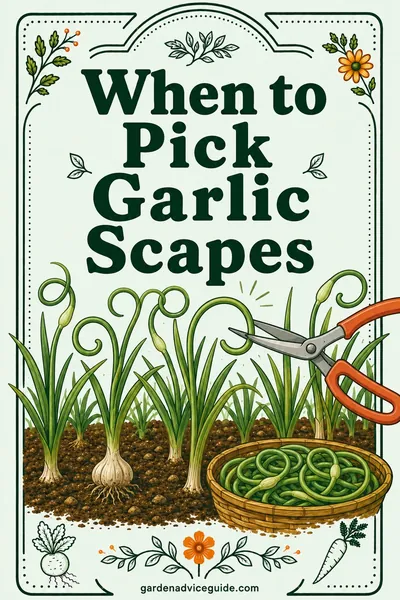
In late spring, hardneck garlic grows the strangest-looking thing in the vegetable garden: a smooth round stalk that rises from the center of the plant, then bends and curls into a loop like a pig's tail, with a pointed bud at the tip.
That's the scape, the plant's flower stalk, and it's the clearest single answer to "is this garlic?" you'll ever get. No common garden plant makes that curling topknot in June. It's also a two-part signal: the variety is hardneck, and bulb harvest is roughly three to four weeks away.
You should remove scapes rather than admire them for long, because they cost you bulb size while they develop. The full timing and technique, including the one-full-curl rule, is in our guide on when to pick garlic scapes.
Softneck garlic skips this stage completely. A June garlic bed with no scapes isn't failing; it's probably just planted with a softneck variety, which is common in warmer zones.
Stage 5: maturity (browning from the bottom up)
As harvest approaches in early to mid-summer, garlic starts to look like it's declining, and this time it genuinely is, on purpose. The lowest leaves yellow and brown first, then the browning climbs the plant one leaf at a time while the top leaves stay green.
The classic ready-to-dig picture is a plant with roughly the bottom half of its leaves brown and about 4-6 green leaves still standing on top. Dig at that point and the bulb below is fully sized with intact wrappers. Wait until every leaf browns and the wrappers start rotting away, leaving naked cloves that store poorly.
Don't judge by the calendar alone, and don't judge by one plant; scan the whole bed and go by the average. The complete set of dig-day checks, including the test-dig, is in our when to harvest garlic guide.
What garlic should NOT look like (problem signs)
Normal garlic goes through some ugly phases, so the trick is separating routine scruffiness from real trouble. These are the looks that mean something's wrong:
- Yellowing from the top down, or yellowing in April-May. Bottom-up browning in June or July is ripening. Whole-plant yellowing in mid-spring points to a problem: waterlogged soil, nitrogen shortage, or root damage. Check drainage first.
- Orange or rusty speckles on the leaves. Small orange pustules that smear like rust powder are garlic rust, a fungal disease. It spreads fast in cool, damp weather. Affected leaves won't recover, and a bad infection shrinks the bulb.
- Wilting or collapsing plants, especially with yellow leaves. A garlic plant that flops while neighbors stand tall often has trouble at the roots: white rot (look for fluffy white growth and black specks at the bulb base), bulb mites, or onion maggots. Pull one and inspect the base.
- Stunted, thin plants with only a few narrow leaves in late spring. Usually crowding, poor soil, or a too-late planting that missed the chilling period.
- Twisted, corkscrewing leaves without a scape present. Scapes curl; leaves shouldn't. Distorted foliage can indicate thrips damage or virus, especially with silvery streaking.
- A flower stalk on softneck garlic. Stressed softnecks occasionally bolt. It's a stress flag (heat, drought, erratic spring temperatures) more than a disease, but treat it like a scape and remove it.
One reassurance worth repeating: browned leaf tips alone, especially after winter or a dry week, are cosmetic. Garlic tips burn easily and the plant shrugs it off.
What's happening underground, month by month
The part you can't see follows its own schedule, and it explains why the top looks the way it does. From a fall planting, the clove roots within two to three weeks and may swell slightly, but it stays a single clove through winter. Cold exposure during those months flips the internal switch that tells it to divide.
Through early and mid-spring, the plant is still essentially a rooted clove with a leafy top; if you dug one in April expecting a bulb, you'd find something barely thicker than a scallion, and that's normal. Real bulbing starts in late spring, triggered by lengthening days rather than plant size, which is why every leaf you grow before the trigger matters: the plant sizes the bulb with whatever leaf factory it built by then. In the final four to six weeks the bulb divides into cloves and swells rapidly, roughly doubling in the last month, then the roots and wrappers begin drying as the plant shuts down.
What does garlic look like when growing, month by month?
This timeline assumes an October planting in a cold-winter climate (zones 4-6). Shift everything two to five weeks earlier for zones 7-9, where planting runs later (November-December) but spring stages arrive sooner. Your own calendar from our when-to-plant lookup will be tighter than any table.
| Month | Above ground | Below ground |
|---|---|---|
| October | Bare soil or mulch; first grass-like tips may appear late in the month | Clove roots within 2-3 weeks of planting |
| November | Slim green shoots 4-6 inches tall through the mulch | Root system expanding; still a single clove |
| December | Growth stalls; tips may brown or die back in hard freezes | Dormant-ish; roots creep during mild spells |
| January | Little to nothing visible in cold zones; slow green growth in mild ones | Chilling hours accumulating (vernalization) |
| February | Battered shoots or bare mulch; regrowth begins late month in milder areas | Cold requirement completing |
| March | Fresh green regrowth; plants 6-10 inches with 4-6 flat leaves | Roots surge; still no bulb |
| April | Rapid growth to 12-18 inches; leek-like fan of blue-green leaves | Clove thickening; bulbing not yet started |
| May | Full size, 18-24 inches, 8-12 leaves; scapes emerge on hardnecks late in the month (earlier in the south) | Day length triggers bulbing; bulb begins to swell |
| June | Scapes curl and are removed; lowest 1-3 leaves start to yellow | Bulb divides into cloves and sizes up fast |
| July | Bottom half of leaves brown, tops still green; harvest look | Bulb at full size; wrappers set, roots drying |
A worked example: one garlic bed through the year
Here's what this looks like on a real timeline. Say you plant 40 hardneck cloves in zone 6 Ohio on October 15, two inches deep under four inches of straw.
By November 10 you'd see about 30 of the 40 showing shoots 3-5 inches tall, and by Christmas most tips look frost-burned and sad. Nothing visibly changes until early March, when fresh green centers appear, and by April 20 you have a handsome bed of 16-inch leek-looking fans, all 40 up, including the ten slowpokes. Around May 28 the first scapes rise and curl; you snap all of them by June 10. On July 1 you count leaves on a few plants and find 4-5 brown at the bottom with 5-6 green on top, dig a test bulb, see tight wrappers and fat cloves, and harvest the bed the first full week of July, about 37 weeks after planting.
Match your own bed against that arc and you'll usually find it's doing exactly what it should, just shifted a couple of weeks for your zone and the year's weather.
FAQ
What does garlic look like when it first starts growing?
Like fat blades of grass. Each clove sends up a single slim green spear that reaches 4-6 inches in the fall, then splits into a few flat, folded leaves. It looks nothing like the finished bulb; the bulb doesn't form until late spring.
How can I tell garlic from onions when they're growing?
Feel a leaf. Garlic leaves are flat, solid straps with a crease down the middle; onion leaves are round hollow tubes you can gently squeeze flat. Garlic also grows its leaves in a flat fan, while onion leaves circle the stem.
My garlic sprouted in fall. Is that bad?
No, it's normal and healthy. Fall-planted garlic is supposed to root and put up 4-6 inches of shoot before winter. Even if hard freezes kill that top growth back, the clove and roots survive under mulch and regrow in spring.
Why does my garlic look dead in winter?
Winter dormancy is ugly by design. Shoots brown, flop, or vanish entirely under mulch in cold zones while the roots live on. Unless the bed stayed waterlogged or cloves heaved out of the soil, wait for March before judging anything.
What does garlic look like when it's ready to harvest?
Half dead, from the bottom up. When roughly the lower half of the leaves have browned and 4-6 green leaves remain on top, the bulb below is full-sized with intact wrappers. Our when to harvest garlic guide covers the test-dig that confirms it.
Why are my garlic leaves turning yellow in spring?
Early whole-plant yellowing usually means soggy soil, low nitrogen, or root trouble, not ripening. Ripening browns the lowest leaves first and doesn't start until early summer. Check drainage, then feed lightly if the bed is hungry.
What is the curly thing growing out of my garlic?
That's a scape, the flower stalk that hardneck garlic sends up in late spring. It curls into a loop, and you should remove it at one full curl so the plant puts its energy into the bulb. See when to pick garlic scapes for the exact timing.
How long does garlic take from planting to harvest?
About eight to nine months for fall-planted garlic: roughly October to July in cold climates, and closer to November through May or June in warm ones. Spring-planted garlic finishes in 90-120 days but grows smaller bulbs because it misses the long cold period.
Updated August 2026. Source: University of Minnesota Extension, Growing garlic in home gardens (extension.umn.edu).