How to Grow Tomatoes

Plant tomatoes outside 1 to 2 weeks after your last frost date, once night temperatures hold above 50F, and bury two thirds of the stem when you do it. Give them 8 hours of direct sun, soil around pH 6.2 to 6.8, and 1 to 2 inches of water a week delivered on a schedule rather than whenever you remember. Then decide early whether your variety is determinate or indeterminate, because that single fact sets your spacing, your support, your pruning, and how the harvest arrives.
Most tomato failures trace back to two things: planting too early into cold soil, and watering that swings between soaked and bone dry.
Not sure of your date? Check your planting window with our free When-to-Plant Lookup before you buy a single plant.
Determinate vs Indeterminate: Decide This First
Every other decision in this guide branches off this one. The seed packet or plant tag will say which you have, usually in small print near the days-to-maturity number.
Determinate tomatoes are bush types. They grow to a genetically fixed height, roughly 3 to 4 feet, set all their flowers in a short window, ripen most of their crop across 2 to 3 weeks, and then wind down. Roma, Celebrity, and most paste tomatoes are determinate. If you can sauce or want a big single harvest, this is your plant.
Indeterminate tomatoes are vines. They keep growing from the tip until frost kills them, setting new flower clusters the whole time, and can hit 6 to 10 feet in a good season. Cherokee Purple, Sungold, Brandywine, and most cherry types are indeterminate. You get a steady trickle of fruit from midsummer to frost instead of one wave.
There's a third label you'll see on tags: semi-determinate. Treat it as a compact indeterminate. Cage it, prune lightly, expect 4 to 5 feet.
| Determinate | Indeterminate | |
|---|---|---|
| Mature height | 3 to 4 ft | 6 to 10 ft |
| Spacing in row | 24 in | 30 to 36 in |
| Support | Cage or short stake | Tall stake, string, or Florida weave |
| Pruning | Almost none | Suckers below first flower cluster |
| Harvest pattern | One wave over 2 to 3 weeks | Steady until frost |
| Best for | Canning, small spaces, short seasons | Slicing, long seasons, cherry types |
| Container size | 10 gal minimum | 15 to 20 gal |
The practical mistake people make is pruning a determinate tomato like a vine. Strip the suckers off a bush type and you cut your yield, because a determinate plant already carries all the flower buds it's ever going to make. Every sucker you remove takes fruit with it.
When to Plant Tomatoes by Zone
Tomatoes are killed by frost and sulk below 50F, so the frost date is the anchor. Start seeds indoors 6 to 8 weeks before your last frost, then set transplants out 1 to 2 weeks after it.
| Zone | Typical last frost | Start seed indoors | Set transplants out |
|---|---|---|---|
| 3 | May 15 to Jun 1 | Late March | Early June |
| 4 | May 5 to May 20 | Mid March | Late May |
| 5 | Apr 25 to May 10 | Early March | Mid to late May |
| 6 | Apr 10 to Apr 25 | Late February | Early to mid May |
| 7 | Mar 25 to Apr 10 | Mid February | Mid to late April |
| 8 | Mar 10 to Mar 25 | Late January | Late March to early April |
| 9 | Feb 5 to Feb 25 | Late December | Late February to March |
| 10 | Frost rare | October and January sowings | October and February |
Read those dates as regional averages, not promises. USDA zone maps and frost tables are built from 30-year weather station averages across a broad area. Your own yard can run 1 to 2 weeks off the printed date in either direction because of elevation, a nearby lake, a slope that drains cold air, or a south-facing wall that holds heat. A garden at 800 feet and one at 2,000 feet in the same county are not on the same calendar. Your county extension office publishes local frost data and usually knows the microclimates by name, so it's worth a phone call.
Soil temperature settles the argument better than the calendar does. Push a soil thermometer 4 inches down at 9 a.m. and look for a steady 60F before you transplant. Below that, roots barely function, the plant stalls, and a tomato set out two weeks early is routinely overtaken by one planted late into warm ground.
In zones 9 and 10, the real enemy is summer heat, not frost. Tomatoes stop setting fruit above about 90F daytime and 75F nights, so those gardens run a spring crop and a fall crop and let the plants coast through July and August.
Soil and Sun
Tomatoes want 8 hours of direct sun. Six will produce a crop, but a thinner one that ripens later and gets more disease, because leaves that stay damp into the morning are leaves that get infected.
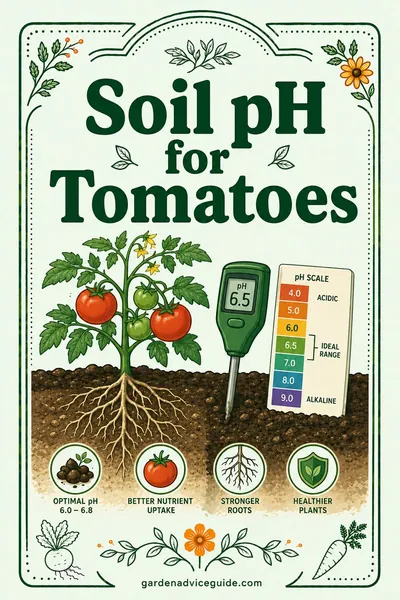
Target soil pH is 6.2 to 6.8. That range keeps calcium, phosphorus, and magnesium all readily available at once. Below 5.5 you get genuine calcium uptake problems on top of everything else. A soil test through your county extension service is simple and tells you what to add instead of guessing, and our guide to soil pH for tomatoes walks through the amendments and how long each takes to work. Lime moves pH slowly, so fall is the time to apply it.
Bed prep that pays off:
- Work 2 to 3 inches of finished compost into the top 8 inches. This does more for water consistency than any fertilizer.
- Skip fresh manure and heavy nitrogen. You'll get a beautiful 6-foot plant with almost no fruit.
- Loosen deep. Tomato roots go 2 feet down when the soil lets them, and a deep root system is what buffers you against a hot dry week.
- Rotate. Don't put tomatoes where tomatoes, peppers, eggplant, or potatoes grew in the last 2 to 3 years. Early blight and verticillium overwinter in soil and debris.
How to Plant Tomatoes Deep
This is the technique that separates a good tomato plant from a mediocre one, and it looks wrong the first time you do it.
Bury two thirds of the stem. Tomatoes are one of the few vegetables that grow adventitious roots directly from buried stem tissue. Those fuzzy hairs on the stem are root primordia waiting for contact with soil. A 12-inch transplant goes into the ground with 8 inches buried and 4 inches showing, and within 2 weeks that buried stem is a dense root mass.
Two ways to do it:
- Deep hole. Dig 8 to 10 inches down, strip the leaves off the bottom two thirds of the stem, drop the plant in, backfill. Best in loose, warm, well-drained soil.
- Trench planting. Dig a shallow trench 4 to 5 inches deep, lay the plant on its side with the stem along the trench, and gently bend the top 4 inches upright. Backfill. Use this in heavy clay or cold soil, because the roots stay in the warmer upper layer. The stem will straighten itself in a few days.
Either way, strip the leaves that would be underground first. Buried leaves rot.
Water in with a full gallon per plant to settle soil against the roots and kill air pockets. Then leave it alone for 3 or 4 days. Slight stress right after transplanting drives roots down.
Worked example. A 4x8 raised bed, 32 square feet, planted with indeterminate slicers at 30 inches in row and 36 inches between rows. That's 3 plants down the 8-foot length in two rows, so 6 plants total. Each needs about 1.5 gallons of water per week early and 2.5 gallons in July heat, which is 9 to 15 gallons for the bed weekly, split into two waterings. At 2 to 3 inches of mulch over the whole 32 square feet, you'll need roughly 5 to 8 cubic feet of mulch, depending on depth.
Spacing and Support
Spacing is an airflow decision as much as a root decision. Crowded tomatoes stay wet longer and blight moves through them fast.
- Determinate, caged: 24 inches apart in row, 36 inches between rows.
- Indeterminate, staked or strung: 18 to 24 inches in row (single stem), 36 to 48 inches between rows.
- Indeterminate, caged unpruned: 36 inches apart every direction.
- Containers: one plant per pot, always. Two in a 20-gallon pot both underperform.
Use our plant spacing calculator to work out how many plants a specific bed actually holds before you buy flats you can't fit.
Get support in the ground on planting day. Driving a stake next to an established plant tears roots you can't see.
Staking. One 6 to 8 foot stake per plant, driven 12 inches deep, plant tied every 8 to 12 inches with soft cloth strips in a figure eight so the tie doesn't strangle the stem. Requires pruning to one or two stems. Best fruit quality, cleanest fruit, most work.
Caging. Skip the 3-foot cone cages sold at box stores, which are sized for determinates at best and collapse under an indeterminate by July. Use a 5-foot cylinder of concrete reinforcing mesh, 18 to 24 inches across, anchored with a stake. No pruning needed, more leaf cover so less sunscald, harder to find fruit inside.
Florida weave. The system for a row of 4 or more, especially determinates. Drive a stout T-post at each end of the row and between every 2 to 3 plants. Run twine down one side of the row, wrapping each post, then back up the other side, so plants are sandwiched between two strands. Add a new level of twine every 8 to 10 inches as the plants grow. It's fast, uses little material and almost no hardware, and comes down in ten minutes at the end of the season.
Watering: The Thing That Decides Everything Else
If you fix one habit this season, fix this one. Tomatoes need 1 to 2 inches of water per week, which over the 6 to 8 square feet one plant occupies works out to roughly 4 to 9 gallons a week, delivered in two deep soakings rather than daily sips.
Consistency matters more than volume. Calcium moves through a tomato plant only dissolved in water, and it can't be redistributed once it's been deposited. Break the water supply for two days while fruit is expanding and the cells at the blossom end get built without it. Two weeks later you find a sunken black patch. That's blossom end rot, and it's a watering problem wearing a calcium costume. The same swings cause split and cracked fruit, when a dry plant gets a heavy drink and the fruit expands faster than its skin can stretch.
Rules that hold up:
- Water the soil, not the leaves. Drip line or soaker hose, or the wand held at the base. Wet foliage is how blight travels.
- Morning, not evening. Leaves that get wet dry within an hour.
- Mulch 2 to 3 inches deep with straw, shredded leaves, or grass clippings once the soil has warmed. Mulch is what makes consistent moisture possible without watering daily.
- Check by finger, not by schedule. Dig 2 inches down. Dry at 2 inches means water.
- Containers dry out 3 to 4 times faster. In July heat a 15-gallon pot may need water every single day.
Our guide to how often to water tomatoes breaks the numbers down by pot size, soil type, and week of the season, and the watering guide tool converts inches to actual minutes on your hose.
Feeding Tomatoes Through the Season
Tomatoes are heavy feeders, but the type of food has to change as the plant changes.
At planting: a balanced starter, roughly 5-10-10, worked into the planting hole. Some gardeners add a handful of bone meal. Keep nitrogen modest.
Until first flowers: nothing more if your soil has compost in it. The plant is building leaves and roots and has what it needs.
Once fruit sets: switch to a low-nitrogen, higher-potassium feed every 2 to 3 weeks. Something like 5-10-10 or a dedicated tomato fertilizer. Potassium is what drives fruit sizing and flavor. Our guide on when to fertilize tomatoes puts the whole sequence on a calendar, from transplant through the last pick.
The classic mistake is a lawn-type high-nitrogen fertilizer applied all season. You get a dark green plant 7 feet tall with three tomatoes on it. Nitrogen builds leaves; potassium and phosphorus build fruit.
Pruning and Suckering
A sucker is the shoot that grows from the 45-degree crotch between the main stem and a leaf branch. Left alone, every sucker becomes a full stem with its own leaves, flowers, and fruit.
On indeterminates, prune. Pinch out every sucker below the first flower cluster, without exception, because those low shoots sit in the splash zone for soil-borne disease and produce little. Above the first cluster, choose your system: single stem for maximum fruit size and airflow, or two stems (keep the sucker directly below the first flower cluster, which is always the strongest one) for more total fruit that runs slightly smaller.
Pinch suckers at 2 to 4 inches long, with fingers, in dry weather so the wound seals fast. Snapping off a thumb-thick sucker in August leaves a wound big enough for disease.
On determinates, don't prune beyond removing the low shoots below the first cluster and any leaf touching the ground. That's it.
Late season, both types: about 4 weeks before your first fall frost, top the plant by cutting off the growing tip, and strip new flowers. New blossoms in September will not become ripe tomatoes, and cutting them off pushes the plant's sugar into the fruit already on the vine.
Common Tomato Problems and What They Mean
| What you see | Likely cause | What to do |
|---|---|---|
| Sunken black patch on fruit bottom | Blossom end rot, uneven watering | Mulch, fixed schedule, see blossom end rot |
| Brown spots with rings on lower leaves, moving up | Early blight | Remove lower leaves, mulch, rotate next year |
| Greasy gray-green patches spreading fast in cool wet weather | Late blight | Pull and bag the plant, do not compost |
| Concentric cracks around the shoulder | Water surge after dry spell | Even watering, harvest at first blush |
| Flowers drop with no fruit | Temps over 90F or under 55F | Shade cloth in heat, wait it out |
| Yellow lower leaves, older first | Nitrogen or natural aging | See tomato leaves turning yellow |
| Fat green caterpillar, stripped stems | Tomato hornworm | Hand pick at dusk, leave any covered in white cocoons |
| Curled leaves, sticky residue | Aphids | Blast with water, see how to get rid of aphids |
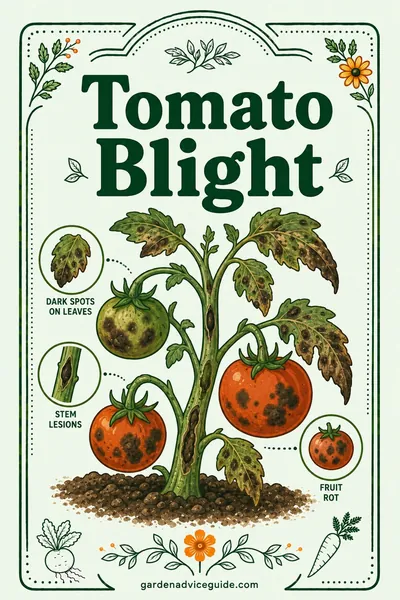
Blight is the one that ends seasons. Our tomato blight guide covers telling early from late blight, which matters because one is manageable and one means pulling the plant today.
How to Grow Tomatoes in Pots
Container tomatoes work, but the margins are thinner and the mistakes are less forgiving.
- Size up. 10 gallons minimum for a determinate, 15 to 20 for an indeterminate. A 5-gallon bucket dries out by noon in July and produces a stunted plant.
- Use potting mix, not garden soil. Garden soil compacts into a brick in a container.
- Drainage holes, plenty of them. Do not add gravel to the bottom; it raises the saturated zone rather than lowering it.
- Feed more often. Every watering flushes nutrients out the bottom. Liquid feed every 10 to 14 days once fruit sets.
- Pick compact varieties if you're on a balcony: Patio, Bush Early Girl, Tumbling Tom, or any cherry labeled determinate.
- Move pots out of afternoon sun during a heat wave. That's a container advantage; use it.
When to Harvest Tomatoes
Pick at the breaker stage, the moment the blossom end first shows a blush of color, or any time after, since fruit picked then finishes ripening on the counter with no real flavor loss and escapes birds, splitting rain and hornworms. Check the vines every 2 days in peak season, and bring in every mature green fruit before frost. Our full guide on when to pick tomatoes covers ripe color by variety, why heat stalls the color change, and how to time the last picking around rain and frost.
Storing Tomatoes
Never refrigerate a ripe tomato. Below about 55F the enzymes that produce tomato flavor compounds shut down permanently, and the cell walls break down into mealy texture. This is the single biggest thing people do to ruin good tomatoes.
- Ripe, on the counter: stem end down, out of direct sun, 3 to 5 days.
- Breaker, partly colored or mature green: finish it indoors out of direct sun. Ripening times by temperature, the paper bag and banana trick, and end of season storage for green fruit are covered in our guide on when to pick tomatoes.
- Already cut: now the fridge is fine, covered, 2 days.
- Freezing whole: wash, dry, freeze on a tray, then bag. The skins slip off under warm water and they go straight into sauce. Texture is gone, flavor isn't.
- Canning: tomatoes sit right at the borderline pH for safe water bath canning, so follow a tested recipe and add the bottled lemon juice or citric acid it calls for. The USDA Complete Guide to Home Canning is the source to trust here.
FAQ
How long does it take to grow tomatoes from seed?
Figure 6 to 8 weeks from seed to transplant size indoors, then 50 to 85 more days from transplant to first ripe fruit depending on the variety. Early types like Early Girl run about 50 to 55 days from transplant; big heirlooms like Brandywine need 80 to 90. The days-to-maturity number on the packet counts from transplant date, not from sowing, which trips up a lot of first-year gardeners.
Should I prune tomato suckers?
Prune them on indeterminate vines, leave them alone on determinate bushes. On an indeterminate, remove every sucker below the first flower cluster and then keep the plant to one or two main stems for better airflow and larger fruit. On a determinate, the plant already holds all the flower buds it will make, so pruning suckers directly removes future tomatoes.
How deep should I plant tomato seedlings?
Bury roughly two thirds of the stem, stripping off the leaves that would end up underground. Tomatoes form roots along any buried stem, so an 8-inch-deep planting on a 12-inch seedling builds a much larger root system in about 2 weeks. In cold or heavy soil, trench-plant sideways instead so the roots stay in the warmer top few inches.
Why are my tomato flowers falling off without setting fruit?
Almost always temperature. Tomato pollen goes sterile above about 90F daytime or 75F at night, and it fails again below 55F, so the flower opens, doesn't get pollinated, and drops. Shade cloth during a heat wave and even watering help, but mostly you wait for the weather to break and the plant resumes setting fruit on its own.
How far apart should tomato plants be?
Determinates caged go 24 inches apart in the row with 36 inches between rows. Indeterminates staked and pruned to a single stem can go 18 to 24 inches, but unpruned in cages they need a full 36 inches every direction. Tighter than that and the foliage stays damp after rain, which is exactly the condition blight needs.
Can you grow tomatoes in a 5 gallon bucket?
You can, but you're fighting the pot all season. Five gallons dries out completely on a hot July afternoon, and those swings drive blossom end rot and cracking. If you're buying containers anyway, 10 gallons is the realistic minimum for a determinate and 15 to 20 for an indeterminate, and the larger pot needs far less babysitting.
Do tomatoes need full sun all day?
They want at least 8 hours of direct sun and will take more. Six hours produces a crop, but a smaller one that ripens later and carries more disease pressure because the leaves stay wet longer in the morning. If you have to choose, morning sun beats afternoon sun, since it dries the foliage early and reduces heat stress at midday.
When should I stop watering tomatoes at the end of the season?
Keep watering normally until the last fruit you plan to harvest reaches breaker stage, then you can ease off. Some gardeners cut water slightly in the final 2 weeks to concentrate flavor, which works, but going too far cracks fruit when the next rain arrives. A cleaner move is to top the plant about 4 weeks before your first frost and strip new flowers, so the water is going into fruit that will actually finish.
Updated August 2026
A note on numbers. This page gives you spacings, depths, temperatures, watering rates and days to harvest, not dollar figures. Transplants, cages, amendments and soil tests are priced by your region, your supplier and the season, and we do not set any of it. Work out what you need here, then price the list locally.