When to Pick Garlic Scapes (the One-Curl Rule)

Pick garlic scapes when the stalk has made one full curl, like a loose pig's tail, and is still smooth and tender. For most northern gardens that's June into early July; in warmer southern zones it happens in May or early June. Knowing when to pick garlic scapes really is that simple: cut or snap the stalk where it meets the top leaf, and your plant pours its remaining energy into the bulb instead of a flower.
Not sure where your garden falls in that window? Check exact timing for your zone with our free when-to-plant lookup. It works backward from your planting date and zone, so you get a real calendar week instead of a guess.
Waiting too long is the mistake that costs people. A scape that's straightened back out has already turned woody, and it's been stealing energy from your bulb the whole time. This guide covers exactly what to look for, month by month and curl by curl.
What garlic scapes are (and why only some garlic makes them)
A garlic scape is the flower stalk of hardneck garlic. Sometime in late spring, a round green shoot pushes up from the center of the plant, distinctly different from the flat leaves around it. Left alone, it would eventually straighten, open, and produce a head of tiny bulbils instead of true seed.
Only hardneck varieties (Rocambole, Porcelain, Purple Stripe, and their relatives) send up scapes. Softneck garlic, the braidable type common in grocery stores and in warm-climate gardens, doesn't produce them at all. So if you planted softneck and you're watching for scapes, you can stop waiting; they're not coming.
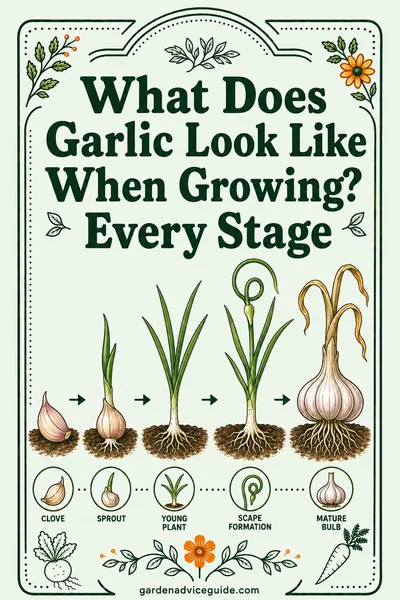
If you're not sure which type you planted, the scape itself is your answer. A curling stalk in June means hardneck. No stalk by the time bulbs are sizing up usually means softneck. You can read more about how the two types grow differently in our guide to what garlic looks like at every growing stage.
When to harvest garlic scapes: the one-full-curl rule
The single most reliable signal is the curl. Here's how the scape develops and what each stage tells you:
| Scape stage | What it looks like | Should you pick it? |
|---|---|---|
| Emerging | Straight shoot, 4-8 inches, poking above the leaves | Not yet. Let it grow a few more days. |
| Starting to bend | Top third leaning over like a candy cane | Almost. You can pick now if you want the most tender scapes. |
| One full curl | Stalk makes a complete loop, tip pointing back down or sideways | Yes. This is the sweet spot. |
| Second curl or straightening | Tight double coil, or the stalk rising straight and tall again | Overdue. Pick immediately; the lower stalk is turning woody. |
| Standing straight, bulging tip | Rigid stalk, swelling flower head at the top | Too late for eating. Still cut it off to protect bulb size. |
Why one curl and not sooner or later? Earlier is fine for tenderness, but you get a shorter scape and slightly less to harvest. Later, the stalk starts converting soft tissue to tough fiber from the bottom up, and the developing flower head starts drawing hard on the plant's reserves. One full curl is the point where the scape is at maximum useful size while still tender end to end.
The curl test beats the calendar every time. Weather shifts the schedule by two weeks or more from year to year, but the curl never lies. Use the month windows below to know when to start checking, then let the plants tell you the rest.
When to pick garlic scapes by month and region
Scapes appear roughly eight months after fall planting, and latitude drives the timing. Here's when to start walking your rows:
| Region (typical zones) | When scapes appear | Peak picking window |
|---|---|---|
| Deep South, coastal (8-9) | Late April to mid-May | May |
| Mid-South, transition (7) | Mid-May to early June | Late May to mid-June |
| Lower Midwest, Mid-Atlantic (6) | Late May to mid-June | Early to late June |
| Upper Midwest, Northeast (4-5) | Early to late June | Mid-June to early July |
| Far north, high elevation (3) | Late June into July | Late June to mid-July |
A quirk worth knowing: hardneck garlic actually performs best in the colder half of that table. It needs a long cold period (vernalization) to form scapes and well-divided bulbs at all. Gardeners in zones 8-9 often find their hardnecks scape weakly or not at all, which is one reason softnecks dominate warm-climate growing.
Within a single garden, expect the scape window to last about two to three weeks. Plants don't all scape on the same day, so plan on two or three picking passes about four or five days apart.
Why picking scapes gives you bigger bulbs
This is the part that surprises new growers: scape removal isn't just about getting a bonus vegetable. It measurably changes your bulb harvest.
Once the scape forms, the plant splits its energy between two jobs, sizing up the bulb underground and building a flower head on top. Every day the scape stays on, the flower head wins a bigger share. Cut the scape and you redirect all of that energy downward, right during the three to four weeks when bulbs do most of their sizing.
University trials back this up. Research summarized by University of Minnesota Extension and Cornell's vegetable program has found that removing scapes increases bulb size, with commonly reported gains in the range of 20-30% compared to leaving scapes on. Cornell's work also noted the effect is strongest when soil moisture gets tight late in the season, because a stressed plant can't afford to feed both a bulb and a flower.
Put numbers on it: if plants with scapes left on would have averaged 2-ounce bulbs, timely scape removal pushes that average toward 2.4 to 2.6 ounces. Over a 50-plant bed, that's roughly a pound and a half to two pounds of extra garlic for five minutes of snapping stalks. Few things in the garden pay that well.
How and when to harvest garlic scapes, step by step
There's no wrong tool here, but there is a right spot. You want to remove the scape as low as you can without cutting into the leaves that feed the bulb.
- Pick a dry morning if you can. Scapes are crisp and snap cleanly early in the day. Dry foliage also lowers the odds of spreading any leaf disease as you work down the row.
- Find the top leaf. Follow the scape down to where it emerges from the highest leaf on the plant.
- Snap or snip right at that point. For the snap method, grip the scape a few inches above the top leaf and bend it sharply to the side; a tender scape breaks with a clean pop. For the snip method, use scissors or pruners and cut just above the top leaf.
- Don't yank. Pulling straight up can tear the stalk down into the plant's neck or even loosen the bulb. Bend or cut, never wrestle.
- Make a second pass in 4-5 days. Late scapes will have curled by then. Keep checking until the whole bed is done.
Snap versus snip is mostly personal preference. Snapping is faster and self-selecting, because a scape too tough to snap cleanly is telling you it's past prime eating anyway. Snipping gives a tidier cut and works better once any stalks have started to toughen. Either way, the plant seals the small wound quickly.
One caution: leave all the leaves alone. Each leaf corresponds to a bulb wrapper layer and keeps photosynthesizing until harvest. You're removing exactly one thing, the round flower stalk, and nothing else.
What happens if you wait too long
Miss the window and two things go wrong at once, one in your kitchen and one in your soil.
In the kitchen sense, the scape turns woody. The fibers that let the stalk stand up straight again are lignin, the same stuff that makes twigs snap instead of bend. A straightened scape can be tough from the base up through most of its length, with maybe only the top few inches still tender. It's not dangerous to eat, just stringy and disappointing.
Underground, the bulb pays a tax the whole time. The longer the flower head develops, the more stored energy it burns, and that's energy that never reaches your bulb. Growers who forget scapes entirely routinely harvest noticeably smaller heads, which matches the 20-30% penalty the trial data describes.
The fix is simple: cut late scapes anyway. Even if a scape is too tough to be worth eating, removing it still stops the energy drain for the remaining weeks before harvest. A partial save beats no save.
Scapes are your harvest countdown clock
Here's the timing bonus most guides skip: the scape isn't just a crop, it's a calendar. Once scapes reach the one-curl stage, your garlic bulbs are typically about three to four weeks from harvest.
That makes scape day the moment to start your harvest prep. Ease off watering over the following weeks so the bulbs cure in drier soil, and start watching the lower leaves, because bulbs are ready to dig when roughly the bottom half of the leaves have browned while the top ones stay green. The full set of dig-day signals is covered in our guide on when to harvest garlic.
A worked example. Say you're in zone 5 Wisconsin and you planted 50 hardneck cloves on October 12. You spot the first curled scapes on June 18 and finish picking the bed by June 24. Count forward three to four weeks from that first-curl date and you get a harvest watch window of roughly July 9 to July 16. You'd stop watering around July 2, check leaf browning from July 9 on, and realistically dig the bed the second or third week of July. If those 50 plants would have averaged 2 ounces with scapes left on, timely removal puts you near 2.5 ounces each, about 7.8 pounds of garlic instead of 6.2.
Your dates will shift with your zone and your planting date. That's exactly what our when-to-plant lookup is for; give it your zone and it maps the whole season, from the fall planting window (covered in depth in when to plant garlic) through scape season to dig day.
Storing garlic scapes after picking
Scapes are one of the easiest harvests to keep. Treat them like sturdy green beans, not like delicate greens.
Put unwashed scapes in a loosely closed plastic or produce bag in the refrigerator crisper drawer. They'll hold their snap for two to three weeks, and often stay usable for a month. Wash them only when you're ready to use them, since surface moisture in the bag shortens their life.
A few practical notes from doing this every June:
- Don't trim until use. Whole scapes store longer than cut pieces.
- They're tougher than they look. Scapes don't wilt the way scallion tops do; if one goes limp and rubbery, it's past its best.
- Room temperature is fine for a day or two, like a cut flower in a glass of water, but the fridge wins for anything longer.
- For long-term storage, freezing works. Chop and freeze in bags; texture softens but flavor holds for months.
That's the whole storage job. What you cook with them is your business (this is a growing site, not a recipe site), but you'll have weeks to decide.
FAQ
How do I know exactly when to pick garlic scapes?
Watch the curl, not the calendar. When the stalk has made one complete loop and still feels smooth and tender, it's ready. That lands in May or June for most southern gardens and June into early July for northern ones.
Do all garlic plants get scapes?
No. Only hardneck garlic produces scapes. Softneck varieties, the kind usually sold in grocery stores, go from leaves straight to bulb with no flower stalk. If your garlic never scapes, you almost certainly planted a softneck.
Should I cut garlic scapes or leave them on?
Cut them. Removing scapes at the one-curl stage redirects the plant's energy into the bulb, and university trials report bulb size gains around 20-30%. The only reason to leave a few scapes on is if you want bulbils for propagation or a bloom for curiosity's sake.
What happens if I pick garlic scapes too early?
Nothing bad happens to the plant. You'll just get shorter scapes and slightly less harvest per stalk. Early scapes are the most tender of all, so picking at the first bend instead of the full curl is a fine trade.
Is it too late to pick scapes once they straighten out?
Too late for good eating, but not too late to help the bulb. A straightened scape is woody, but cutting it off still stops it from draining energy during the final weeks of bulb sizing. Cut it anyway.
How long after scapes appear is garlic ready to harvest?
About three to four weeks after the scapes reach the one-curl stage. Use scape day as your cue to reduce watering, then dig when about half the lower leaves have browned. Our when to harvest garlic guide walks through the dig-day checks.
How long do garlic scapes last in the fridge?
Two to three weeks easily, and often up to a month. Keep them unwashed in a loosely closed bag in the crisper, and wash only right before using.
Can I pick scapes in the rain or does it matter?
You can, but a dry morning is better. Dry stalks snap more cleanly, and working through wet foliage raises the small risk of spreading leaf diseases from plant to plant down the row.
Updated August 2026. Sources: University of Minnesota Extension (Growing garlic in home gardens, extension.umn.edu) and Cornell University vegetable program research on scape removal and bulb size.