When Should New Sod Be Fertilized?

New sod should be fertilized twice in its first season: once as a starter fertilizer raked into the bare soil right before the rolls go down, and again about 4 to 6 weeks after installation, once the sod has rooted and passes the tug test. Do not scatter fertilizer on top of fresh sod in week one. The roots are not connected to the soil yet, so the nitrogen pushes leaf growth the plant cannot support, and you get thin, stressed grass sitting on a root system that never went anywhere.
So the honest answer to when should new sod be fertilized is: before it arrives, then a month or so later, then straight into the normal calendar for your grass type.
Build the rest of that calendar with our free lawn care schedule tool, which lays out feeding, mowing and aeration dates for your grass and your frost window.
Updated September 2026
When should new sod be fertilized? The week by week answer
Here's the whole first season in one table. Week zero is installation day.
| Week | What the sod is doing | Fertilizer action |
|---|---|---|
| Before install | Bare graded soil | Starter fertilizer raked into the top 2 to 3 inches |
| Week 0 | Rolls laid, no root contact | Nothing. Water only |
| Weeks 1 to 2 | White root hairs pushing into soil | Nothing |
| Week 3 | Roots knitting, seams closing | Nothing. Run the tug test |
| Weeks 4 to 6 | Rooted, growing, first mow done | First real feeding, light nitrogen |
| Weeks 7 to 10 | Filling in, color deepening | Nothing |
| Weeks 10 to 12 | Established lawn | Second feeding if the season allows |
| After 12 weeks | Normal lawn | Switch to the standard calendar for your grass |
Two dates matter more than the rest: the starter feeding under the sod, and the 4 to 6 week feeding on top of it. Everything in between is watering and patience.
The starter fertilizer that goes down before the sod
This one is easy to skip and hard to fix later, because once the sod is down you can never get nutrients into that soil layer again except by washing them through.
Use a starter blend with a high middle number. Phosphorus, the second number on the bag, is the one that drives root initiation, and it barely moves through soil. Spreading it on top of established turf mostly leaves it sitting on the surface. Raking it into bare soil puts it exactly where new roots will be within days. Common starter ratios look like 10-20-10 or 18-24-12.
Work it into the top 2 to 3 inches. Broadcast it over the graded soil, rake it in, then lightly firm the surface. Do not till it 6 inches deep, because you want it in the layer the sod roots will reach first.
Check your state's phosphorus rules. Many states restrict phosphorus lawn fertilizer to two situations: establishing a new lawn, or a soil test showing a deficiency. New sod is the classic exemption, so you are almost certainly allowed to use it, but the bag you grab off the shelf for the rest of the year may legitimately contain none at all.
A soil test beats a guess. If you have time before installation, a basic test tells you pH and phosphorus level. Sod on soil with a pH below about 5.5 will look chlorotic no matter how much nitrogen you throw at it, and lime takes months to move the number, so pre-install is your one good window.
Why the first two weeks get nothing
The temptation is real. The sod looks a little pale on day 5 and the instinct is to feed it. Do not.
There are no roots yet. A freshly cut sod roll has been sliced off its old root system. What holds it together is a thin mat of stems and old roots, plus soil. For the first two weeks the plant is living on stored energy and the water you apply, and it is spending everything it has on new root initiation.
Nitrogen redirects that energy upward. Feed it now and the plant makes leaves instead of roots. Leaves lose water. Roots that do not exist cannot replace it. That combination is exactly how a lawn ends up brown three weeks after installation while the owner insists they fertilized and watered it.
Granular fertilizer on top of sod can burn it. Prills sitting on wet blades in full sun draw moisture out of the leaf. On established turf the canopy and thatch buffer that. On new sod that is already water stressed, it shows up as scorched tips within a couple of days.
Pale is often thirst, not hunger. Nine times out of ten, yellowing new sod is a watering problem, either not enough or far too much. Our new sod watering schedule walks through the day by day depths and the tug test.
The tug test: your actual green light
Do not feed by the calendar alone. Feed when the sod has rooted, and there is a simple way to know.
- Pick a corner of a roll, ideally somewhere in the middle of the lawn rather than near a sprinkler head.
- Grab the edge and pull straight up, firmly but not violently.
- If the corner lifts away like a rug, the sod has not rooted. Keep watering, keep waiting.
- If it resists and the soil comes with it, roots have crossed the seam. That normally happens between day 14 and day 21.
- Repeat in three or four spots. Shady zones and low spots root slower.
Once the whole lawn passes the tug test and you have mowed it at least once, the fertilizer window is open. For most installs that lands somewhere in weeks 4 to 6.
How much nitrogen, and in what form
Keep the first feeding light. This is a lawn that has just been through major surgery.
Target about half a pound of actual nitrogen per 1,000 square feet for that first application, and no more than one pound. The rest of the year can run at normal rates.
Slow release is better than quick release here. Look for a bag where a meaningful share of the nitrogen is listed as slow release, controlled release, or coated. It feeds over weeks instead of hitting the plant in three days, which suits a lawn still building roots.
Water it in the same day. A quarter inch of irrigation moves the granules off the blades and into the soil. Skipping this step is the most common cause of streaking and tip burn on new lawns.
| Feeding | Timing | Nitrogen rate per 1,000 sq ft | Form |
|---|---|---|---|
| Starter, pre-install | Raked into bare soil | About 0.5 to 1 lb | Starter blend, high phosphorus |
| First feeding | Weeks 4 to 6, after the tug test | About 0.5 lb | Slow release nitrogen |
| Second feeding | Weeks 10 to 12, if the season allows | About 0.75 to 1 lb | Slow release nitrogen |
| Ongoing | Standard calendar for your grass | Grass dependent | Grass dependent |
Worked example: 3,000 square feet of fescue sod laid in early September
Here's the arithmetic done all the way through.
The lawn is 3,000 square feet of tall fescue sod, a cool-season grass, installed on September 5 in a zone 6 yard with a first frost around October 20.
Before install. A starter blend gets raked into the graded soil at about 0.75 pounds of nitrogen per 1,000 square feet. Using an 18-24-12 product, the math is 0.75 / 0.18 = 4.2 pounds of product per 1,000 square feet, so 12.5 pounds across the whole 3,000. Rake in, firm, lay sod the same day.
September 5 to 26. Water only. Two to three light waterings a day for the first week, then tapering as roots take hold.
September 22. The tug test passes in every zone except one shady corner near the fence. Wait three more days for that corner.
September 28. First mow, blades set high, one third of the leaf removed at most. See when to mow new grass after seeding for the height rule, which applies to sod too.
October 3, week 4. First feeding at 0.5 pounds of nitrogen per 1,000 square feet. Using a 24-0-6 slow release product, that is 0.5 / 0.24 = 2.1 pounds of product per 1,000 square feet, or 6.3 pounds for the lawn. Spread in two passes at right angles, then irrigate a quarter inch.
Stop date check. The last feeding of the year should land roughly six weeks before the first frost, which puts the cutoff around September 8 in a normal year. October 3 is past that cutoff, so this is a judgment call and it goes in favor of the sod: a brand new cool-season lawn benefits from that light feeding more than it risks from late growth, precisely because the rate is low and the form is slow release. A full rate of quick nitrogen in October would be the wrong move.
Second feeding. Skipped this year. Resume in spring with the normal cool-season calendar in our when to fertilize your lawn guide.
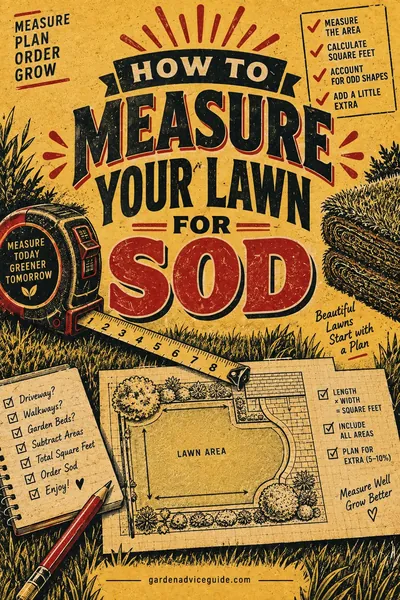
If you are still at the planning stage, work out your square footage first with how to measure your lawn for sod, because every fertilizer rate on this page is per 1,000 square feet and a wrong area estimate throws all of it off.
Cool-season sod versus warm-season sod
The 4 to 6 week rule holds for both, but the season around it changes.
Cool-season sod (fescue, bluegrass, ryegrass). Best installed in early fall or early spring. Fall installs get one light feeding and then rest. Spring installs get the 4 to 6 week feeding, then nothing through the heat of summer, then a real fall feeding once nights cool off. Never push nitrogen into a cool-season lawn in July.
Warm-season sod (bermuda, zoysia, St. Augustine, centipede). Best installed in late spring through midsummer, once the grass is actively growing. These grasses root fast in heat, so the tug test often passes in 10 to 14 days, and the first feeding can come at week 3 or 4. They also use more nitrogen over the season than cool-season turf, so the follow-up feedings come roughly every six weeks until about six weeks before frost.
Centipede is the exception. It wants a fraction of the nitrogen everything else does, and one light feeding a year is often plenty. Overfeeding centipede is the usual cause of centipede decline, and a brand new centipede lawn is the easiest one to ruin this way.
Zoysia is slow. It greens up late and establishes slowly, sometimes weeks behind bermuda laid the same day. Judge zoysia by the tug test, never by the calendar.
Reading new sod: hungry, thirsty, or drowning
Yellow sod sends people to the fertilizer aisle, and that is usually the wrong aisle.
| What you see | Most likely cause | What to do |
|---|---|---|
| Uniform pale green at week 5, sod rooted | Genuinely hungry | Light nitrogen feeding |
| Yellow with brown crispy edges, seams pulling apart | Underwatered | More water, check sprinkler coverage |
| Yellow and soft, spongy underfoot, smells sour | Overwatered | Cut back, let the surface dry between waterings |
| Yellow only in strips | Fertilizer streaking from a bad spreader pass | Water heavily, wait it out |
| Yellow only in shade | Normal, plus slower rooting | Wait, do not feed extra |
| Blue-green then gray-green | Early drought stress | Water before wilt |
Sod that has not rooted cannot take up nutrients from the soil regardless of how much you apply, so fertilizing an unrooted, struggling lawn adds a second problem on top of the first.
Watering around the feeding
Fertilizer and water are one system on a new lawn.
- Do not feed on a dry lawn. Water the day before if the soil is dry. Nutrient uptake happens in solution.
- Do not feed right before a downpour. Heavy rain within hours moves a light, quick release application straight past the root zone.
- Do irrigate a quarter inch after spreading. Enough to move the granules off the blades and start dissolving them, not enough to flush them.
- Do go back to normal watering after. Deep and infrequent, on the schedule in our best time to run sprinklers on your lawn guide, once the sod is established.
Get your frost cutoff right before you plan a late-season feeding. Our frost date lookup gives the first and last frost for your area, and the USDA's plant hardiness zone map is the underlying reference for zone boundaries.
Frequently asked questions
How soon can you fertilize new sod?
You can fertilize the soil under it any time before installation, and that is the ideal moment. On top of the sod, wait until it has rooted, which is normally 4 to 6 weeks and confirmed by the tug test rather than by counting days. Warm-season sod laid in summer sometimes gets there in 3 weeks.
What happens if I fertilize new sod too early?
Two things, both bad. The nitrogen pushes leaf growth that the missing root system cannot support with water, so the sod stresses faster in heat. And granules sitting on wet blades in sun can scorch the leaf tips outright. If you have already done it, water deeply and skip the next scheduled feeding.
What is the best fertilizer for new sod?
Before installation, a starter blend with a high middle number, worked into the bare soil. After it roots, a slow release nitrogen product at a light rate. The specific brand matters far less than the timing, the rate, and watering it in the same day.
Does new sod need fertilizer if the installer already put starter down?
That starter is the pre-install feeding, so the answer is yes to the 4 to 6 week feeding but no to anything sooner. Ask the installer what went down and at what rate, and write it on a tag in the garage. Doubling up a starter application is one of the easier ways to burn a new lawn.
My new sod is turning yellow. Should I fertilize it?
Probably not yet. Check the water first with a screwdriver pushed into the soil the morning after a watering, and run the tug test. Yellow sod that lifts like a rug is a water and rooting problem, and fertilizer makes it worse. Yellow sod that is firmly rooted at week 5 is a genuine candidate for a light feeding.
Can I fertilize new sod in the fall?
Yes, and for cool-season sod fall is the best installation season anyway. Keep the rate light and the form slow release if you are inside six weeks of your first frost. A full rate of quick nitrogen that close to a freeze pushes tender growth into cold weather, which is a known cause of winter damage.
When does new sod switch to a normal fertilizer schedule?
Roughly 12 weeks after installation, or after the second feeding, whichever comes later. At that point treat it as an established lawn and follow the standard calendar for your grass type, which for cool-season turf means the heaviest feeding in fall and for warm-season turf means late spring through summer.
The short version
Feed the soil before the sod goes down with a starter blend raked into the top few inches. Give the new lawn nothing but water for the first three weeks. Run the tug test, mow once, then apply about half a pound of slow release nitrogen per 1,000 square feet somewhere in weeks 4 to 6. Add one more light feeding around week 10 to 12 if the season still allows it, and after that the lawn is just a lawn.