When to Fertilize Zoysia Grass

The short answer on when to fertilize zoysia: start about four weeks after your average last spring frost, once the lawn is fully green and actively growing, then repeat roughly every six weeks through the heat. Your last feeding of the year goes down no later than about six weeks before your average first fall frost. That usually adds up to three or four feedings a year, all of them delivered in warm weather, never at the shoulders of the season.
Everything keys off your two frost dates. Build your free dated lawn care schedule and the tool will give you the exact feeding dates for your ZIP code and your grass.
Updated September 2026
Zoysia punishes bad timing more than most lawn grasses because it is so slow. It takes weeks longer to green up than the bermuda next door, it grows sideways instead of upward, and it holds thatch like a sponge. Feed it too early and you have fed the weeds. Feed it too late and you have handed a freeze a lawn full of soft tissue.
When to fertilize zoysia: the three dates that matter
Forget the calendar dates you see on bags. Three anchor points run the whole program, and all three come off your own frost dates.
Date one: the first feeding, about 25 to 30 days after your last spring frost. By then the lawn is not just showing green flecks, it is uniformly green and growing enough that you have already mowed it once or twice. That is the signal. Zoysia does not use nitrogen while it is still waking up, so anything applied before full green-up either leaches past the roots or feeds cool-season weeds that are growing hard while your lawn is not.
Date two: every six weeks after that, while the heat lasts. Zoysia does nearly all of its work between roughly 80 and 95 degrees. A six week interval keeps a steady, moderate supply of nitrogen through that stretch instead of one big spring shove. In practice that gives most lawns three feedings, four in the Deep South where the season runs longer.
Date three: the hard stop, about six weeks before your average first frost. This is the one people break. Nitrogen after that date pushes tender new growth into a freeze it cannot survive, and it is a common cause of winterkill and of spring dead spot showing up the following March. Whatever you skipped in summer, do not make it up in October.
Write those three dates down and you have the whole program. Everything else in this article is detail on top of them.
Why the first feeding waits for full green-up
Zoysia is the most cold hardy warm-season grass, which is why it grows well from zone 6 all the way to zone 10. That same cold hardiness makes it the slowest to wake up. It is normal for a zoysia lawn to sit tan and patchy while the neighborhood is green, and normal for full green-up to run two to four weeks behind bermuda in the same yard.
Here is what people do wrong. They see the lawn looking rough in April, assume it is hungry, and put down a spring fertilizer. Three things happen:
- The dormant zoysia cannot use it. Roots below about 60 degrees take up very little nitrogen. Most of it moves past the root zone with the next rain.
- The weeds can. Poa annua, henbit, chickweed, and crabgrass seedlings are all growing at soil temperatures that zoysia sleeps through. An April feeding is a weed feeding.
- It can slow green-up rather than speed it. Early nitrogen pushes leaf growth before the root system has recovered from winter, which leaves the lawn less able to handle the first dry spell in June.
The exception is not fertilizer at all. It is the scalping cut. About two weeks before your last frost, many zoysia owners drop the mower a notch or two and take one low cut to strip out the dormant brown material so sunlight reaches the soil. That speeds green-up by a week or two. Do it once, at the start of the season, and never again during the year.
If your lawn looks pale and slow in May and you are tempted to feed early, check soil temperature instead. Push a probe thermometer three inches down in an open sunny spot and read it in the morning. Steady readings in the mid 60s and rising mean green-up is underway. That is your green light, not the date on a bag.
Feeding windows by zone
Zoysia is rated for zones 6 through 10. Find your row, then adjust with your own frost dates rather than the regional averages here.
| Zone | Typical last frost | Typical first frost | Full green-up | First feeding | Last feeding no later than | Feedings per year |
|---|---|---|---|---|---|---|
| 6 | Late April to mid May | Mid to late October | Mid to late May | Late May to early June | Around September 1 | 2 to 3 |
| 7 | Early to mid April | Early November | Late April to early May | Early May | Around September 20 | 3 to 4 |
| 8 | Mid to late March | Late November | Mid April | Mid to late April | Around October 10 | 4 |
| 9 | Late February | Mid December or later | Late March | Late March to early April | Around November 1 | 4 |
| 10 | No reliable frost | No reliable frost | Never fully dormant | March | Mid to late October | 3 to 4 |
Two notes on the edges of that table.
Zone 6 is the tight one. The window between reliable green-up and the six week cutoff is short, sometimes only three months. That is fine. A zone 6 zoysia lawn is better off with two well-timed feedings than with three where the last one is rushed in late September.
Zone 10 runs on daylength, not frost. Without a frost date to count back from, use shortening days as the signal. Once the lawn is clearly slowing in October, stop the nitrogen even though it never turns brown.
Our growing zone lookup will tell you which row you are in, and the frost date tool gives you the two dates the whole schedule hangs on.
How much nitrogen zoysia actually wants
Zoysia is a moderate feeder, not a heavy one. Most university turf programs put a home zoysia lawn somewhere between 1 and 3 pounds of actual nitrogen per 1,000 square feet per year, and the range is that wide because the right number depends on your situation.
| Your lawn | Target nitrogen per 1,000 sq ft per year | Why |
|---|---|---|
| Shaded, low traffic, clippings returned | 1 to 1.5 lb | Shade limits growth. Extra nitrogen makes thin, disease-prone turf |
| Average full sun home lawn, clippings returned | 2 lb | The default for most yards |
| Full sun, heavy traffic, sandy soil, clippings bagged | 2.5 to 3 lb | Sandy soil leaches, bagging removes nutrients |
| New sod or plugs in year one | 2 to 3 lb | Establishment needs push, but split it into small doses |
| Fine-bladed varieties mowed low | 2.5 to 3 lb | Frequent low mowing removes more leaf tissue |
Two rules that matter more than the exact number:
Never apply more than 1 pound of actual nitrogen per 1,000 square feet in one go, and half a pound is safer in summer heat. Zoysia responds to a big dose by growing leaf tissue fast and building thatch faster, and thatch is already zoysia's worst habit.
Returning clippings counts. Mulched clippings put back roughly a quarter to a third of the nitrogen you applied. If you mulch every mow, you can sit at the low end of your range and get the same color.
Soil test before you assume you need phosphorus or potassium. Most established lawns have plenty of phosphorus and need none, which is why so many lawn products now carry a zero in the middle number. Our guide to testing garden soil covers what the numbers on the report actually mean.
Worked example: a 5,000 square foot zoysia lawn in zone 7
Say you have a full sun zoysia lawn in central North Carolina. Your average last frost is April 5 and your average first frost is November 5. You mulch your clippings, so you are targeting 2 pounds of nitrogen per 1,000 square feet for the year.
Step 1: find the first feeding date. April 5 plus 25 days = April 30.
Step 2: find the stop date. November 5 minus 45 days = September 21.
Step 3: fill in the six week intervals. April 30, then June 14, then July 29, then September 12. The next one would land October 27, well past the stop date, so it does not happen.
That is four feedings between April 30 and September 12.
Step 4: split the nitrogen. Two pounds of nitrogen across four feedings is 0.5 pound per 1,000 square feet each time. That is a comfortable summer rate.
Step 5: convert nitrogen into product. Say your bag is 32-0-4, so it is 32 percent nitrogen.
0.5 divided by 0.32 = 1.56 pounds of product per 1,000 square feet.
Your lawn is 5,000 square feet, so 1.56 x 5 = 7.8 pounds of product per application, call it just under 8 pounds.
Four applications x 7.8 pounds = about 31 pounds of product for the season.
Step 6: put it on the calendar.
| Date | Job |
|---|---|
| Mar 22 | One scalping cut to strip dormant material. Bag the clippings |
| Mar 22 to Apr 12 | Spring pre-emergent window. Do not do this if you plan to seed |
| Apr 30 | Feeding 1, about 8 pounds of 32-0-4 spread evenly |
| May 15 to Jun 20 | Core aerate and dethatch if the thatch layer is over half an inch |
| Jun 14 | Feeding 2 |
| Jul 29 | Feeding 3 |
| Sep 1 to Sep 16 | Fall pre-emergent as soil temperatures fall back through 70 degrees |
| Sep 12 | Feeding 4, the last nitrogen of the year |
| Sep 21 | Hard stop. No nitrogen after this date |
| Oct to Nov | Keep mowing until growth stops, then put the mower away |
What that schedule buys you. Even color from May through September, growth delivered during the heat when zoysia can use it, and a lawn going into winter with hardened tissue instead of soft October growth. The thing it avoids is the classic mistake of a big April feeding followed by nothing all summer, which produces a lawn that looks great for three weeks and thin by July.
A month by month plan
This is the zone 7 version. Shift it earlier for zone 8 and 9, later for zone 6, using the zone table above.
| Month | What the lawn is doing | Feed? | Other jobs |
|---|---|---|---|
| January to February | Fully dormant, tan | No | Keep traffic light. Frozen dormant zoysia bruises easily |
| March | First green flecks at the base of the plants | No | Scalping cut about two weeks before last frost. Sharpen the blade |
| April | Patchy green-up, uneven color | No, wait | Start mowing at 1 to 1.5 inches. Spot spray winter weeds |
| May | Uniformly green, growing | Yes, feeding 1 | Aerate, dethatch if needed, set the irrigation |
| June | Strong growth, filling in | No | Mow every 5 to 7 days. About 1 inch of water a week |
| July | Peak growth in peak heat | Yes, feeding 2 or 3 | Water deeply and less often. Watch for drought stress |
| August | Still growing hard | Maybe, if on a four feed schedule | Do not aerate now if the lawn is drought stressed |
| September | Growth slowing as nights cool | Last feeding early in the month only | Fall pre-emergent for winter weeds |
| October | Color fading, growth stopping | No | Last mow of the year. Rake leaves off promptly |
| November to December | Going dormant, then tan | No | A dormant lawn is not dead. Leave it alone |
What to feed and what to skip
| Product | Good for zoysia? | Notes |
|---|---|---|
| Slow release granular, high first number, low or zero middle | Yes, the default | Steady release suits zoysia's slow steady growth |
| Balanced granular with potassium for the last feeding | Yes | Potassium supports cold hardiness going into fall |
| Organic granular (feather meal, composted poultry blends) | Yes | Slow and forgiving, but needs warm soil to release |
| Fast-release urea alone in midsummer | Risky | Surge growth, thatch buildup, and burn risk on hot days |
| Weed and feed in early spring | No | Timed for cool-season lawns and it feeds your weeds, not your zoysia |
| Iron or chelated iron for color | Yes, as a supplement | Greens the lawn up without pushing growth. Useful late in the season |
| Lime | Only if a soil test says so | Zoysia is happy from about pH 6.0 to 7.0. Guessing at lime is how lawns end up too alkaline |
| Any nitrogen after your stop date | No | This is the single most damaging thing on the list |
Iron deserves a specific mention. If your color fades in late August but you have already used your full nitrogen allowance for the year, an iron application gives you deep green without a growth flush. It is the safe answer to the late-season temptation to add one more bag of fertilizer.
Common zoysia feeding mistakes
Feeding at first green-up instead of full green-up. Covered above, and it is the most common one by a wide margin.
Skipping the summer feedings because the lawn looks fine. Zoysia looks fine right up until it does not. The mid-season feedings are what carry color into September.
One heavy application instead of several light ones. A full year of nitrogen in one spring dose builds thatch, invites large patch disease, and gives you two weeks of growth you then have to mow.
Fertilizing a drought-stressed lawn. Water deeply first, wait a week, then feed. Fertilizer salts in dry soil burn roots.
Ignoring thatch. Zoysia spreads by both stolons and rhizomes, which is exactly the growth habit that builds thatch fast. Over half an inch of spongy material between the blades and the soil means fertilizer never reaches the root zone. Dethatch or verticut after full green-up in late spring, never in fall.
Fertilizing new sod on the old schedule. New sod wants small, frequent, light feedings while it roots, not the standard program. Our new sod watering schedule covers the first six weeks in detail, and when to plant zoysia sod covers the install timing.
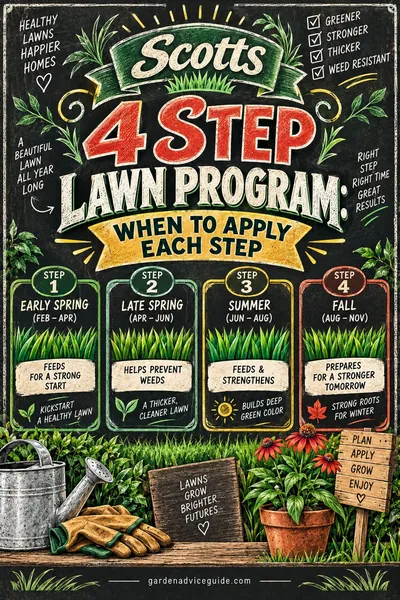
Using a lawn program built for fescue. Four-step programs sold at big box stores are timed for cool-season grass, which means the heaviest applications land in spring and fall. That is close to backwards for zoysia. We break the timing problem down in Scotts 4 step program timing.
Yellow or thin zoysia: what it usually means
Yellow zoysia sends more people to the fertilizer aisle than any other symptom, and fertilizer is the wrong answer about half the time.
| What you see | Likely cause | What to do |
|---|---|---|
| Uniform pale green in midsummer, slow growth | Genuine nitrogen shortage | Feed at your normal rate on the next scheduled date |
| Tan and patchy in April while neighbors are green | Normal slow green-up | Nothing. Wait. Do not feed |
| Yellow between the veins on new growth, worst in wet soil | Iron shortage, often from high pH or cold wet ground | Soil test. Chelated iron for a fast fix |
| Circular tan patches in spring, orange edges | Large patch disease | Reduce nitrogen, improve drainage, water in the morning only |
| Yellowing after a heavy feeding in heat | Fertilizer burn | Water deeply. Halve the rate next time |
| Thin and yellow under trees | Shade, not hunger | Prune for light or accept a thinner stand. Extra nitrogen makes it worse |
| Yellow strips in a grid pattern | Spreader overlap | Cosmetic, grows out. Use half rate in two passes at right angles next time |
| Dead patches appearing in spring after a mild fall | Late nitrogen and winter injury | This is what the stop date prevents |
Notice how many rows have nothing to do with fertility. That is the point of testing before feeding, and it is the reason the schedule matters more than the bag you pick.
FAQ
When should I fertilize zoysia in the spring?
Not at the first sign of green. Wait until the lawn is uniformly green and you have mowed it at least once, which is usually about four weeks after your average last frost. In zone 7 that lands around the end of April, and in zone 6 it can be late May. Feeding a half-dormant zoysia lawn feeds your winter weeds instead.
Can I fertilize zoysia in the fall?
Only if the date falls at least six weeks before your average first frost. In most of zone 7 that means early September is the last chance, and October is always too late. Late nitrogen pushes soft growth into a freeze and can leave you with dead patches next spring. If the lawn looks dull in October, use an iron product for color rather than nitrogen.
How often should I fertilize zoysia grass?
Every six weeks through the growing season, which works out to three or four feedings a year for most lawns. Zone 6 lawns often only fit two. More feedings than that is not better with zoysia, because it builds thatch quickly and thick thatch causes more problems than a slightly paler lawn ever will.
What is the best fertilizer for zoysia grass?
A slow-release granular product with most of its nitrogen in slow-release form, a low or zero middle number unless a soil test says otherwise, and some potassium in the last feeding of the year. The exact brand matters far less than the rate and the date. Apply no more than 1 pound of actual nitrogen per 1,000 square feet at a time, and half a pound in the peak of summer.
Why is my zoysia still brown in May?
Because it is zoysia. It is the slowest of the common lawn grasses to break dormancy and it routinely runs two to four weeks behind bermuda in the same yard. As long as you can find green at the base of the plants when you part the canopy, the lawn is alive. A scalping cut in early spring speeds green-up more than any fertilizer will.
Should I water after fertilizing zoysia?
Yes, about a quarter to half an inch right after application. That moves granules off the leaf blades, where they can burn, and dissolves them into the root zone where they do the work. Do not apply granular fertilizer to a wet lawn, because the granules stick to the blades. Our watering guide covers how to measure what your sprinklers actually put down.
Does zoysia need more or less fertilizer than bermuda?
Less. Bermuda is a hungrier grass and often runs at the top of the warm-season nitrogen range, while zoysia does well in the middle of it. Feeding zoysia on a bermuda program gives you thatch, disease pressure, and a lot of extra mowing. If you are choosing between the two, our guide to when to plant bermuda grass compares how the two behave through the season.
Can I fertilize and apply pre-emergent at the same time?
You can, and combination products exist, but the ideal dates rarely line up. Spring pre-emergent goes down around your last frost, weeks before zoysia is ready to be fed. Applying the combination product at the pre-emergent date means feeding a dormant lawn. Buy them separately and hit each date properly. Our guide to pre-emergent timing covers the soil temperature trigger.