When to Overseed Your Lawn in Spring

Overseed a cool-season lawn in spring once soil temperature at 2 inches holds between 50 and 55°F for about a week and daytime air runs 60 to 75°F. For most of the country that lands between early March in the South, mid-April in the middle, and early May in the far North. The calendar date matters less than the thermometer, because seed sown into 45°F soil can sit for a month without sprouting.
Get your own dated schedule by grass type and zip code with our free lawn care schedule tool, then use the soil temperature tables below to pick the exact week.
Updated September 2026
One fork before you buy a bag. This article is about cool-season grasses: tall fescue, Kentucky bluegrass, perennial ryegrass, and fine fescue. If you have bermuda, zoysia, St. Augustine, or centipede, your seeding season is later and hotter, and the warm-season section near the bottom explains what to do instead.
When to overseed your lawn in spring: the soil temperature rule
Grass seed responds to soil temperature, not to the date on the calendar or how nice the weekend felt. Cool-season seed germinates between about 50 and 65°F of soil temperature, with 60°F being close to ideal. Below 50°F, germination slows to a crawl and seed sits vulnerable to rot, birds, and washout.
The practical test: push a soil thermometer 2 inches down, read it mid-morning for three days running, and look for a steady 50 to 55°F. Mid-morning matters. A 4 p.m. reading on a sunny March day flatters the number by several degrees.
Air temperature is the second gate. You want daytime highs of 60 to 75°F and nights above about 40°F. That combination gives seedlings enough warmth to grow without the heat stress that comes later.
| Soil temp at 2 in | What happens to cool-season seed |
|---|---|
| Below 45°F | Essentially dormant. Seed sits and often rots |
| 45 to 50°F | Very slow. Three weeks or more to emerge |
| 50 to 55°F | Green light. Germination is reliable, just unhurried |
| 55 to 65°F | The sweet spot. Fastest, most even germination |
| Above 70°F | Germination is fine, survival is not. Heat stress starts |
That last row is the whole problem with spring seeding. The window opens when soil hits 50°F and closes when it passes 70°F, and in much of the country those two events are only six to eight weeks apart.
Spring overseeding timing by zone
These are typical windows, not guarantees. A cold March pushes everything back two weeks, and elevation moves it more than latitude does.
| Zone | Typical spring window | Soil hits 50°F around | Notes |
|---|---|---|---|
| 3 | May 5 to June 1 | Early May | Very short window before summer |
| 4 | April 25 to May 25 | Late April | Ryegrass in the blend helps |
| 5 | April 15 to May 15 | Mid April | Reliable window, watch for late frost |
| 6 | April 1 to May 5 | Early April | Best spring window in the country |
| 7 | March 15 to April 20 | Mid March | Seed early, heat arrives fast |
| 8 (cool-season lawns) | March 1 to April 5 | Early March | Transition zone only. Very tight |
The old-timer version of this table works surprisingly well: seed when the forsythia is in full bloom and the lilacs are budding. Forsythia blooms on accumulated soil warmth, which is exactly what you are trying to measure. It also flags the crabgrass pre-emergent window, and those two jobs conflict, which brings us to the biggest spring-specific problem.
The pre-emergent conflict nobody warns you about
Here is the trap. The right week to apply crabgrass pre-emergent and the right week to overseed are the same week, and the two jobs cancel each other out.
Pre-emergent herbicides work by creating a barrier that stops germinating seeds from developing roots. They cannot tell a crabgrass seed from a fescue seed. Apply one in March and seed in April, and most of your seed never comes up. There is no visible sign of this. The lawn just stays thin and you assume the seed was bad.
| Active ingredient | Common product names | Wait before seeding |
|---|---|---|
| Prodiamine | Barricade | 12 to 16 weeks |
| Dithiopyr | Dimension | 8 to 12 weeks |
| Pendimethalin | Scotts Halts | 8 to 12 weeks |
| Siduron | Tupersan | Safe at seeding |
| Mesotrione | Tenacity | Safe at seeding |
You have three honest options:
- Seed and skip the pre-emergent this spring. Accept a crabgrass year, hand pull what shows up, and go back to a normal program next spring. This is the right call if the lawn is genuinely thin, since bare ground grows crabgrass anyway.
- Use a seeding-safe product. Siduron and mesotrione are labeled for use at seeding. They are harder to find on a big-box shelf and they do not control every weed, but they let you do both jobs in the same month.
- Skip the seeding and wait for fall. For a lawn that is only slightly thin, this is usually the better outcome.
The timing side of the herbicide job is covered in detail in when to apply pre emergent weed control. Broadleaf weed killers matter too: wait three to four weeks after spraying before you seed, and wait until new grass has been mowed three or four times before you spray it.
Be honest about spring versus fall
Fall is the better time to overseed a cool-season lawn, and it is not close. Soil is still warm from summer while air is cooling, crabgrass is finished for the year, and the new grass gets two mild growing seasons before it faces heat.
Spring seedlings get maybe eight weeks of good weather before June, then they spend July trying to survive with a root system a couple of inches deep. Survival rates are noticeably lower. The full case is laid out in when to overseed lawn in fall.
Spring is still the right call in four situations:
- Winter killed patches. Snow mold, vole tunnels, plow scrape along the driveway, or salt damage on the curb strip. You cannot leave bare soil until September without growing weeds in it.
- A new build or new sod repair. Bare dirt in April is going to grow something. Better that it be grass.
- You missed fall entirely. A thin lawn seeded in spring beats a thin lawn seeded never.
- You are in zone 3 or 4. The fall window up north is genuinely tight, and spring is a legitimate second option.
If your lawn is only mildly thin and you can wait, wait. If it has bare ground in it, seed now.
How to overseed in spring, step by step
- Mow low, one notch shorter than usual. Take the lawn down to about 2 inches and bag the clippings. Seed needs light and soil contact, and existing grass will hoard both.
- Dethatch or rake hard. If thatch is more than half an inch, dethatch. Otherwise a stiff rake over the thin areas is enough to open the surface. Seed lying on thatch does not germinate.
- Core aerate if the soil is compacted. Spring aeration is safe for cool-season lawns and the open holes make excellent seed pockets. Aerate first, then seed, then leave the plugs to break down on their own.
- Spread at the overseeding rate, not the new-lawn rate. Double the rate does not double the lawn. It produces crowded seedlings that thin themselves out.
- Apply a starter fertilizer the same day. Phosphorus is the one nutrient new roots genuinely need, and starter blends carry it.
- Rake lightly or roll for seed to soil contact. Seed needs to be nestled into soil, not sitting on top of it. A light topdressing of compost, about a quarter inch, does the job on rough areas.
- Water lightly and often until germination. This is the step people get wrong. See the watering section below.
- Stay off it. No foot traffic, no dog, no pre-emergent, no broadleaf spray until the new grass has been mowed three or four times.
Seeding rates that match the bag
Rates are in pounds per 1,000 square feet, and these are the same figures used in the lawn schedule tool.
| Grass | New lawn rate | Overseed rate | Days to germinate |
|---|---|---|---|
| Kentucky bluegrass | 2 to 3 lb | 1 to 1.5 lb | 14 to 30 |
| Tall fescue | 6 to 8 lb | 3 to 4 lb | 7 to 12 |
| Perennial ryegrass | 6 to 9 lb | 4 to 6 lb | 5 to 10 |
| Fine fescue | 4 to 5 lb | 2 to 3 lb | 7 to 14 |
Cold soil stretches every one of those germination numbers. Seed that sprouts in 8 days at 65°F can easily take 3 weeks at 50°F, so do not panic at day 10 and reseed on top of it.
Kentucky bluegrass is the problem child in spring. At 14 to 30 days to germinate plus 8 to 10 weeks to establish, a bluegrass seedling sown May 1 is barely rooted when summer arrives. In spring, lean on tall fescue or a blend with ryegrass in it, and save straight bluegrass for a fall seeding.
A worked example: 5,000 square feet in zone 5
You are in zone 5 with a tall fescue lawn, 5,000 square feet, and two bare strips along the driveway from snow plowing.
Week of April 8: soil thermometer reads 46, 48, then 47°F. Too cold. Wait. Buy seed and starter fertilizer now, since garden centers sell out of the good blends by May.
Week of April 15: readings of 52, 54, and 53°F, forecast highs in the mid 60s. Green light.
Saturday, April 18:
- Mow at 2 inches, bag the clippings.
- Rake the two bare strips down to soil.
- Spread seed at the overseed rate: 3.5 lb per 1,000 square feet, so 17.5 lb for the whole lawn. Hit the bare strips at the new-lawn rate of 7 lb per 1,000 instead.
- Spread starter fertilizer at the label rate.
- Rake the bare strips lightly and topdress with a quarter inch of compost.
- Skip the crabgrass pre-emergent entirely this spring.
April 18 to May 1: water lightly two or three times a day, about 10 minutes per zone, enough to keep the top half inch damp without puddling.
Around April 28: first blades appear on the fescue, which is day 10 in cool soil.
Around May 8: shift to one deeper watering every other day to push roots down.
Around May 15: first mow, once the new grass reaches 3.5 inches, cutting no more than a third of the blade.
Mid June: three or four mows in, so it is now safe to spot spray broadleaf weeds. Feed lightly, then leave the lawn alone through July and plan a proper fall overseeding in September.
Watering, mowing and feeding after you seed
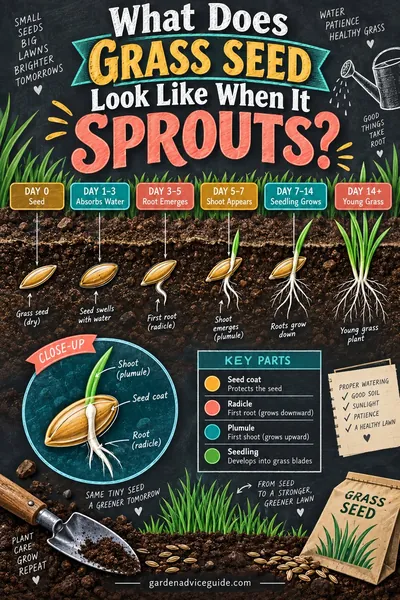
Watering is the job that decides the outcome. New seed has no roots, so it lives entirely on the moisture in the top half inch of soil, and that layer dries out in a few hours on a breezy April day. Water lightly two or three times a day until germination, then reduce frequency and increase depth. The full day-by-day version is in our watering schedule for a newly seeded lawn.
Mowing waits until the new grass is about a third taller than your normal cut height, which is usually 3 to 4 weeks after germination. Cut with a sharp blade and take no more than a third of the blade at once. Details in when to mow new grass.
Feeding is a two-step job: starter fertilizer at seeding, then a follow-up feed four to six weeks later once the seedlings have real roots. Skip nitrogen-heavy summer feeds on a spring-seeded lawn, since soft growth going into July is exactly what you do not want. Our guide to when to fertilize after overseeding has the full timeline.
Warm-season lawns: spring seeding is different
Bermuda, zoysia, and centipede run on the opposite calendar. They need soil at 65 to 70°F and rising, which is late spring through midsummer, usually two to three weeks after your last frost date. Seed bermuda in March because the air felt warm and you will lose the bag.
Zoysia is rarely worth seeding into an existing lawn at all, and St. Augustine is not sold as seed in any useful form in the United States, so both of those are sod or plug jobs. The timing for a bermuda seeding is covered in when to plant bermuda grass.
The one spring job that does apply to warm-season lawns: if you overseeded with ryegrass last fall for winter color, that ryegrass competes with bermuda green-up in April and May. Mow it short and stop watering it once soil passes 65°F so the permanent turf can take back over.
When it is too late to overseed in spring
The window closes when soil temperature passes about 70°F and daytime highs settle above 80°F, because seedlings that germinate then face summer with nothing under them. In practice that means late May in zones 6 and 7, and mid June in zones 3 through 5.
Past that point you have two better choices than seeding anyway:
- Wait for fall. Mark the calendar for about 45 days before your first fall frost and do the job properly.
- Patch only. Small bare spots can be seeded in early summer if you are willing to water them daily. A whole-lawn seeding in June is throwing seed away.
If you are unsure which side of the line you are on, our guide to when is it too late to plant grass seed works through both the spring and fall deadlines.
FAQ
Can you overseed a lawn in March?
In zones 7 and 8 yes, since soil often reaches 50 to 55°F by mid March. In zones 5 and 6, March is usually too cold and the seed just sits. Read the soil temperature at 2 inches rather than trusting the month, and remember that a March seeding conflicts directly with crabgrass pre-emergent timing.
What soil temperature do I need to overseed in spring?
50 to 55°F at 2 inches deep, held for about a week, with 55 to 65°F being the ideal range for fast even germination. Below 45°F nothing happens and seed often rots. Above 70°F germination still works but the seedlings face summer heat before they have roots.
Should I put down fertilizer or seed first?
Do both on the same day, seed first and starter fertilizer second, so the fertilizer lands on top and washes down with the first watering. Use a starter blend with phosphorus rather than a standard lawn feed, and never use a weed and feed product, since almost all of them contain a pre-emergent that blocks your seed.
How long does grass seed take to grow in spring?
Perennial ryegrass takes 5 to 10 days, tall fescue 7 to 12, fine fescue 7 to 14, and Kentucky bluegrass 14 to 30. Cool spring soil adds a week or more to all of those numbers. A stand seeded in mid April is usually ready for its first mow in mid to late May.
Is spring or fall better for overseeding?
Fall, clearly, for cool-season grass. Fall seedlings get warm soil, cool air, no crabgrass competition, and two growing seasons before their first summer. Spring is a legitimate second choice for winter damage, bare patches, and northern lawns where the fall window is short.
Do I need to aerate before overseeding in spring?
Only if the soil is compacted or the thatch layer is more than half an inch. Core aeration and overseeding pair well because the holes give perfect seed to soil contact. On a lawn that is simply thin, a hard raking of the bare areas achieves the same thing with less work.