When to Plant Onions

Plant onion sets and transplants 2 to 4 weeks before your average last spring frost, and start onion seeds indoors 10 to 12 weeks before that same date. Young onions shrug off frost down to about 20°F once they've rooted, so early planting is an advantage rather than a gamble. In zones 8 through 10 the schedule flips completely: onions go in during fall and winter, October through January, for a late-spring harvest.
Get your last frost date first with our free frost date lookup, then count back. Everything below hangs on that one number and on one other thing that almost nobody mentions until paragraph forty.
Day length decides whether you get a bulb at all
Here's the fact that determines success or failure before you plant a single onion, and most articles bury it under a soil pH chart.
Onions do not bulb because of the calendar or the temperature. They bulb because the day reaches a specific number of daylight hours. Until that trigger hits, the plant only makes leaves. When it hits, leaf production stops and everything the plant has stored gets pushed into the bulb.
Different onion varieties are wired to different triggers:
- Long-day onions start bulbing at 14 to 16 hours of daylight. Those hours only happen in the northern US, roughly above 37 degrees latitude, which is about the line running through southern Missouri, central Kansas, and northern California.
- Short-day onions start bulbing at 10 to 12 hours. Southern gardens hit that in late winter and early spring.
- Intermediate-day onions (sold as day-neutral) bulb at 12 to 14 hours and cover the middle band of the country.
Now the failure modes, which are the whole point. Plant long-day onions in Houston and the day length never reaches 14 hours during the growing season, so you get gorgeous green tops and a bulb the size of a marble, forever. Plant short-day onions in Minnesota and the opposite happens: the 10-hour trigger fires in early spring when the plant is still tiny, so it bulbs immediately and gives you a golf ball. Day length is a hard switch in plenty of plants, and it is what tells a holiday cactus to set buds in late September.
Neither problem is fixable with better soil, more water, or more fertilizer. Texas A&M AgriLife Extension has published on this for decades because it's the single most common reason a southern onion patch fails. Buy the right type for your latitude and half the job is done at the checkout counter.
One more piece of the mechanism worth knowing: every leaf an onion grows before bulbing becomes one ring in the finished bulb. More leaves at trigger time equals a bigger onion. That's why planting date matters so much. Two extra weeks of leaf growth before the day-length switch flips is two or three extra rings.
When to plant onions by region and day length
Use latitude, not just your USDA zone, since day length tracks latitude and zone tracks winter cold. A gardener in coastal zone 8 Oregon and one in zone 8 Georgia need different onions.
| Region | Approx. latitude | Onion type to buy | Planting window | Harvest window |
|---|---|---|---|---|
| Northern US, Upper Midwest, New England, Pacific Northwest | Above 40°N | Long-day | Late March to early May (2-4 weeks pre-frost) | Late July to September |
| Mid-Atlantic, Ohio Valley, Central Plains, Northern California | 36-40°N | Intermediate or long-day | Early March to mid April | July to August |
| Mid-South, Oklahoma, Tennessee, North Carolina | 33-36°N | Intermediate | February to March | June to July |
| Deep South, Texas, Gulf Coast, Southern California, Arizona | Below 33°N | Short-day | October to January | April to June |
| Florida, South Texas, low desert | Below 30°N | Short-day | November to January | March to May |
Real varieties for each type, so you're not guessing at the rack:
- Long-day: Patterson, Copra, Walla Walla Sweet, Yellow Sweet Spanish, Redwing, Ailsa Craig.
- Intermediate: Candy, Super Star, Sierra Blanca, Red Candy Apple, Cabernet.
- Short-day: Texas Early Grano, Yellow Granex (the Vidalia type), Southern Belle, Red Creole, White Bermuda.
Patterson and Copra store for eight to ten months. Walla Walla and Granex are sweet onions that store for a few weeks at best, so grow those to eat, not to keep.
Zones 8 to 10: your window opens now
If you're in the Gulf South, Texas, Florida, southern California, or the low desert, fall planting is the main event, not a backup plan.
Southern onions are grown through the cool season. Short-day transplants go in from October through January, grow leaves through the mild winter, hit their 10 to 12 hour trigger in late winter, bulb through spring, and get pulled before the real heat arrives. Try to grow them in a southern summer instead and heat plus long days plus disease will beat you every time.
The practical schedule:
- Zone 8: set transplants late October through December. Harvest May into June. Onion seed can be sown in beds in late September for transplants in November.
- Zone 9: set transplants November through early January. Harvest April into May.
- Zone 10 and South Texas: set transplants December through January. Harvest March into May.
Young onions in zones 8 and 9 will take a hard freeze without much damage. Plants under about pencil thickness at the time of a severe freeze come through better than large ones, which are more likely to be pushed into bolting by prolonged cold.
Fall is the busiest southern planting season of the year. Our roundup of what to plant in October covers what else should be going in the same beds.
Sets vs transplants vs seed
Three ways to start an onion, and the choice affects bulb size more than most people expect.
Sets are tiny dormant bulbs grown from seed the previous year. They're the easiest thing in gardening: push them into the soil an inch deep, pointy end up, done. The catch is that a set is a second-year onion, and second-year onions are biologically inclined to flower. Cold weather after planting can push them into bolting, and a bolted onion stops making bulb and won't store. Sets also come mostly as unnamed "yellow," "white," or "red," which means you have no idea what day length they were bred for.
Transplants are pencil-thin seedlings sold in bundles of 50 to 60, usually shipped bare root. They're the sweet spot for most gardeners: named varieties, correct day length printed on the bundle, low bolting risk, and full bulb size potential.
Seed gives you the widest variety choice, the lowest cost per plant, the biggest bulbs, and the least bolting. It also demands 10 to 12 weeks under lights before your transplant date, which is a real commitment in February.
| Method | Sold as | Relative cost per plant | Ease | Bulb size potential | Bolting risk | Variety choice |
|---|---|---|---|---|---|---|
| Sets | Mesh bags of 80 to 100 small bulbs | Middle of the three | Easiest | Small to medium | Highest | Poor, often unnamed |
| Transplants | Bundles of 50 to 60 pencil-thick seedlings | Most expensive by a wide margin | Easy | Large | Low to moderate | Good, day length labeled |
| Seed | Packets of 300 or more | Cheapest by a very long way | Most work | Largest | Lowest | Best |
Seed is not close on cost. One packet plants more onions than most households eat in a year, for less than a single bundle of transplants, and it is the only route that gives you every named variety in the catalog. What you pay for with sets and transplants is the ten to twelve weeks under lights that you get to skip.
A useful trick if you're buying sets anyway: choose the smallest ones, under about 3/4 inch across, roughly dime-sized. Larger sets bolt far more often. Plant the big ones two inches apart and pull them young as green onions, and reserve the small ones for bulbs.
When to plant onion sets and seeds, precisely
- Onion seeds indoors: 10 to 12 weeks before your last frost. Zone 5 with a May 10 frost means mid-February to March 1. Keep seedlings trimmed back to about 4 inches so they stay stocky instead of flopping.
- Onion sets and transplants outdoors: 2 to 4 weeks before your last frost. Zone 5 means roughly April 12 to April 26.
- Zones 8 to 10: transplants October through January as above, no indoor start needed.
Onion seed is famously short-lived. Buy fresh every year, because two-year-old onion seed germinates poorly and three-year-old seed often doesn't come up at all.
Planting depth and spacing
Two numbers, and getting them wrong costs you real bulb size.
Depth: 1 inch. Set the bulb or the seedling so about an inch of the white stem is underground and no more. Do not bury the neck. Onions bulb at the soil surface, half above ground, and a buried neck gives you a long white shank instead of a fat bulb, plus it invites rot.
Spacing: 4 to 6 inches for full-size bulbs, in rows 12 to 18 inches apart. That sounds generous until you see two onions planted 2 inches apart fighting each other to a draw.
The practical version most gardeners use is to plant at 2 inches and thin by eating. Set everything 2 inches apart, then starting about six weeks in, pull every other one as a green onion until the survivors are standing 4 to 6 inches apart. You get scallions in spring and full bulbs in summer from one bed.
| Goal | Spacing | Depth | Notes |
|---|---|---|---|
| Full-size storage bulbs | 4-6 in | 1 in | Rows 12-18 in apart |
| Green onions / scallions | 2 in | 1-2 in | Harvest at pencil size |
| Both from one bed | Plant at 2 in | 1 in | Thin to 4-6 in by pulling scallions |
Feeding: heavy, then stop
Onions are heavy feeders with shallow, sparse roots that can't forage far. They need the nutrients delivered to them.
Work 2 to 3 inches of compost into the bed before planting, then side-dress with a nitrogen source every two to three weeks through the leaf-growing phase. That's the phase where you're building rings, so it pays back directly.
Then comes the part people miss. Stop all nitrogen the moment bulbing starts. You'll see it: the base swells, the soil cracks slightly around the bulb, and the plant stops making new leaves. Nitrogen after that point produces thick, soft necks that never seal properly, and a thick-necked onion rots in storage within weeks instead of keeping for months.
Water: consistent, but never soggy
Onions want about an inch of water a week, delivered steadily. Their shallow roots dry out fast in the top few inches of soil, and any drought stress during bulbing shrinks the final bulb permanently. Uneven watering also causes splitting and doubles.
They also hate sitting wet. Waterlogged soil rots onion roots quickly and sets up neck rot and downy mildew. The answer to both requirements is the same: well-drained soil, ideally a raised bed or a slightly mounded row, plus mulch to even out the moisture, plus regular light irrigation instead of occasional flooding.
Stop watering entirely once about half the tops have fallen over. From that point you're curing, not growing, and extra water only encourages rot.
When do you pull onions?
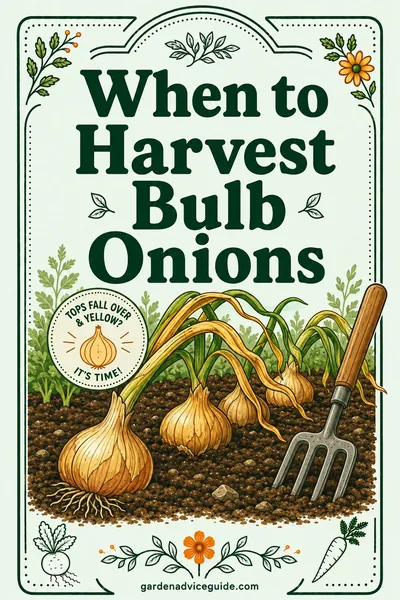
Short version: when 50 to 80 percent of the tops have flopped over on their own, which is usually 100 to 120 days after transplanting.
Don't knock the tops down yourself to speed things up. That old trick shortens the storage life of the bulb because it interrupts the natural process that seals the neck. Let the plant decide.
Once most tops are down, stop watering, wait a few dry days, then lift the bulbs with a fork rather than pulling by the tops. Cure them in a warm, dry, shaded, airy spot for two to three weeks until the necks are tight and papery and the outer skins rustle. Only then trim and store.
That's the summary. For the full treatment, including how to tell a storage onion from one you need to eat this month and what to do when rain arrives right at harvest time, see our dedicated guide on when to harvest bulb onions.
Worked example: zone 5 at 43 degrees latitude
A gardener in southern Wisconsin, zone 5b, sitting at 43°N with an average last frost of May 10.
Variety choice: 43 degrees is well north of the 37-degree line, so long-day it is. Patterson for storage (about 104 days, keeps into spring) and Walla Walla for fresh eating. Short-day varieties are off the table entirely here.
February 22: seed goes into flats indoors under lights, 11 weeks before the last frost. Sown thickly in a deep tray, thinned to about half an inch apart. Tops get trimmed back to 4 inches twice during March to keep the seedlings stocky.
April 20: transplants go out, exactly 3 weeks before the last frost. Seedlings are pencil-thin. Set 1 inch deep, 2 inches apart in rows 15 inches apart. A light frost the following week does no damage.
May and early June: nitrogen side-dressing every two weeks. Every other plant gets pulled as a green onion from mid-May onward, leaving the keepers at 5 inches apart.
Mid-May to early June: the day length at 43°N crosses 14 hours in early May and 15 hours by the end of the month, so the long-day trigger fires and bulbing begins. Nitrogen stops the moment the bases start to swell. By then each plant has 10 to 13 leaves, which is 10 to 13 rings.
Late July into early August: tops start falling. When about two thirds are down, watering stops. Bulbs come up with a fork a few days later.
Early to late August: curing on a slatted rack in the garage, out of sun, with a box fan running. Necks go tight and papery in about two and a half weeks. Patterson bulbs then store in a cool, dry, dark spot into the following March.
Total elapsed time from seed to a cured storage onion is right around six months, and the whole thing was set in motion by one decision in February about latitude.
For laying out the rest of the year around that schedule, our planting calendar by zone does the same window math for every other crop. And if you're planting onions this fall in the South, note that garlic goes in during the same window and wants nearly identical soil and spacing.
FAQ
When do you plant onion sets?
Push onion sets in 2 to 4 weeks before your average last spring frost, an inch deep with the pointed end up. In zone 5 that's mid to late April, in zone 6 early April, and in zone 7 mid March. In zones 8 through 10, sets and transplants go in during fall and winter instead, from October through January.
When should I start onion seeds indoors?
Sow onion seed 10 to 12 weeks before your last frost date, which for most northern gardeners means late January through early March. Trim seedlings back to about 4 inches whenever they get floppy so the plants put energy into stem thickness. Buy fresh seed every year, since onion seed loses germination fast.
Why did my onions grow big tops but no bulbs?
Almost always the wrong day-length type for your latitude. Long-day onions planted in the South never reach their 14 to 16 hour trigger, so they keep making leaves and never bulb. Too much nitrogen late in the season and overcrowded spacing can also push a plant toward leaves instead of bulb.
When do I pick onions and how do I know they're ready?
Wait until 50 to 80 percent of the tops have fallen over on their own, typically 100 to 120 days after transplanting. Stop watering at that point, give it a few dry days, then lift with a fork. Don't bend the tops down yourself, since it shortens how long the bulbs keep.
Can onions survive a frost after planting?
Yes. Established onion plants tolerate temperatures down to about 20°F, which is exactly why the planting window sits before your last frost rather than after it. Newly set transplants that haven't rooted yet are more vulnerable, so a row cover during a hard freeze in the first week or two is cheap insurance.
Why are my onions flowering, and what should I do?
That's bolting, usually triggered by a cold spell after planting or by using sets larger than about 3/4 inch across. A bolted onion stops enlarging its bulb and will not store. Snap off the flower stalk, then use those bulbs first over the next few weeks rather than putting them in storage.
Are sets or transplants better for big onions?
Transplants, by a clear margin. Sets are the easiest option but they bolt more often, produce smaller bulbs, and are usually sold without any day-length label. If you want large storage onions, buy named transplants matched to your latitude, or start your own from seed in winter.
How deep and how far apart do onions go?
One inch deep, with the neck above ground, and 4 to 6 inches apart in rows 12 to 18 inches apart. If you want scallions too, plant at 2 inches and thin by pulling every other one as a green onion until the keepers stand 4 to 6 inches apart. Never bury the neck, since onions bulb at the soil surface.
Updated August 2026
A note on numbers. This page gives you timing, spacings, depths and quantities, not dollar figures. Seed, plants and garden supplies are priced by your region, your supplier and the season, and we do not set any of it. Work out what you need here, then price the list at two or three local suppliers.