Grass Seed Not Growing?

When grass seed is not growing, the cause is usually one of four things you can check in ten minutes: a crabgrass preventer or weed and feed still active in the soil, seed that landed on thatch or hard ground and never touched soil, seed washed off by a storm, or a slow grass like Kentucky bluegrass that simply isn't due yet. Shade, birds, old seed, the wrong soil temperature, a dried out surface and seed buried under too much straw make up the rest. Each one leaves a different pattern on the lawn, and the pattern tells you which fix to use.
Before you reseed anything, line up the next window with our free lawn care schedule so the second round doesn't fail for the same reason as the first.
Updated September 2026
Grass seed not growing? Read the pattern first
Walk the seeded area and look at where grass came up and where it didn't. Lawn seeding failures are rarely uniform, and the shape of the bare ground points straight at the cause.
| What you see | Most likely cause | Go to |
|---|---|---|
| Nothing anywhere, seed still visible and unchanged | Too early to judge, or soil too cold | Causes 1 and 6 |
| Seed swelled, pushed a tiny root, then nothing | Pre-emergent herbicide, or the surface dried out | Causes 2 and 5 |
| Grass up in raked bare spots, nothing where you seeded over old turf | Poor seed to soil contact | Cause 3 |
| Bare stripes down a slope, thick clumps at the bottom | Washout | Cause 4 |
| Good stand in the open, thin or nothing under trees | Shade and root competition | Cause 7 |
| Seed gone from the surface, no seedlings | Birds, ants or runoff | Causes 8 and 4 |
| Thin everywhere, coarse or weedy grass you didn't expect | Old or low quality seed | Cause 9 |
| Sparse under straw piles or topsoil mounds | Buried or smothered | Cause 10 |
| Bare along the driveway and walks, fine in the middle | Pre-emergent spread past the edge | Cause 2 |
| Came up, then fell over at the soil line | Disease, not germination | Note under cause 5 |
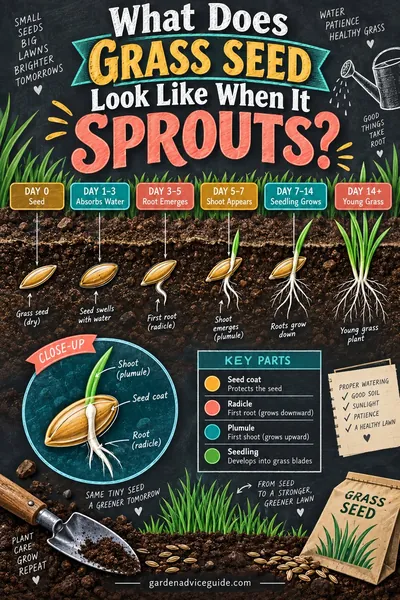
Then do one more check that takes thirty seconds. Scrape up a pinch of seed and soil from a bare spot and look at the seeds closely. Hard, tan and unchanged means the seed never got going. Swollen with a short root tip that has gone brown means it started and something stopped it. No seed at all means it left. Our guide to what grass seed looks like when it sprouts shows each stage up close, so you can tell a stalled seed from one that is right on schedule.
1. It hasn't had enough time yet
The most common "failure" is a lawn that is working fine on a slower clock than the owner expected. Grass species germinate at very different speeds, and the front of the bag usually advertises the fastest one in the mix.
| Grass type | Days to first sprouts in good conditions | Don't call it failed before |
|---|---|---|
| Annual ryegrass | 5 to 10 | Day 14 |
| Perennial ryegrass | 5 to 10 | Day 14 |
| Tall fescue | 7 to 14 | Day 18 to 21 |
| Fine fescues (creeping red, chewings, hard) | 7 to 14 | Day 21 |
| Kentucky bluegrass | 14 to 30 | Day 35 to 40 |
| Bermudagrass | 10 to 30 | Day 30 |
| Zoysiagrass | 14 to 21 | Day 30 |
| Centipedegrass | 14 to 28 | Day 35 |
| Bahiagrass | 21 to 28 | Day 40 |
| Buffalograss | 14 to 30 | Day 35 |
Those numbers assume soil in the right temperature band for that grass. Cool soil adds a week or more to every row.
Mixes germinate in waves. A sun and shade blend of perennial ryegrass, fine fescue and Kentucky bluegrass can look finished at day 10 because the rye is up, look patchy at day 20, and then fill in around day 35 as the bluegrass arrives. If you judge it at day 12, you are judging only the ryegrass.
The fix: find the slowest grass on the seed label and wait out its full window, keeping the care going until then. Dig a few seeds to confirm they are swelling. Reseeding over a two week old seeding usually wastes the second bag, because the new seedlings crowd the ones already on their way.
2. A pre-emergent or weed and feed is still active
This is the cause people miss most, because the product went down months earlier and nobody connects the two. Crabgrass preventers work by killing seedlings as their first root emerges, and they cannot tell crabgrass from tall fescue. Seed sown into a treated lawn swells, pushes a root tip, and dies before you ever see green. It looks exactly like bad seed.
Where it hides:
- Spring crabgrass preventer. Prodiamine, dithiopyr and pendimethalin typically carry an 8 to 16 week wait before seeding on the label. A split application in May and June can still be active in September.
- Weed and feed and "crabgrass preventer plus fertilizer" bags. Many contain the same active ingredients. Read the back panel, not the front.
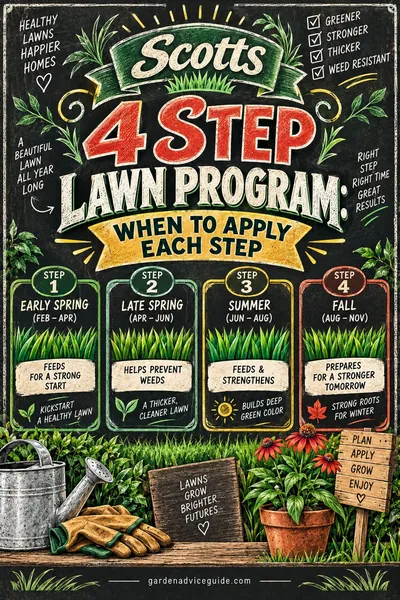
- Multi-step lawn programs. The early steps usually include a pre-emergent. Which step carries what is laid out in our four step program timing guide.
- Corn gluten meal. It's organic, and it still inhibits root formation in new grass seed for roughly 6 weeks.
- A lawn service or a neighbor. A shared strip or a property line that someone else treated behaves the same way.
- Overspread along the edges. Broadcast spreaders throw granules several feet past where you walk. Bare seeded strips along driveways and walks, with a good stand in the middle, are a classic sign.
Broadleaf weed killers have a shorter wait, usually 3 to 4 weeks before seeding, and non-selective products used to clear an area often allow seeding within about a week. The label is the authority on every one of them.
The fix: find the date and the product, count forward to the end of the wait, and reseed after it. If that pushes you past your fall cutoff, plan a dormant seeding or a spring seeding instead. Two products, siduron and mesotrione, are labeled for use at seeding, but they only help the next round. They do not neutralize a different pre-emergent already in the soil. The full timing picture is in when to apply pre-emergent weed control, and when to apply prodiamine covers the longest lasting of the common products.
3. The seed never touched soil
Grass seed has to sit in firm contact with mineral soil to take up water evenly. Seed resting on thatch, dead grass, a hard crust or a layer of leaves gets wet and dries out within the hour, over and over, and most of it never germinates. The few seeds that do sprout on thatch push a root into a spongy layer that dries faster than soil, and they die on the first warm afternoon.
This is why overseeding an existing lawn fails far more often than seeding bare ground. You spread seed over grass, and the grass holds it an inch above the dirt.
Signs this is your problem:
- Seedlings came up where you raked hard or where the soil was bare, and almost nowhere else
- You can pick up loose seed by brushing the grass blades with your hand
- Thatch is more than half an inch thick when you cut out a plug with a knife
- The soil is so compacted that a screwdriver won't push in more than an inch or two
The fix: get the seed down to soil before you spread it again.
- Mow the existing grass short, around 1.5 to 2 inches, and bag the clippings.
- Open the soil. Core aerate compacted ground, or use a slit seeder, which cuts shallow grooves and drops seed straight into them. For small patches, a stiff garden rake dragged hard until you see soil does the same job. Timing for the aerator is in when to aerate your lawn.
- Spread the seed in two passes at right angles for even coverage.
- Rake lightly so most seed ends up under about 1/8 to 1/4 inch of soil. Some seed showing on the surface is normal.
- Firm it in by walking small patches or making one pass with an empty lawn roller. You are pressing seed into contact, not compacting the ground. If you core aerated first, skip the roller. Our page on when to roll your lawn explains why a light pass is the only rolling a seedbed needs.
4. Rain or sprinklers washed the seed away
Washout has a distinctive look. You get bare stripes running downhill, a thick green clump of seedlings at the bottom of the slope or along the curb, and fans of fine silt where the water spread out. On flat ground it shows up as bare high spots, with crowded seedlings in every footprint and low spot where water sat.
It takes less rain than you'd think. A thunderstorm dropping an inch in an hour moves loose seed on almost any slope, and half an inch can move it on a steep bank or on crusted, hard soil. Sprinklers do the same thing on a smaller scale when a single session runs long enough to puddle.
The fix:
- Don't rake the clumps back out. Seedlings that sprouted at the bottom of the slope get torn up. Leave them and reseed the bare stripes above.
- Rough up the washed area lightly with a rake so new seed has grooves to lodge in.
- Cover slopes. A thin layer of clean straw, enough that you can still see about half the soil through it, slows runoff. On anything steeper than about 3 to 1, pin down a biodegradable erosion control blanket instead, because straw alone slides.
- Water slopes in shorter sessions. How to split sessions on slopes and sandy soil is covered in our watering schedule for a newly seeded lawn, so it isn't repeated here.
- Check the forecast before you seed and avoid the day before a big storm. Seed that has already swelled and anchored a root holds against rain far better than dry seed sitting loose.
5. The surface dried out during germination
A grass seed that swells and then dries out is dead. It sits in the top quarter inch of soil in full sun and wind, and one missed midday session on a hot, breezy day can end a seeding.
The tells are seed that is swollen and split with a shriveled root tip, seedlings that came up in the shade of the house but nowhere in the open lawn, and a bare arc or corner that the sprinkler never quite reaches.
The fix: reseed the bare areas and follow a schedule that tapers as the grass grows. We keep the whole plan, with session lengths and a simple way to test sprinkler coverage, on the watering schedule for a newly seeded lawn page.
If your seedlings came up and then collapsed at the soil line, that is a disease problem rather than a dry one. The general seed troubleshooting in why are my seeds not germinating explains how to tell seed rot and damping off apart from simple drying.
6. The soil was too cold or too hot for that grass
Grass seed reads soil temperature, not the calendar. Cool season grasses (tall fescue, fine fescue, Kentucky bluegrass and ryegrass) germinate best with soil between about 50 and 65°F. Warm season grasses (bermuda, zoysia, centipede, bahia and buffalograss) want soil at 65 to 70°F and rising.
Two lawn specific mistakes cause most of these failures:
- Warm season seed sown in fall. Bermuda sown in October in the transition zone may never germinate at all, or it sprouts and then dies at the first frost. It's a late spring and early summer seed.
- Cool season seed sown in late spring. It germinates, then meets 90°F heat with roots barely an inch deep. The stand looks fine in June and is gone by August, which people misread as a germination failure.
Very late fall seedings fail from the other side. The seed sits in 45°F soil and does next to nothing, although seed that stays viable may still come up in spring.
The fix: check your cutoff before reseeding. If you are already past it, our guide on when it is too late to plant grass seed covers dormant seeding and spring options, and when to plant grass seed has the full windows by grass type.
7. Too much shade for the grass you planted
Grass under trees fails for three reasons at once: too little light, tree roots taking the water and nutrients, and fallen leaves smothering the seedlings in October. Seeding the same bag you used on the sunny front lawn under a maple almost guarantees a thin result.
Most turfgrasses need at least 4 hours of direct sun a day to hold a stand, and several need far more. Dappled light under a tree usually adds up to less than it looks, so count the hours before you pick a seed. Our guide to full sun vs partial shade shows how to map direct sun across a lawn through the day.
| Grass | Direct sun needed to hold a lawn | Shade verdict |
|---|---|---|
| Fine fescues | About 3 to 4 hours, or bright dappled light | Best cool season choice for shade |
| Tall fescue | About 4 to 6 hours | Handles light shade |
| Kentucky bluegrass | 6 hours or more | Poor, except shade tolerant cultivars in light shade |
| Perennial ryegrass | 6 hours or more | Poor |
| St. Augustinegrass | About 4 to 6 hours | Best warm season choice, but sold as sod or plugs, not seed |
| Zoysiagrass | About 4 to 6 hours for fine bladed types | Fair |
| Centipedegrass | About 6 hours | Fair to poor |
| Bermudagrass | 7 to 8 hours | Very poor, thins in any shade |
Signs shade is your problem: the seed germinated under the tree, grew thin and pale, leaned toward the light, and then faded over a few weeks while the open lawn thickened.
The fix:
- Switch to a real shade mix heavy in fine fescue. Check the label percentages, because many "sun and shade" bags are mostly ryegrass.
- Seed shaded areas early in the fall window, before leaf drop, and clear leaves off the new grass at least twice a week once they start falling. A wet leaf mat kills seedlings in about a week.
- Raise the canopy. Having a certified arborist remove low limbs can add an hour or two of sun at ground level.
- Plan on overseeding every fall. Shade lawns thin out each summer and need topping up.
- Know when to stop. Below about 3 hours of direct sun, no lawn grass holds for long. A shade ground cover is the permanent fix, and our list of deer resistant ground cover includes several that grow in dry shade under trees.
8. Birds, ants and other seed thieves
Birds eat grass seed, and a flock of sparrows, doves or juncos working a freshly seeded lawn is alarming to watch. In practice, birds rarely cause a total failure. They pick seed off the surface, and surface seed was the least likely to germinate anyway. Seed raked in to 1/8 inch is mostly out of reach.
When birds really are the cause, the picture looks like this: seed gone from open, exposed patches of bare soil, little or no seed left when you scrape a spot, and heavy bird traffic in the first three or four days.
The fix:
- Rake the seed in rather than leaving it on top. This is the single most effective step.
- Mulch lightly with clean straw, enough to hide the seed while letting light through. Use straw, not hay, which is loaded with weed seed.
- Cover small patches with floating row cover or burlap pinned at the edges for the first week, and pull it off as soon as you see green.
- Seed at the full label rate. Standard rates already allow for some loss to birds and weather.
- Skip the plastic owls and reflective tape. Birds get used to them within a day or two.
Ants are the thief people overlook. In dry, sandy soil, harvester ants and some other species carry seed back to the nest, leaving bare rings around the mounds. Squirrels, chipmunks and skunks dig in freshly worked ground mostly for grubs and buried nuts, and the seed loss from that is usually minor.
9. The seed was old, poor quality or the wrong kind
Grass seed loses germination with age. Stored cool and dry, it typically drops something like 10 to 20 percent of its germination rate a year. Stored in a hot garage or a damp shed, it can lose far more.
Every bag carries a seed label, and the label tells you more than the front of the bag does.
| Label line | What to look for |
|---|---|
| Germination | 85 percent or higher for most cool season grasses; Kentucky bluegrass is often lower, around 75 to 80 percent |
| Pure seed | The share of the bag that is the grasses named; higher is better |
| Other crop seed | As close to zero as possible; can include coarse or unwanted grasses |
| Weed seed | Under 0.5 percent, and preferably zero |
| Noxious weeds | Should read none |
| Inert matter | Coatings, chaff and filler; coated seed can be half coating by weight, so fewer seeds per pound |
| Test date | Within roughly the past year |
Two poor seed patterns are easy to misread as germination failure:
- Annual ryegrass as the main ingredient. It sprouts fast and then dies in summer heat or after one winter, so a lawn that looked great in October is thin by June. Our guide to when annual ryegrass dies explains the timeline.
- Forage type tall fescue, such as older Kentucky 31 blends. It germinates fine, then grows into coarse, clumpy tufts that never knit into a lawn.
The fix: check the germination percentage and test date before you blame anything else. If the bag is more than a year or two old, run a quick paper towel germination test before sowing it. The method, with the math for adjusting your seeding rate, is in why are my seeds not germinating. If fewer than about 6 of 10 seeds sprout, buy fresh seed for the lawn and use the old bag on bare dirt where extra seed does no harm.
10. The seed was buried or smothered
Grass seed is small and carries only enough stored energy to push a shoot through a thin covering. Seed covered deeper than about 1/2 inch mostly fails. In a lawn, that usually happens by accident:
- Topsoil or compost spread too thick over the seed. A quarter inch helps; an inch buries it.
- Straw piled on instead of scattered. If you can't see soil through the straw, seedlings under it turn yellow and die.
- Seed raked into deep furrows or tilled in after spreading.
- Heavy rain or foot traffic on soft, freshly tilled soil pressing seed down.
- Seeding far above the label rate. Crowded seedlings compete, the stand thins itself out, and disease often starts in the densest patches. More seed rarely means more lawn.
The fix: fluff and pull back thick straw until about half the soil shows, rake heavy topdressing down to a thin layer, and reseed smothered spots at the normal rate.
Worked example: one lawn, three different failures
A 2,500 square foot front lawn in zone 6, overseeded with a tall fescue and Kentucky bluegrass blend on September 1. Crabgrass preventer went down in April and again as a split application on June 12. On September 22, day 21, the lawn shows three distinct problem areas.
The 6 foot strip along the driveway is bare. Seed is still visible, some of it swollen with dead brown root tips. June 12 plus the label's 16 week maximum runs to October 2, and the owner walked the spreader twice along the drive, which doubled the rate there. The rest of the lawn got a single pass, and at that rate its shorter wait had already run out by September 1. Diagnosis: pre-emergent. Plan: no reseeding this fall. Dormant seed the strip in late November, after the soil drops below 40°F and the product has run its course.
The bank by the street is striped, with a thick clump at the curb. A 1.4 inch storm on September 4 moved the seed before it anchored. Diagnosis: washout. Plan: leave the curbside clump, rake the stripes lightly, reseed on September 23 at the normal rate with a thin, pinned straw layer. That is still just ahead of the zone 6 cutoff at the start of October.
The circle under the silver maple is thin, pale and leaning. Germination happened, but the spot gets about 3 hours of filtered sun, and the blend is mostly tall fescue and bluegrass. Diagnosis: shade. Plan: overseed the circle with a fine fescue shade mix on September 23 and blow leaves off twice a week from early October.
The rest of the lawn looks thin, but it's on schedule. The fescue is up and thickening, and bluegrass seedlings are just starting to show at day 21. Diagnosis: nothing wrong. Plan: keep going, and don't reseed.
The areas that need seed now come to roughly 300 square feet on the bank and 400 under the maple, with a 150 square foot strip left for dormant seeding. Reseeding the whole 2,500 square feet would have wasted most of a bag, buried seedlings that were already coming, and failed again on the driveway strip.
How to reseed a failed patch the right way
Once you know the cause, the repair follows the same short sequence for almost every patch.
- Confirm the cause is gone. Wait out any herbicide interval, fix the runoff path on a slope, or switch species for shade.
- Check the calendar. Make sure enough growing time is left before your cutoff. The lawn care schedule tool gives your windows by grass type and location.
- Clear the surface of dead seedlings, thick straw and leaves.
- Loosen the top half inch with a rake until you see soil.
- Seed at the new lawn rate on bare patches, and at the overseeding rate where some grass remains.
- Rake in lightly and firm it, to about 1/8 to 1/4 inch of cover.
- Mulch thinly where you had washout or bird pressure.
- Keep the surface moist through the full window for the slowest grass in the mix.
- Hold the weed control. Starter fertilizer at seeding is fine, but any weed killer waits until the new grass has been mowed three or four times. The follow-up feeding schedule is in when to fertilize after overseeding.
Frequently asked questions
Why is my grass seed not growing after 2 weeks?
Two weeks is too soon to judge most lawns. Ryegrass should be up by then, but tall fescue can take up to three weeks and Kentucky bluegrass up to five, and cool soil stretches all of those. Dig up a few seeds. If they are swollen or showing a root tip, keep the care going and wait. If they are hard and unchanged in warm soil, look at pre-emergent use and seed to soil contact.
Can grass seed grow if you just throw it on the ground?
Some will, most won't. Seed thrown onto an existing lawn or hard soil sits on top, dries out between waterings, washes off in rain and gets picked off by birds. Loosening the soil first, raking the seed in to about 1/8 inch and pressing it down multiplies the number of seeds that become grass.
Will grass seed grow if I used crabgrass preventer?
Not until the product wears off. Common pre-emergents such as prodiamine, dithiopyr and pendimethalin kill grass seedlings the same way they kill crabgrass, and labels usually call for 8 to 16 weeks before seeding. Siduron and mesotrione are labeled for use at seeding, but they don't cancel out a different product already in the soil.
Does grass seed grow in shade?
Only certain grasses, and only in partial shade. Fine fescues manage on about 3 to 4 hours of direct sun or bright dappled light, and tall fescue handles light shade. Bermuda and perennial ryegrass fail in any real shade. Below roughly 3 hours of direct sun, no lawn grass lasts, and a shade ground cover is the better plan.
Do birds eat enough grass seed to ruin a new lawn?
Rarely. Birds take seed from the surface, which is the seed least likely to germinate anyway. Raking seed in, adding a thin layer of straw, and seeding at the full label rate cover normal losses. If whole patches are stripped bare, check for ants in dry sandy soil, or for washout, which moves seed in a way that looks similar.
How do I know if my grass seed is too old?
Check the test date and germination percentage on the seed label. Seed tested more than a year or two ago may have lost a good share of its germination, especially if it was stored somewhere hot or damp. Put 10 seeds on a damp paper towel in a sealed bag at room temperature for the germination window of that grass. If fewer than 6 sprout, buy fresh seed.
Should I put more seed down if it's not growing?
Not until you know why the first round failed. Extra seed on top of a pre-emergent dies the same way, and extra seed on top of a slow bluegrass seeding crowds out seedlings that were about to come up. Diagnose first, fix the cause, then reseed only the bare areas at the normal rate.
Can I put topsoil over grass seed that isn't growing?
Only a very thin layer. A quarter inch of screened topsoil or compost improves contact and holds moisture, but anything over about half an inch buries grass seed too deep for the shoots to reach light. If seed is sitting on the surface, rake it into the existing soil instead of covering it.