Raised Bed Garden Layout Ideas That Actually Work

The raised bed garden layout ideas that hold up over years all obey the same three numbers: beds no wider than 4 feet, paths at least 24 inches (36 if you use a wheelbarrow), and tall crops on the north end so nothing shades anything else. Get those right and almost any arrangement works. Get them wrong and you'll be stepping into your own beds by July.
Everything else is style. A four-bed grid, a U-shape around a standing spot, an L in a patio corner, and a single long bed against a fence all grow the same vegetables. What separates them is how the space you have is shaped and how often you plan to walk out there.
Work out how many plants each bed will actually hold with our free plant spacing calculator, then use the dimensions below to lay the beds out on the ground.
Updated September 2026
The three numbers behind every good layout
Bed width: 4 feet, and here's why
An average adult can comfortably reach about 24 to 30 inches into a bed without putting a knee on the soil. Two people, or one person working from both sides, covers 48 to 60 inches. Four feet is the standard because it's the widest bed most people can service from the edges without stepping in, and stepping in is what compacts soil and undoes the main advantage of a raised bed.
| Bed width | Access | Good for | Watch out |
|---|---|---|---|
| 2 to 2.5 ft | One side only | Beds against a fence, wall, or house | Too narrow for big root systems |
| 3 ft | Both sides | Kids, shorter reach, tight yards | More path per square foot grown |
| 4 ft | Both sides | The default for almost everyone | The practical maximum |
| 5 ft or more | Both sides | Very few people | Center is unreachable, you will step in it |
Length is a lumber question. Framing lumber comes in 8 and 12 foot lengths, so 4x8 is the cheapest useful bed to build and 4x12 the next step up. Beyond about 16 feet, people start cutting through the bed instead of walking around it, so add a cross path.
Path width: match it to what you push
| Path width | What it handles |
|---|---|
| 18 in | Absolute minimum. Walking only, no cart, no kneeling |
| 24 in | One person with a bucket. Comfortable for most yards |
| 30 in | Kneel down and work with a tray beside you |
| 36 in | Wheelbarrow or a two-wheel garden cart, both directions |
| 36 to 48 in | Wheelchair or walker access, with a 60 in turning space at each end |
| Mower width plus 4 in | Grass paths. A 21 in deck needs a 26 in path, so build 30 |
The most common regret in a first garden is 18 inch paths. They look generous on graph paper and feel like a hallway once the squash leans out. If you can only afford width in one place, put it in the main path and squeeze the secondary ones.
Bed height: how you want to work
Six inches is enough for lettuce and radishes over decent native soil. Ten to twelve inches is the practical default, especially if you're building over lawn or hardpan. Eighteen to twenty-four inches lets you sit on the edge to weed, and 30 to 36 inches lets you work standing up or from a wheelchair.
Height also decides your fill volume, which gets expensive fast. That math belongs with the materials rather than the layout, so run the numbers through our raised bed soil calculator before you commit to a height. If you're still deciding between framed beds and open ground, our raised bed vs in ground comparison covers the tradeoff.
Which way should the beds run?
North to south, for the long axis, in most gardens. Beds oriented with the long side running north-south let sun sweep across both sides through the day, so plants at the east and west edges get similar light. This is the right call when crops in a bed are roughly the same height.
East to west, when you want deliberate tiers. Run the long axis east-west and you can plant a tall row along the north edge, medium in the middle, and short along the south edge, with every tier getting full sun. This is the better layout for a bed with a trellis in it.
Across the slope, if you have one. On any slope over about 5 percent, run beds along the contour rather than up and down it. The beds themselves act as terraces and slow runoff instead of channeling it.
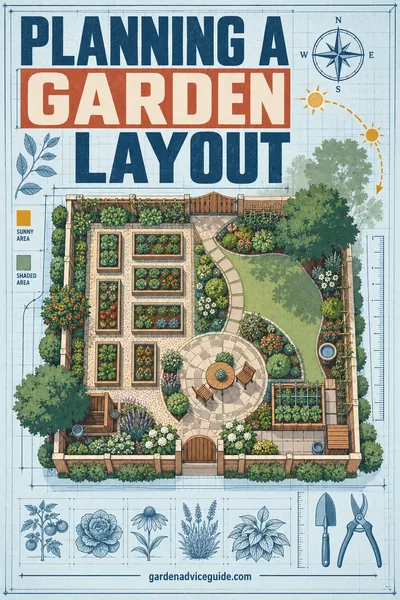
Toward the sun you actually have. Six to eight hours of direct sun is the target for tomatoes, peppers, squash, and beans. Four to six is workable for lettuce, spinach, kale, and most herbs. Spend an afternoon mapping the shade before you dig, which is step one in our full garden layout planning guide.
Raised bed garden layout ideas for six common yard shapes
| Layout | Typical footprint | Growing area | Best for |
|---|---|---|---|
| Parallel pair, two 4x8 beds | 11 x 8 ft | 64 sq ft | A first garden |
| Four-bed grid, four 4x8 beds | 14.5 x 19 ft | 128 sq ft | A family vegetable garden |
| U-shape, three beds | 12 x 12 ft | 96 sq ft | One central standing spot |
| L-shape, two beds in a corner | 12 x 12 ft corner | 64 to 80 sq ft | Patios and small lots |
| Four-square potager | 16 x 16 ft | 128 sq ft | Ornamental and edible together |
| Single long fence bed, 2.5 x 20 | 20 x 5 ft | 50 sq ft | Side yards and rentals |
The parallel pair is two 4x8 beds with a 36 inch path between them. It's the cheapest real garden you can build, it fits almost anywhere, and it teaches you what you actually want before you spend more.
The four-bed grid is the workhorse. Four 4x8 beds in two rows of two, with a wide main path down the middle and narrower cross paths. It's the layout that plays best with crop rotation, since four beds map directly onto the four main plant family groups.
The U-shape puts three beds around a single standing position, so you can pivot from one to the next without walking. It's excellent for herbs and salad you pick daily, and it's the layout to choose if bending and walking are limiting factors.
The L-shape tucks two beds into a corner formed by a fence, a garage wall, or a patio edge. It leaves the middle of a small yard open, which matters if the same space is also a lawn or a play area.
The four-square potager is four beds around a center point, often with a bench, a birdbath, or a large pot in the middle and paths forming a cross. It costs more path area than a grid, and it's the layout people actually enjoy looking at from the house.
The single long fence bed is 2 to 2.5 feet wide, worked from one side only, and it turns a useless strip into 40 or 50 square feet of production. Leave 18 to 24 inches between the bed and the fence so you can maintain both.
What to plant where inside a bed
Layout doesn't stop at the frame. Where plants sit inside the bed changes yield more than most people expect.
North edge: anything tall or trellised. Pole beans, peas, cucumbers, indeterminate tomatoes, and corn. In the northern hemisphere, tall plants on the north side shade nothing but the fence.
Middle: medium crops. Peppers, eggplant, bush beans, broccoli, cabbage, determinate tomatoes, basil.
South edge: low crops. Lettuce, spinach, arugula, radishes, carrots, beets, low herbs. These also give you a clear view into the bed.
Corners: things that can spill. Squash and melons trained out over the edge, trailing nasturtium, creeping thyme. A corner plant uses path airspace, not bed soil.
The edge nearest the door: anything you harvest daily. Cut-and-come-again lettuce, cilantro, parsley, scallions, cherry tomatoes. Convenience is what determines whether food actually gets eaten.
Keep one square open per bed for succession sowing. Two weeks after the radishes come out, something else goes in. Our succession planting guide covers the intervals that keep a small bed producing all season.
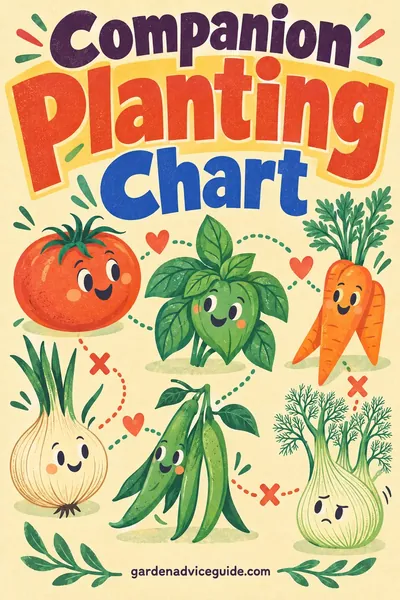
Grouping by family rather than by whim also makes rotation trivial, and pairing crops thoughtfully within a bed is worth ten minutes with our companion planting chart before you plant.
If you want the plants-per-square approach to filling those beds, that method has its own page in our square foot gardening guide rather than being repeated here.
Trellises and the shade they cast
A trellis is a layout decision, not an accessory. It adds vertical growing space and it takes light away from whatever sits north of it.
At 40 degrees north latitude, a 6 foot trellis casts under 2 feet of shadow at noon in late June. By late September that same trellis throws roughly 5 feet, and mid-afternoon shadows in any month run considerably longer. So:
- Put trellises on the north edge of a bed, or along the north side of the whole garden.
- Leave 4 to 6 feet of clear space north of a trellis if you want full sun there.
- Or use the shade deliberately. A trellis of pole beans is a good place to grow July lettuce, which bolts in full sun anyway.
- Keep trellises out of the main path. A cucumber vine leaning into a 24 inch path effectively makes it a 16 inch path.
Zone the beds by how often you'll visit them
This is the layout idea that changes outcomes most and gets mentioned least.
Within 20 feet of the kitchen door: herbs, salad greens, cherry tomatoes, scallions. Things you grab in bare feet while cooking. If they're at the back of the yard, they don't get picked.
Mid yard: main season crops that need weekly attention. Tomatoes, peppers, beans, cucumbers, brassicas.
Far end: space hogs and set-and-forget crops. Winter squash, potatoes, sweet corn, and a dedicated perennial bed for asparagus, rhubarb, strawberries, and perennial herbs, which stay out of the annual rotation entirely.
Two more placement rules worth following. Put the garden where you can see it from a window you use every day, because visibility is what makes problems get noticed early. And keep every bed within one hose length of a spigot: a 50 foot hose reaches a 50 foot radius, and a garden past that becomes a watering-can chore nobody keeps up.
Worked example: a 20 x 24 foot backyard
The setup: a rectangle of lawn 20 feet wide (east to west) and 24 feet deep (north to south), full sun, fence on the north side, a spigot at the house on the south side. Four 4x8 beds, each with the 8 foot length running north-south.
| Element | Dimension | Running total (E-W) |
|---|---|---|
| Perimeter path, west side | 24 in | 2.0 ft |
| Bed 1 and Bed 3 | 4 ft | 6.0 ft |
| Center main path | 30 in | 8.5 ft |
| Bed 2 and Bed 4 | 4 ft | 12.5 ft |
| Perimeter path, east side | 24 in | 14.5 ft |
| Element | Dimension | Running total (N-S) |
|---|---|---|
| Path along the north fence | 24 in | 2.0 ft |
| Beds 1 and 2 | 8 ft | 10.0 ft |
| Cross path | 36 in | 13.0 ft |
| Beds 3 and 4 | 8 ft | 21.0 ft |
| Path at the south end | 24 in | 23.0 ft |
The result: the garden block measures 14.5 by 23 feet and drops into a 20 by 24 foot yard with 5.5 feet to spare along one side. That leftover strip takes a compost bin, a hose reel, and a 2 foot wide herb bed against the house.
The growing area math: four beds at 32 square feet each is 128 square feet of soil out of 480 square feet of yard, so 27 percent. That ratio is normal and it is the honest cost of raised beds. Narrow every path to 18 inches and you get to about 35 percent, which is a bad trade for a garden you have to walk in every day.
How the four beds get assigned: bed 1 to tomatoes and peppers, bed 2 to beans, peas, and cucumbers on a north-edge trellis, bed 3 to brassicas and greens, bed 4 to roots and onions. Next season each group moves one bed clockwise, which is a full four year rotation with zero planning.
Worked example: a 6 foot side yard
The setup: a strip between the house and the property fence, 6 feet wide and 22 feet long, with sun from about 10 a.m. to 4 p.m.
- One bed, 2.5 ft wide by 18 ft long, set 18 inches off the fence so the fence stays maintainable.
- A 3 foot path on the house side, wide enough for a wheelbarrow and for the outside faucet.
- Growing area: 45 square feet, worked entirely from one side. Nothing sits more than 30 inches from the path edge.
- Planting: salad greens and herbs at the near end by the gate, bush beans and peppers in the middle, a 6 foot trellis of cucumbers at the far north end where its shadow falls on the fence rather than on the bed.
Forty-five square feet is enough for a steady salad supply plus a real cucumber and bean harvest for two people. A side yard is usually the last space anyone considers and often the easiest win.
Layout mistakes that cost you a season
Five foot beds. You will step into the middle. Every time you do, you undo the soil structure you paid for.
Eighteen inch paths. They work in April and fail in July, when foliage has closed over them.
Beds longer than 16 feet with no cross path. People take the shortcut through the bed. Every time.
Grass paths narrower than the mower. You end up trimming by hand forever. Either build the path 30 inches or use wood chips.
Beds under a tree canopy. Even outside the drip line, tree roots move into raised beds through the open bottom and take the water. Keep beds 15 feet out from a mature tree if you can.
Everything visited equally. Salad at the far fence gets ignored. Put daily crops by the door.
No staging space. Leave a 3 by 3 foot flat spot for trays, bags, tools, and the harvest basket. Without it, that job happens on top of a bed.
No room for hoops or covers. If you plan on row cover or a cold frame, leave 12 inches of clearance beyond the bed edge so the hoops have somewhere to land.
Frequently asked questions
How wide should a raised bed be?
Four feet if you can reach it from both sides, and 2 to 2.5 feet if it's against a fence or wall and you can only work one side. The rule behind those numbers is that no part of the soil should be more than 24 to 30 inches from an edge, so you never have to step in.
How much space should I leave between raised beds?
Twenty-four inches is the practical minimum for comfortable walking, 30 inches lets you kneel and work, and 36 inches is what a wheelbarrow or garden cart really needs. For wheelchair or walker access, plan on 36 to 48 inch paths with a 60 inch turning space at the ends.
Which direction should raised beds face?
Run the long axis north to south when the plants in a bed are similar heights, so both sides get even sun. Run it east to west when you want tall crops on the north edge and short crops on the south edge in deliberate tiers. On a slope, orientation across the contour beats both.
How many raised beds does a family of four need?
Roughly 100 square feet of growing space per person supplies a substantial share of summer vegetables, so a family of four is looking at three to six 4x8 beds depending on how much you want to preserve. Start with two, grow well in them for a season, and expand once you know what you eat.
Can a raised bed be longer than 8 feet?
Yes, and 12 foot beds are common because lumber comes that way. Past about 16 feet, add a cross path so nobody is tempted to walk through the bed to reach the other side. Long beds also need mid-span bracing, since soil pressure bows the sides outward over time.
What should I plant in the middle of a raised bed?
Medium height crops that don't need daily picking: peppers, eggplant, bush beans, determinate tomatoes, broccoli. Save the edges for things you harvest often, and keep the tall or trellised crops on the north side where their shadow falls outside the bed.
How far should a raised bed be from a fence?
Eighteen to 24 inches. That gap lets you get behind the bed to paint or repair the fence, keeps damp soil away from fence posts, and gives air movement that reduces mildew on the plants at that edge. Beds pushed tight to a fence turn into a maintenance problem in about three years.
Do raised beds have to be in full sun?
Fruiting crops like tomatoes, peppers, squash, and beans want six to eight hours of direct sun. Leafy crops and most herbs do fine on four to six, and lettuce actually benefits from afternoon shade in summer. Map your sun before you build, since moving a filled bed later is a real project.
The short version
Build beds 4 feet wide (2.5 against a wall), keep main paths at 30 to 36 inches, run the long axis north to south unless you're deliberately tiering, and put tall crops on the north edge. Those four rules cover almost every layout that works.
Then choose the shape that fits your yard: a parallel pair to start, a four-bed grid for a full vegetable garden, a U or an L for tight spaces, a long narrow bed for a side yard. Put daily-harvest crops closest to the door, leave a staging spot, and stay inside a hose length of the spigot.
Once the beds are drawn, size the planting with our plant spacing calculator and work through the sun mapping and rotation steps in our garden layout planning guide.