Best Patio Tomato Varieties for Containers

The best patio tomato varieties for containers are compact determinate and dwarf types that stop growing at a set height: 'Patio Hybrid', 'Bush Early Girl', 'Better Bush', 'Bush Goliath', 'Tiny Tim', 'Red Robin', 'Husky Cherry Red', 'Window Box Roma', and the trailing 'Tumbling Tom' for baskets. Each of those finishes under about 4 feet and fruits heavily in a 3 to 10 gallon pot.
Skip standard indeterminate varieties unless you can give them a 15 gallon pot and a 6 foot support. That single choice, variety type over anything else, decides whether your pot produces tomatoes or a tangle of vines with three fruits on it.
Match the plant to the pot before you plant anything, and use our free plant spacing calculator if you are fitting more than one container into a small balcony or deck.
Updated September 2026
Best patio tomato varieties for containers: the full list
Days to maturity are counted from transplant, which is how seed companies list them. Pot size is the working minimum, not the ideal; going one size up always helps.
| Variety | Type | Mature height | Days to harvest | Minimum pot | Fruit |
|---|---|---|---|---|---|
| Patio Hybrid | Determinate | 20 to 24 in | 65 to 70 | 5 gal | 3 to 4 oz, salad size |
| Bush Early Girl | Determinate | 18 to 24 in | 54 to 65 | 5 gal | 6 to 7 oz slicer |
| Better Bush | Semi-determinate | 30 to 36 in | 68 to 72 | 7 gal | 4 oz slicer, strong flavor |
| Bush Goliath | Determinate | 36 in | 68 to 75 | 10 gal | 8 to 10 oz, true slicer |
| Celebrity | Semi-determinate | 36 to 48 in | 70 to 75 | 10 gal | 7 to 9 oz, disease resistant |
| Husky Cherry Red | Dwarf indeterminate | 36 to 48 in | 60 to 65 | 7 gal | Cherry, produces all season |
| Tiny Tim | Dwarf determinate | 12 to 18 in | 55 to 60 | 2 gal | Small cherry |
| Red Robin | Dwarf determinate | 8 to 12 in | 55 | 1 to 2 gal | Cherry, windowsill size |
| Micro Tom | Micro dwarf | 6 to 8 in | 80 to 88 | 1 gal | Tiny cherry, novelty size |
| Tumbling Tom Red or Yellow | Trailing determinate | Trails 18 to 24 in | 65 to 70 | 12 in basket | Cherry, cascades over the rim |
| Window Box Roma | Determinate paste | 18 in | 70 | 3 to 5 gal | Small plum, good for sauce |
| Bush Champion | Determinate | 24 in | 65 | 5 gal | 8 oz slicer |
If you only want one plant: Patio Hybrid in a 5 gallon pot is the safest single choice. It was bred specifically for containers in the 1970s, it holds itself up with almost no staking, and it ripens a heavy set in a 3 to 4 week window.
If you want tomatoes all summer instead of all at once: Husky Cherry Red. It is a dwarf indeterminate, meaning it stays short but keeps setting fruit until frost, which is a rare and useful combination.
If your space is a railing or a windowsill: Red Robin or Tumbling Tom. Red Robin genuinely fruits in a 1 gallon pot on a sunny sill, and Tumbling Tom is designed to spill over a basket edge.
What "patio tomato" actually means on a tag
The tag word is marketing, but there is real botany under it, and understanding it is the difference between a good container season and a disappointing one.
Determinate. The plant grows to a genetically set height, sets flowers at every tip, ripens most of its fruit in a 2 to 4 week window, then declines. Compact, needs little support, and perfect for pots. Downside: one concentrated harvest rather than a trickle.
Indeterminate. The plant keeps growing from the tip all season, setting fruit as it goes, until frost kills it. A standard indeterminate in the ground reaches 6 to 10 feet. In a pot it becomes a root-bound, wilting, disease-prone mess unless the container is very large.
Semi-determinate. In between. Reaches 3 to 4 feet, keeps producing longer than a true determinate. Better Bush and Celebrity live here, and they are excellent large-pot choices.
Dwarf indeterminate. The useful oddball. Short internodes keep the plant compact while the growth habit stays indeterminate, so it produces continuously at 3 to 4 feet. Husky varieties and the Dwarf Tomato Project releases are in this group.
Micro dwarf. Under 12 inches, bred for windowsills and small pots. Yields are small by definition, but they genuinely work indoors under a bright window or a grow light.
| Type | Height in a pot | Harvest pattern | Support needed | Minimum pot |
|---|---|---|---|---|
| Micro dwarf | 6 to 12 in | Light, continuous | None | 1 gal |
| Dwarf determinate | 12 to 18 in | One flush | None or a short stake | 2 to 3 gal |
| Compact determinate | 18 to 30 in | One heavy flush | Small cage | 5 gal |
| Large determinate | 30 to 40 in | One heavy flush | Cage | 7 to 10 gal |
| Dwarf indeterminate | 36 to 48 in | Continuous to frost | Cage or stake | 7 to 10 gal |
| Standard indeterminate | 60 in and up | Continuous to frost | 6 ft stake or tall cage | 15 to 20 gal |
Pot size is the second decision, and people get it wrong
Root volume caps everything a tomato can do. A plant in a pot that is too small will flower, set a few fruits, then stall, wilt every afternoon, and drop blossoms in July heat regardless of how well you water it.
The working rule: 5 gallons per compact determinate plant, 10 for anything over 3 feet, 15 to 20 for a standard indeterminate. One plant per pot, always. Two tomatoes crammed into a 5 gallon bucket produce less combined than one would alone.
Some useful conversions, because pots are sold in inches and mix is sold in cubic feet:
- 1 cubic foot = 7.48 gallons
- A 12 inch diameter pot about 11 inches deep holds roughly 5 gallons
- A 14 inch pot holds roughly 7 gallons
- A 16 to 18 inch pot holds roughly 10 to 15 gallons
- A standard 2 cubic foot bag of potting mix fills roughly three 5 gallon pots, with a little settling
Depth matters as much as width. Tomatoes root deep, and a wide shallow bowl of the same volume performs worse than a taller pot. Look for at least 12 inches of depth for a determinate, 14 to 16 for anything bigger.
Fabric grow bags deserve a mention. A 5 gallon fabric bag outperforms a 5 gallon plastic pot in most container trials because the fabric air-prunes roots instead of letting them circle, and the sides breathe. The trade-off is they dry out faster, sometimes needing twice-daily water in a heat wave.
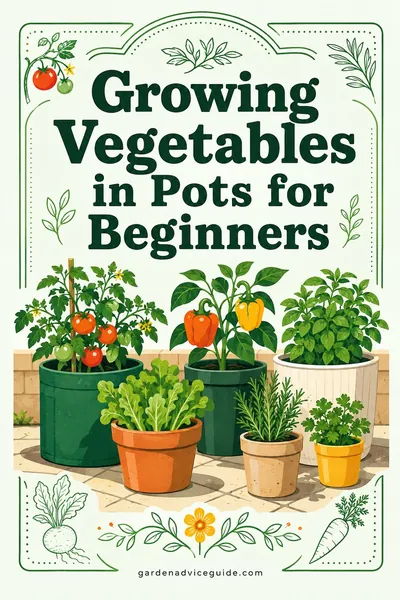
For the broader rules on mix, drainage, and materials, see our full guide to container gardening and, if this is your first season in pots, growing vegetables in pots for beginners.
Cherry, slicer, or paste: what actually performs in a pot
Fruit size and container performance are linked, and the link is not obvious.
Cherry types are the most forgiving. Small fruit means less demand per fruit, faster ripening, and far less cracking when watering is inconsistent, which it always is in containers. Husky Cherry Red, Tiny Tim, Tumbling Tom, and Sungold in a big pot all produce reliably for people who travel or forget a day.
Salad-size fruit is the sweet spot. Patio Hybrid and Better Bush, at 3 to 4 ounces, give real tomato flavor and sandwich-usable fruit without the water demand of a beefsteak.
True slicers work, in a bigger pot. Bush Goliath and Celebrity produce 7 to 10 ounce tomatoes in a container, but they need 10 gallons and consistent water. Skip beefsteaks entirely: a 1 pound fruit on a container plant is where blossom end rot and cracking show up hardest.
Paste types are surprisingly good. Window Box Roma and other compact plum varieties concentrate their harvest into a short window, which is exactly what you want if the goal is sauce. Regular Roma is a large sprawling determinate and needs 10 gallons.
The one recurring container failure is blossom end rot, that sunken leathery brown patch on the bottom of the fruit. It shows up more in pots than in the ground, and the cause is almost never a calcium shortage in the mix. It is inconsistent watering, which prevents the plant from moving calcium into the fruit. Our guide to blossom end rot covers the fix in detail; in a container, it comes down to never letting the pot go bone dry and back.
The indeterminates worth a big pot
Sometimes the flavor is worth the container. These five are the standards people give a 15 gallon pot and a tall stake:
| Variety | Why it earns the space | Support |
|---|---|---|
| Sungold | The best-tasting cherry most people ever grow, extremely productive | 6 ft stake, prune to 2 stems |
| Super Sweet 100 | Long trusses of cherries, produces until frost | 6 ft cage |
| Early Girl | Reliable slicer, early, tolerates less than perfect conditions | 5 ft cage |
| Black Cherry | Complex flavor, heat tolerant, vigorous | 6 ft stake |
| Juliet | Grape type, crack resistant, keeps going in humid heat | 6 ft cage |
Rules that make an indeterminate work in a container:
- 15 gallons minimum. 20 is better. This is not a place to cut back on volume.
- Prune to one or two main stems. Remove suckers weekly. An unpruned indeterminate in a pot outgrows its roots and wilts every afternoon. The method is in how to prune tomatoes.
- Anchor the support to something. A 6 foot plant in a pot is a sail. Tie the stake to a railing or wall bracket, or the first thunderstorm lays it flat.
- Feed weekly at half strength once fruit sets, instead of monthly at full strength.
Worked example: a three-pot balcony in zone 6
South-facing balcony, about 30 square feet of usable floor, roughly 7 hours of direct sun. Transplants going out the last week of May, first fall frost around October 10.
The three plants:
| Pot | Variety | Why |
|---|---|---|
| 15 gal fabric bag | Sungold | The flavor plant, gets the biggest container and the railing tie |
| 5 gal plastic pot | Patio Hybrid | The workhorse, salad tomatoes without staking |
| 2 gal pot on the rail | Red Robin | Fits where nothing else does, fruits by early July |
Potting mix math. Total volume: 15 + 5 + 2 = 22 gallons. Divide by 7.48 gallons per cubic foot and you need 2.94 cubic feet. Two 1.5 cubic foot bags covers it with a little to spare for settling.
Spacing on the floor. The Sungold bag is 16 inches across and the Patio pot is 12. Set them at least 24 inches apart center to center so air moves between the plants; crowded containers on a balcony are where septoria and early blight start.
Water demand in July. On a 90°F day, expect the 15 gallon bag to want about a gallon to a gallon and a half daily, the 5 gallon pot roughly half a gallon, and the 2 gallon pot up to a quart, sometimes twice. Total: about 2 gallons a day at peak. Check with a finger two inches down each morning rather than watering on a schedule. The detail is in how often to water tomatoes.
The season, plant by plant:
| Date | Sungold (15 gal) | Patio Hybrid (5 gal) | Red Robin (2 gal) |
|---|---|---|---|
| May 28 | Transplant deep, burying two thirds of the stem. Stake tied to railing. | Transplant deep. Small cage set. | Transplant. No support. |
| Mid June | First flowers. Suckers pruned weekly. | Flowering heavily. | First fruit set. |
| Early July | First ripe cherries. Weekly half-strength feed. | Green fruit sizing up. | Ripe fruit, picking every few days. |
| Late July | Heavy production. Watering twice on hot days. | Main flush ripens over about 3 weeks. | Slowing, still producing. |
| August | Still producing. Watch for early blight on lower leaves. | Harvest finishing. Cut back or replace. | Done, or holding light. |
| September | Production continues, slower as nights cool. | Empty pot reseeded with lettuce or spinach. | Moved to a bright window. |
| Oct 10 | First frost. Pull the plant, ripen green fruit indoors. |
The takeaway from that table: the determinate gives you a concentrated harvest in July and then the pot is free for a fall crop, while the indeterminate ties up the biggest container from May to October. Plan the mix based on which of those you actually want.
Container-specific care that changes the outcome
Same plant, same variety, and the difference between a good pot and a bad one is usually one of these five.
Plant deep. Bury two thirds of the stem, stripping the lower leaves first. Tomatoes root from buried stem tissue, and in a container that extra root mass is the easiest performance gain available.
Water consistency beats water volume. A pot that swings from soaking to bone dry produces cracked fruit and blossom end rot. Mulch the surface with an inch of shredded bark or straw, which cuts evaporation noticeably, and consider a saucer in the hottest weeks.
Feed more often, at lower strength. Every watering flushes nutrients out the drainage holes. A container tomato needs a balanced liquid feed every 7 to 14 days once fruit sets, or a slow-release granular worked into the mix at planting plus liquid feeding later.
Never use garden soil. It compacts into a brick in a pot, drains badly, and brings in soil-borne disease. Use a real potting mix.
Watch the heat. Dark pots on a south-facing concrete surface can reach soil temperatures above 95°F, at which point roots stop functioning and blossoms drop. Light colored pots, a pot foot to lift them off hot concrete, or clustering containers so they shade each other all help.
For the full growing method that applies to any tomato, in ground or in a pot, start with how to grow tomatoes. If you are starting from seed rather than buying transplants, the timing is in when to start tomato seeds.
FAQ
What is the best tomato variety for a 5 gallon bucket?
Patio Hybrid, Bush Early Girl, or Bush Champion. All three are compact determinates that finish under about 24 inches and set a full crop in that volume. Drill four to six half-inch drainage holes in the bottom of a bucket, and one plant per bucket, never two.
Do patio tomatoes need a cage or stake?
Most need something light. A true dwarf like Red Robin or Tiny Tim holds itself up with nothing. Compact determinates like Patio Hybrid do better with a small cage once fruit sizes up, because a heavy truss can split a stem. Anything over 3 feet needs a real cage or stake anchored to something solid.
How many tomatoes will one patio plant produce?
A healthy Patio Hybrid in a 5 gallon pot typically gives a couple of dozen salad-size fruits across a 3 to 4 week window. A dwarf indeterminate like Husky Cherry Red produces a smaller amount weekly but keeps going until frost, which usually totals more over the season. Yield tracks container volume and sun hours more than variety.
Can I grow patio tomatoes indoors?
Micro dwarfs like Micro Tom and Red Robin can fruit indoors in a very bright south window, and they do much better under a grow light running 14 to 16 hours a day. You will also need to shake or brush the flowers to pollinate them, since there is no wind or bee traffic indoors. Larger varieties will grow indoors but rarely set worthwhile fruit.
Can determinate tomatoes be pruned like indeterminates?
No, and doing it costs you the crop. A determinate sets its flower clusters at the branch tips, so removing suckers removes the fruit. Prune only the leaves below the first flower cluster to improve airflow, and leave the rest of the plant alone.
Which container tomato ripens the fastest?
Bush Early Girl at 54 to 65 days from transplant, with Red Robin close behind at about 55 days. Both are good picks for short northern seasons or for a second planting set out in early July. Micro Tom is the slowest of the small types despite its size, needing 80 days or more.
Do I need to replace the potting mix every year?
Yes for tomatoes, or at minimum refresh the top half and rotate what goes in that pot. Tomatoes are heavy feeders, and reusing exhausted mix for the same crop concentrates soil-borne diseases like verticillium and fusarium wilt. If you must reuse, mix in a third fresh material and compost, and put a different crop family in that pot.
What spacing do compact tomatoes need in a long planter box?
At least 18 to 24 inches between plants, and a planter at least 12 inches deep and 12 wide. Even dwarf tomatoes crowd fast, and a box with plants at 12 inch spacing hits humidity problems and early blight by midsummer. Two plants in a 4 foot box is the practical limit.