50 Gardening Tips and Tricks Worth Actually Using

The gardening tips and tricks that change your results are boring ones: plant by soil temperature instead of the calendar, water deeply twice a week instead of lightly every day, mulch 2 to 3 inches deep, and give plants the spacing on the seed packet. Those four habits fix more problems than any product you can buy. The other 46 tips below are the details that make those four easy to stick to.
Skim the list, pick three, and change only those this season. A gardener who does five things well beats one who does thirty things halfway.
Want the dates for your own address? Build a season plan in minutes with our free planting calendar, which works backward from your frost window instead of a generic national date.
Updated September 2026
The 10 Gardening Tips and Tricks That Pay Off Fastest
If your time is short, these ten do the heavy lifting. They're ranked by trouble prevented per hour spent, not by how interesting they are.
| # | The habit | What it prevents | Time cost |
|---|---|---|---|
| 1 | Top-dress 1 to 2 inches of compost yearly | Compaction, drought stress, most deficiencies | One afternoon per bed |
| 2 | Mulch 2 to 3 inches and top it up | Most annual weeds, splash-borne leaf disease | Two hours per bed |
| 3 | Plant by soil temperature, not date | Rot, stalled seedlings, pest damage on weak plants | Cost of a soil thermometer |
| 4 | Water deeply twice a week, at the roots | Shallow roots, blossom end rot, mildew | Less time than daily sprinkling |
| 5 | Use the spacing on the packet | Powdery mildew, blight, tiny fruit | Planning only |
| 6 | Walk the beds twice a week | Aphid colonies and hornworms, while countable | 5 minutes per visit |
| 7 | Harden off transplants over 7 to 10 days | Transplant shock and sunscald | 10 minutes a day |
| 8 | Rotate plant families on a 3 to 4 year cycle | Soilborne disease buildup, repeat pests | Planning only |
| 9 | Label everything the day you plant it | Guesswork all season, lost varieties | 30 seconds |
| 10 | Keep a one-page garden notebook | Repeating last year's mistake | 2 minutes a week |
Tip 10 is the sleeper. Write down the date you sowed, the variety, and what went wrong. Three seasons of those notes are worth more than any book, because they're about your soil, your slope, and your weather.
Soil Tips: Where Half the Results Come From
11. Test before you amend. A soil test costs one sample and stops years of guessing. Most established beds already have plenty of phosphorus, so the reflexive bone meal is often the wrong move. Our guide to testing garden soil covers how to pull a representative sample.
12. Aim for pH 6.0 to 7.0. That band keeps nutrients available for most vegetables. Blueberries and potatoes want it lower, around 4.5 to 5.5 and 5.0 to 6.0.
13. Top-dress, don't dig in. Spread compost on the surface and let worms move it down. Every deep turn brings a new batch of dormant weed seed into the light.
14. Never add sand to clay. Sand plus clay behaves like concrete. Organic matter is the only real fix, and it takes two to three seasons.
15. Use finished compost only. If it doesn't smell like a forest floor, it's still working, and it will pull nitrogen out of your soil to finish. Cure it another month. The browns-to-greens ratio and how to restart a stalled pile are in our composting guide.
16. Squeeze test before you dig. Grab a handful of soil. If it holds a ribbon and smears, it's too wet. Digging wet clay destroys structure for a full season.
17. Cover bare soil, always. Mulch in season, a cover crop out of season. Bare ground crusts, dries, and grows weeds.
18. Sow a cover crop about 4 weeks before your first frost. Crimson clover and hairy vetch fix nitrogen; winter rye handles later sowings and colder zones; buckwheat flowers in 30 to 45 days for a summer gap.
Seed Starting Tips and Tricks
19. Count backward, don't guess. Most transplants want 6 to 8 weeks indoors before their outdoor date. Tomatoes and peppers run 6 to 8, brassicas 4 to 6, cucurbits only 3 to 4. Our seed starting calculator does the subtraction from your frost date for you.
20. Bottom heat is the single best seed starting trick. A heat mat holding the mix at 75 to 85 F takes pepper germination from 3 weeks to about 8 days. Take the mat away the moment sprouts appear.
21. Move seedlings off heat and under light immediately. Warm and dim is how you get leggy, floppy stems in 48 hours.
22. Keep lights 2 to 4 inches above the leaves, 14 to 16 hours a day. Raise them as plants grow. Light on a windowsill is rarely enough in March.
23. Run a small fan on low. Moving air thickens stems and cuts damping-off dramatically. Brushing seedlings with your hand daily does something similar.
24. Sow at the depth of the seed's own thickness. Lettuce and snapdragon need light and go on the surface. Burying tiny seeds is the top cause of no-shows. More reasons in our guide to seeds not germinating.
25. Use seed starting mix, not garden soil. Garden soil compacts in cells, holds too much water, and carries fungal spores.
26. Water from the bottom. Set trays in a shallow reservoir for 10 to 20 minutes, then drain. The same tray method is how a carnivorous plant is watered, except that tray never gets emptied. Surface watering knocks over seedlings and encourages fungus gnats.
27. Harden off over 7 to 10 days. Start with 1 to 2 hours in dappled shade, add an hour or two daily, and skip windy or below-50 F days. Skipping this stalls plants for two weeks. The full ramp is in hardening off seedlings.
28. Bury tomato transplants deep. Strip the lower leaves and plant two-thirds of the stem underground, or lay it sideways in a trench. Roots form along the buried stem. Do not do this with peppers or anything else.
29. Pinch the first flowers off transplants. A tomato or pepper that fruits at 6 inches tall stays small all season. Pinch, and let it build roots for two more weeks.
Timing Tips: Soil Temperature Beats the Calendar
30. Buy a soil thermometer. Read at 2 inches deep, mid-morning, for three days running. That number tells you what to plant far better than a date on a package.
| Crop | Minimum soil temp | Ideal soil temp | Plant relative to last frost |
|---|---|---|---|
| Peas, spinach | 40 F | 50 to 65 F | 4 to 6 weeks before |
| Lettuce, radish | 40 F | 55 to 65 F | 4 weeks before |
| Broccoli, cabbage transplants | 45 F | 55 to 70 F | 3 to 4 weeks before |
| Carrots, beets | 45 F | 60 to 75 F | 2 to 4 weeks before |
| Beans | 60 F | 70 to 80 F | 1 week after |
| Tomato transplants | 60 F | 65 to 75 F | 1 to 2 weeks after |
| Cucumbers, squash | 65 F | 70 to 85 F | 2 weeks after |
| Melons, okra | 70 F | 75 to 85 F | 2 to 3 weeks after |
31. Know your two real dates. Last spring frost and first fall frost anchor everything. Look yours up with the frost dates tool, and remember they're averages: roughly half of years the frost falls later.
32. Add two weeks to your frost date if you're in a low spot. Cold air drains downhill and pools. A valley bottom garden can run two weeks behind a hillside garden a quarter mile away.
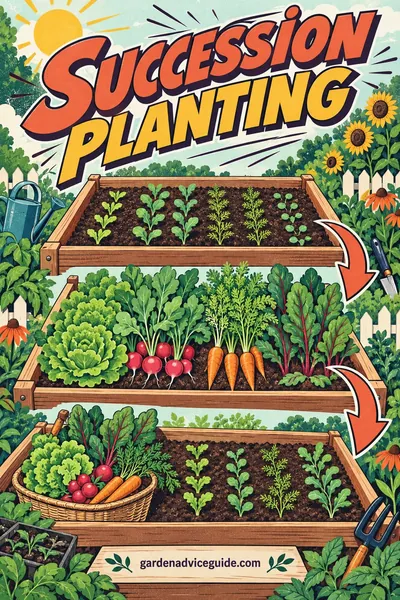
33. Sow small and often. Lettuce, radishes, cilantro, and bush beans every 2 to 3 weeks give you a steady supply instead of a glut. See succession planting for the intervals per crop.
34. Count backward from fall frost for a fall garden. Take days to maturity, add 14 days for slower autumn growth, and count back from your first frost date. That's your sowing date.
35. Plant garlic and spring bulbs after the soil cools below 60 F, usually 4 to 6 weeks before the ground freezes. Too early and garlic sends up top growth that winter kills.
36. Dodge pests with timing. Squash sown after the squash vine borer flight, which runs a few weeks in early to midsummer in most regions, often escapes them entirely.
37. Use your zone for perennials, not for planting dates. Hardiness zone tells you what survives winter. It does not tell you when to sow. Check yours on the growing zones map and get dates from the zone schedules instead.
Spacing and Layout Tips
38. Follow packet spacing, then stop. Crowding is the top cause of powdery mildew and blight in home gardens, because leaves stay wet longer with no airflow. Run your bed through the plant spacing calculator before you dig anything.
39. Put tall crops on the north side. Corn, pole beans, and staked tomatoes on the north edge stop them shading everything else. Flip that in the southern hemisphere.
40. Keep beds 4 feet wide or less. You should be able to reach the center from either side without stepping on the soil. Compaction from footsteps is invisible and permanent.
41. Go vertical in small spaces. Cucumbers, pole beans, and small melons on a trellis take a fifth of the ground area, dry faster after rain, and produce cleaner fruit. Square foot gardening has the per-square counts.
42. Interplant fast and slow crops. Radishes between carrot rows mature and come out before the carrots need the space.
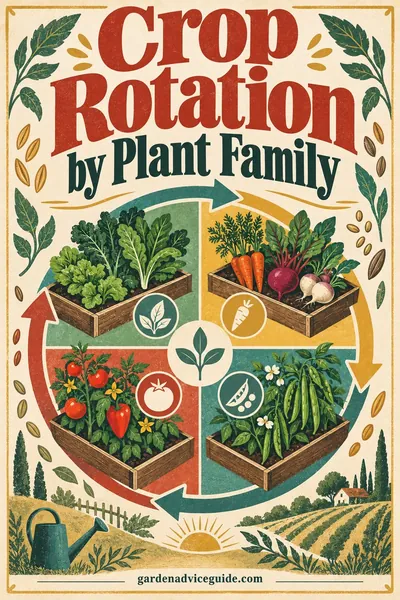
43. Rotate by family, not by crop. Tomatoes moved to where the peppers were is not a rotation; both are nightshades sharing the same diseases. The four-bed sequence lives in our crop rotation guide, and useful pairings are sorted from folklore in the companion planting chart.
Watering Tips and Tricks
44. Give about 1 inch per week, including rain, in one or two deep soakings. Deep watering pulls roots down. Daily sprinkles keep roots in the top inch where they bake.
45. Do the finger test first. Push a finger 2 inches into the soil. Damp means wait. Most plants people think are thirsty are actually drowning.
46. Water in the morning, at soil level. Evening overhead watering leaves foliage wet all night, which is exactly the condition mildew and blight want.
47. Put a soaker hose or drip line under the mulch. It cuts water use sharply, keeps leaves dry, and leaves the paths dry so weeds don't sprout there. Per-crop numbers are in the watering guide.
48. Check containers daily in summer, not on a schedule. A 12-inch pot in July can need water twice a day. Containers have no reserve. Our container gardening guide covers mix and pot size.
49. Keep moisture steady on tomatoes, peppers, and squash. Swings from bone dry to soaked cause blossom end rot and split fruit, and mulch is what evens them out.
50. Water new transplants at the base for the first two weeks, every day or two, then taper. After that, deep and infrequent trains roots downward.
The Conversion That Makes Watering Real
Advice to "give 1 inch of water" is useless until you turn it into gallons. Here's the math: 1 inch of water over 1 square foot is about 0.62 gallons.
| Bed size | Square feet | Water for 1 inch | Split into two soakings |
|---|---|---|---|
| 4 ft x 4 ft | 16 | About 10 gallons | 5 gallons, twice a week |
| 4 ft x 8 ft | 32 | About 20 gallons | 10 gallons, twice a week |
| 3 ft x 6 ft | 18 | About 11 gallons | 5.5 gallons, twice a week |
| 10 ft x 10 ft in-ground | 100 | About 62 gallons | 31 gallons, twice a week |
Set a bucket under your hose and time how long it takes to fill 5 gallons. If it takes 90 seconds, then a 4x8 bed needs about 3 minutes of that hose, twice a week. You now have a number you can actually follow instead of a guess.
Worked Example: One Saturday That Fixes a Struggling Bed
A 4 ft x 8 ft raised bed, third season, tomatoes that yellowed and mildewed last year. That's 32 square feet. Here's a single morning applying the tips above, in order.
8:00. Soil test pulled from five spots and mixed in a clean bucket. It comes back pH 6.4, phosphorus adequate, nitrogen low. No lime, no bone meal. Tip 11 just saved two unnecessary amendments.
8:20. Three cubic feet of finished compost spread on top. Over 32 square feet, that's about 1.1 inches deep, right in the 1 to 2 inch band from tip 1. Nothing gets dug in.
8:45. Soil thermometer at 2 inches reads 58 F. Too cool for tomatoes, which want 60 F minimum. The transplants go back under lights for five more days, and lettuce goes in the north end instead.
9:15. Layout redone. Last year held six tomatoes at 16-inch spacing in a 4-foot-wide bed, and that crowding is why the mildew won. This year it's four plants at 24 inches, staggered, with the trellis on the north side.
9:40. Soaker hose laid down the middle of the bed, then 3 inches of straw mulch over the top. Three inches over 32 square feet takes roughly 8 cubic feet of straw. It's pulled back 2 inches from each planting spot so stems stay dry.
10:00. Labels pushed in with variety and date. Sweet alyssum plugs at both corners for hoverflies.
10:10. Notebook line written: "May 9, bed 2, soil 58 F, 4 tomatoes at 24 in, compost 3 cu ft, straw 3 in."
The season that follows. Watering is 10 gallons on Monday and 10 on Thursday, about 3 minutes of hose each time. Beds get walked Tuesday and Saturday. In June, six aphids on a growing tip get wiped off with a thumb. In July, one hornworm is handpicked. Total work is well under an hour a week, and the mildew that stripped the lower leaves by August last year doesn't arrive until late September.
That's the whole argument for these tips and tricks: the fix was spacing, mulch, and a thermometer, not a spray.
Mistakes That Undo Good Tips
Buying plants before preparing the bed. Transplants sitting in a tray on the driveway for two weeks lose more vigor than any planting technique can give back.
Fertilizing on a schedule instead of a test. Extra nitrogen on tomatoes buys you a tall green plant with almost no fruit.
Planting the whole packet at once. Thirty lettuces maturing the same Tuesday is a waste. Sow a short row every two weeks.
Mulching right against stems. Piled mulch traps moisture at the crown and invites rot. Pull it back 2 inches on vegetables and shrubs alike. Depths per material are in the mulch guide.
Chasing hacks instead of habits. Eggshells, coffee grounds, and Epsom salt get recommended constantly. Crushed eggshells break down far too slowly to fix blossom end rot mid-season, and Epsom salt only helps where a test shows magnesium is low. Steady watering fixes more than any of them.
Letting weeds set seed. One pigweed plant seeds a bed for years. Hoe them at seedling size on a dry day, when the job takes seconds. Longer-term options are in our weed control guide.
Skipping the harvest window. Zucchini goes from perfect to baseball bat in three days, and beans get stringy fast. Check ripeness signs with the when to harvest tool.
Frequently Asked Questions
What are the best gardening tips and tricks for beginners?
Start with four: build soil with compost, mulch 2 to 3 inches deep, plant when soil temperature is right instead of on a calendar date, and follow packet spacing. Add a notebook so you learn from your own beds. Our vegetable garden for beginners guide walks through a first-year plan built on exactly those.
How often should I really water my garden?
About 1 inch per week including rainfall, delivered in one or two deep soakings rather than a daily sprinkle. Check with a finger 2 inches down before watering anything. Containers are the exception, since they can need water once or twice a day in summer heat.
Do coffee grounds and eggshells actually help?
Both are fine in the compost pile and close to useless as a direct fix. Eggshells take years to break down, so they will not stop blossom end rot this season, which is a calcium uptake problem caused by uneven watering. Coffee grounds are a mild nitrogen source but can mat and shed water if piled thickly, so mix them in.
What is the easiest way to keep weeds down?
Light control beats pulling. Three inches of mulch stops most annual weed seedlings, and topping it up midseason closes the thin spots where they return. Water at the roots so paths stay dry, and hoe seedlings shallowly on a dry day rather than digging, since digging brings up new seed.
When should I start seeds indoors?
Count backward from your last frost date: 6 to 8 weeks for tomatoes and peppers, 4 to 6 for brassicas, 3 to 4 for cucumbers and squash. Starting too early is the more common error and gives you root-bound, leggy plants. The when to plant planner handles the subtraction for your location.
How do I make a small garden produce more?
Grow vertically, space correctly, and succession sow. A trellis frees the ground beneath it, correct spacing prevents the disease that ends a crop early, and sowing a short row every two weeks keeps a small bed producing from spring into fall. Interplanting fast radishes between slow carrots adds a crop with no extra space.
Are organic methods worth the extra effort?
They front-load the work into soil building and mulching, then need less firefighting later. After two or three seasons of compost and mulch, beds hold water better and see less pest pressure. Our organic gardening tips page has the pest control ladder and amendment release rates.
What one tool is worth buying first?
A soil thermometer, and it isn't close. It converts the vaguest part of gardening, timing, into a number you can act on, and it prevents the rotted seed and stalled seedlings that come from planting into cold ground. A sharp stirrup hoe is a good second, because it turns weeding from an hour into ten minutes.